Last updated 2026-08-18
TL;DR
Alaska requires a state-issued contractor registration to install helical piers for pay. Most operators need a General Contractor or Specialty Contractor license from the Alaska Division of Corporations, Business and Professional Licensing. Fees run roughly $300 to $600 for the initial license, plus a surety bond. No separate helical pier certificate exists. The work falls under general foundation or specialty contractor authority.
Do you need a license for helical pier in Alaska?
Yes. If you get paid to install helical piers in Alaska, you need a state contractor registration before you sign the contract. Alaska law requires anyone contracting to perform construction work, including foundation installation, to hold a valid certificate before accepting money. [1] Alaska Statutes Title 8, Chapter 18 governs contractor registration, and the Division of Corporations, Business and Professional Licensing (DCBPL) enforces it. [1]
Helical pier installation is foundation work. It doesn't get its own license category in Alaska, so you fold it into one of two buckets. A General Contractor license if you're doing or managing full-scope projects. A Specialty Contractor license if you're doing foundation and ground improvement only. Most standalone helical pier companies operate as Specialty Contractors.
AS 08.18.011 puts it plainly: "A person may not act as a contractor in this state without a certificate of registration issued under this chapter." [1] Short sentence. No wiggle room.
Working unlicensed carries real teeth. Fines run up to $1,000 per violation under AS 08.18.151, and you can't enforce a contract in Alaska court if you weren't licensed when you signed it. [1] That second one is what actually sinks small operators. You do the work, the owner refuses to pay, and the court won't help you collect.
What license class covers helical pier work in Alaska?
Two DCBPL registration tiers apply to helical pier installers, and most solo shops want the Specialty Contractor tier. [1] There is no helical pier license in Alaska. The state sorts you by scope, not by product.
General Contractor covers projects of any dollar value and lets you self-perform or subcontract essentially anything. The trade-off is a higher bond. Confirm the current figure at the DCBPL fee schedule, since the legislature adjusts these periodically. [2]
Specialty Contractor covers a defined trade scope. Foundation work, including driven and installed piling, fits here without a fight. The bond floor is lower. Again, confirm with DCBPL, because bond amounts are set by regulation and change. [2]
A few practical notes. If you subcontract to a licensed general contractor on every job and never sign a direct contract with the property owner, some operators argue the GC's license covers them. Alaska's enforcement guidance does not back that reading for companies that hold themselves out as foundation contractors. Get your own registration.
Alaska does not require a separate journeyman or apprenticeship card to run helical pier equipment. There is no ICC or ICC-equivalent state exam for helical pier. The exam for Alaska contractor registration is a business and law exam, not a trade exam. [2] Compared to states with ICC deep foundation exams, Alaska is easier on the test and cleaner on the trade-scope definition.
If your work crosses into geotechnical design, meaning you specify load ratings or provide stamped drawings, that's a separate professional engineer license under AS 08.48. [3] Most installers work off engineer-supplied plans and never stamp their own work, which keeps them in contractor-only territory.
What are Alaska's contractor license requirements for helical pier installers?
The DCBPL application asks for six things: a registered business entity, a qualifying party, a passed business and law exam, a surety bond, workers' comp coverage or an exemption, and the application fee. [2] Here is what each one means in practice.
Proof of business entity. A sole proprietor can apply individually. An LLC or corporation registers with the Division of Corporations first, then applies for contractor registration under that entity. [2]
Qualifying party. Alaska wants a person responsible for the licensed work listed on the registration. For an owner-operator shop, that's you. [2]
Business and law exam. Alaska uses a PSI-administered Business and Law exam scheduled through PSI. The exam covers Alaska contractor statute, contract law basics, and workers' compensation rules, not trade knowledge. [5]
Bond. Bond amounts are set by regulation. General Contractors post a $25,000 surety bond; Specialty Contractors post $10,000. Confirm current amounts at the DCBPL fee page before you buy a bond. [2]
Workers' compensation. You provide a certificate of workers' compensation insurance or an approved exemption. Alaska's Division of Workers' Compensation handles exemptions for sole owners with no employees. [4]
Liability insurance. DCBPL does not set a specific general liability dollar amount in statute for every contractor category, but municipalities and project owners often require it by contract. A $1 million per-occurrence policy is a common market floor for foundation work.
Application fee. Budget roughly $300 to $600 depending on category, and check the current DCBPL fee schedule before you apply. [2] Fees are set by regulation, so any number printed here goes stale eventually.
How much does helical pier cost in Alaska?
Two cost questions hide under this heading, and they need to stay separate: what it costs to get licensed, and what it costs to install piers on a job. Licensing runs $3,000 to $7,000 in first-year paper for a solo operator. Installed pier costs run $1,500 to $5,000 each.
Licensing and startup costs. The DCBPL application fee runs roughly $300 to $600 for a two-year registration. [2] Add the PSI exam fee, about $100 to $130 per attempt (confirm at PSI's current fee schedule). [5] Bond premium varies by bond amount and your credit. For a $10,000 specialty contractor bond with decent credit, expect $100 to $200 a year. Workers' comp for a one-person foundation operation runs wide with payroll, but a baseline commercial policy in Alaska can start around $2,000 to $5,000 annually. First-year paper for a solo operator lands at $3,000 to $7,000 before you touch any equipment.
Per-pier installed costs on actual jobs. Installed helical pier costs in Alaska run higher than Lower 48 averages because of mobilization distances, permafrost, and the short work window. The national average for helical pier installation is roughly $1,500 to $3,000 per pier installed, and RSMeans data suggests a similar range for deep foundation units in high-cost regions. [6] Alaska jobs with remote access or permafrost soil can push per-pier costs to $2,500 to $5,000 or beyond. Nobody publishes clean statewide Alaska pricing. Those numbers come from contractor conversations and RSMeans regional multipliers, which put Alaska at roughly 1.3 to 1.5 times the national baseline for construction labor. [6]
For homeowners hiring helical pier contractors in Alaska, a typical residential underpinning or new foundation using 8 to 15 piers might run $15,000 to $50,000 total, depending on site access, required depth, and whether the building sits on permafrost or seasonally frozen ground. Get at least three bids from licensed contractors. The spread is often large.
How long does helical pier take in Alaska? (licensing and installation)
Two timelines matter, and they don't overlap. Getting licensed takes 4 to 8 weeks if your paperwork is clean. Installing piers on a typical residential job takes 1 to 3 days once you're on site.
Time to get licensed. DCBPL processing for a complete contractor registration has historically run 2 to 6 weeks, but times swing with application volume and staffing. [2] The board does not publish a guaranteed window. The PSI exam can usually be scheduled within 1 to 2 weeks if seats are open. Plan 4 to 8 weeks from starting paperwork to holding a valid license if everything is in order. If your application has gaps, DCBPL sends a deficiency letter and the clock resets.
The seasonal math is unforgiving. Most new operators chasing summer work need to start licensing no later than January or February to be ready by May breakup. Waiting until March cuts it close.
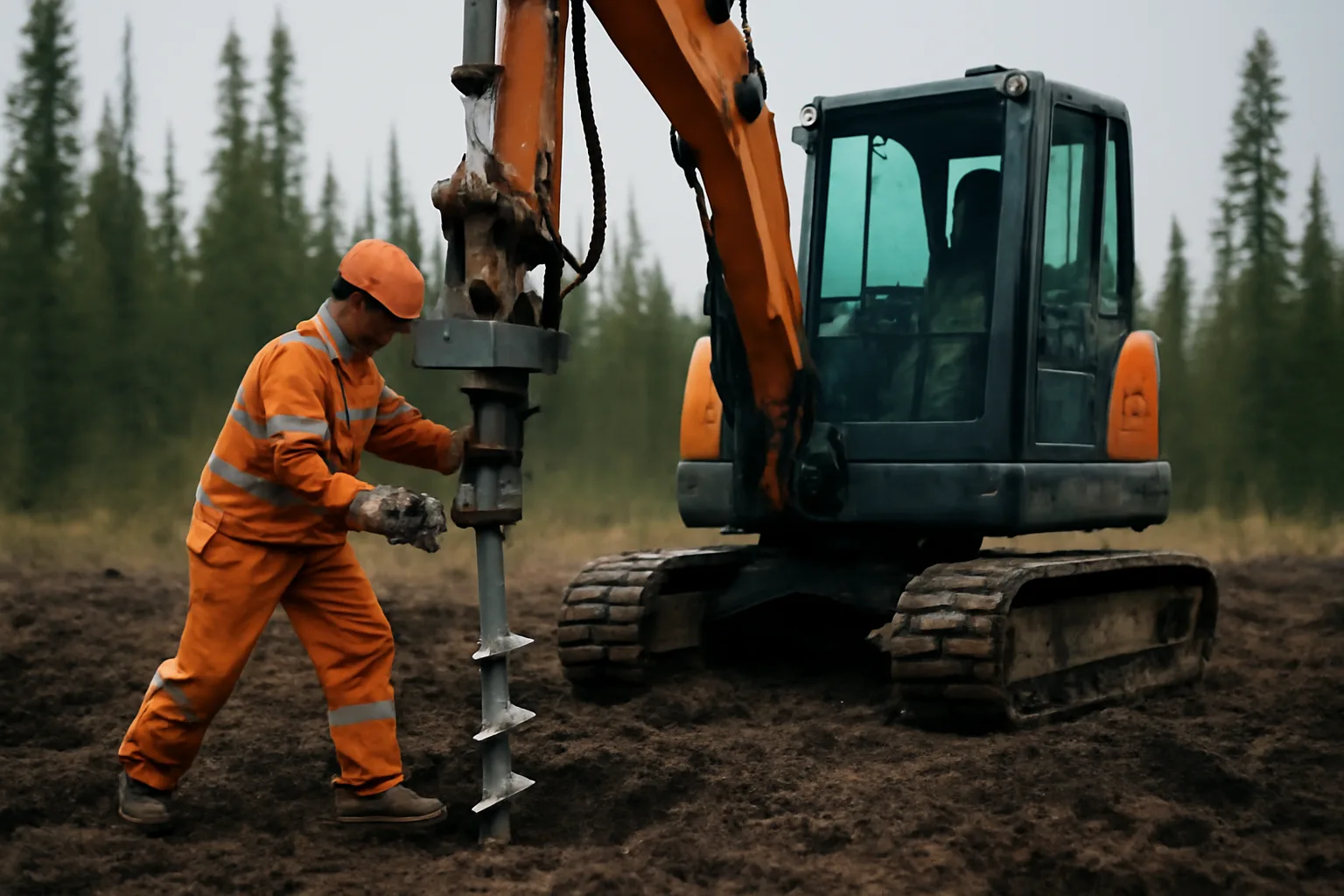
Time to install piers on a job. A single helical pier goes in within 15 to 45 minutes under good soil conditions with a hydraulic drive head on a mini excavator. A typical residential project using 10 to 12 piers takes 1 to 3 days of installation, not counting mobilization, cap welding, and grade-beam work.
Alaska complicates all of it. Frozen ground, even seasonal frost, can slow installation hard or force pilot drilling. Active permafrost zones may require thermal piling strategies, adfreeze calculations, or a summer-only window timed to when the active layer thaws enough to accept the helix plates. Some Southcentral projects install fine in two days. Some Interior or Arctic Slope projects need staged installation across multiple site visits. Talk soil conditions, active layer depth, and installation season through with your geotechnical engineer before you quote a client a date.
Does Alaska have special rules for helical piers in permafrost?
Alaska is the only U.S. state where permafrost is a routine design and installation concern, and it changes the technical picture a lot. [7] The Alaska Department of Transportation and Public Facilities keeps engineering guidance on deep foundation performance in permafrost, and the Alaska Housing Finance Corporation publishes residential foundation guidelines that address frozen ground. [8]
The licensing question doesn't change. You still need a valid contractor registration whether the site is thawed gravel or active permafrost. What changes is the technical work stacked on top.
Permafrost projects typically require a licensed PE to evaluate active layer depth, long-term adfreeze bond, and thermal stability. The engineer produces project-specific helical pier specifications, and you install to that spec. That's standard practice in Alaska's Interior and on the North Slope.
Some jurisdictions, including certain Anchorage building code sections and Mat-Su Borough requirements, set frost-depth and foundation-depth minimums that decide where helical piers are appropriate versus other foundation types. Check with the local building department before bidding in an unfamiliar borough.
If you're adding Alaska to a service territory from another state, permafrost is the biggest knowledge gap you'll hit. The mechanical installation is the same. The soil behavior and long-term performance assumptions are not.
What local permits and inspections are required in Alaska?
State contractor licensing is the floor. Local building permits sit on top of it, and skipping them is a fast way to lose money.
Anchorage requires building permits for foundation work, and the Municipality of Anchorage Building Safety Division enforces the 2021 IBC with local amendments. [9] Helical pier installs that are part of structural underpinning or a new foundation require engineering drawings and inspection. The permit fee is based on project valuation.
Matanuska-Susitna Borough, Fairbanks North Star Borough, and the Kenai Peninsula Borough each run their own building departments and permit rules. Most require licensed contractor work and an engineer-stamped foundation plan for any deep foundation system.
Small unorganized boroughs and rural communities may have no local building department at all. In that case you default to state-level rules, and if the project involves state funding like an AHFC loan, AHFC's inspection standards apply. [8]
Call the local building department before you bid. Every time. Don't assume the state license means a permit isn't required. The permit protects you legally as much as it protects the building owner.
How does Alaska compare to neighboring states for helical pier licensing requirements?
If you're expanding a helical pier business across the Pacific Northwest, or picking where to base operations, the licensing picture varies a lot by state. Alaska's exam is less trade-specific than most, but the year-round insurance carry against a short season is the real cost.
| State | License Type for Foundation Work | Exam Type | Bond Floor | Permafrost Factor |
|---|---|---|---|---|
| Alaska | Specialty Contractor (DCBPL) | Business & Law (PSI) | ~$10,000 | High in Interior/Arctic |
| Washington | Specialty Contractor (L&I) | Business & Law | $6,000 | Low |
| Oregon | CCB Contractor License | Business & Law | $15,000 | None |
| Montana | No state license (local only) | None | Varies | Minimal |
Alaska's testing bar is lower than states with trade-specific exams, which makes entry easier on the exam side. The barrier is the bond amount and the year-round insurance cost against a shorter operating season. [1][2]
For guides covering other states, see the helical pier license in Alabama and helical pier license in Arizona pages, or the how to start helical pier in Alaska guide for the full business-launch checklist.
What's the step-by-step process to get licensed for helical pier in Alaska?
Here's the sequence, in order. Skip a step and the application stalls.
Step 1: Form your business entity. Register your LLC, corporation, or sole proprietorship with the Alaska Division of Corporations through the DCBPL online portal. You need a valid Alaska business entity before the contractor registration application will go through. [2]
Step 2: Register with the IRS. Get an Employer Identification Number (EIN) at irs.gov/ein. It takes about 10 minutes online and it's free. [10] You need it for the contractor application and for hiring.
Step 3: Schedule and pass the PSI Business and Law exam. Create an account at the PSI Exams candidate portal, select the Alaska contractor exam, and book a date. Study the Alaska statutes in the candidate handbook. Two to four hours of focused study gets most people with construction business background ready. [5]
Step 4: Buy your surety bond. Get a $10,000 (Specialty) or $25,000 (General) Alaska contractor surety bond from a licensed surety. Your insurance broker can usually arrange it. You'll get a bond certificate to upload with the application. [2]
Step 5: Secure workers' compensation. Buy a commercial workers' comp policy, or apply for a sole-owner exemption through the Alaska Division of Workers' Compensation. [4]
Step 6: Submit the DCBPL application. Complete the online application, upload every required document, and pay the fee. [2] You get a registration number when it's approved.
Step 7: Pull project permits. Once licensed, pull building permits through the local building department for each project that needs one. Keep your registration number handy, because permit applications ask for it.
If you want help with bid math and the paperwork sequence before you commit to a full launch, the HelicalPath Stamp + Bid-Math Kit at /start walks through the business math of a helical pier startup, including how to price jobs in high-cost markets like Alaska.
What continuing education or renewal does Alaska require for helical pier contractors?
Alaska contractor registrations run two-year terms, and as of the most recent DCBPL guidance the state does not require continuing education hours to renew. [1][2] Renewal means paying the renewal fee before expiration and keeping your bond and insurance current. Some states mandate CE credits; Alaska does not.
Still, confirm the current renewal rules directly with DCBPL when your renewal date gets close. The legislature can add CE requirements by regulation, and rules shift between publication cycles.
One place ongoing education is effectively required even without a legal mandate: permafrost and frozen ground foundation design is a moving field. The University of Alaska Fairbanks Cold Climate Housing Research Center publishes updated guidance periodically. [7][11] Staying current matters for your liability exposure even when the licensing board doesn't track it.
Where to get help and official information for Alaska helical pier licensing
Here are the primary sources, not general searches.
Alaska DCBPL Contractor Registration: The official application portal, fee schedule, and licensing requirements live at commerce.alaska.gov under Contractor Registration. [2] First stop.
Alaska Statutes Title 8, Chapter 18: The actual statute text is at the Alaska Legislature's public website. [1] Reading it yourself takes 20 minutes and removes any ambiguity about what the law says.
Alaska Division of Workers' Compensation: For workers' comp requirements and sole-owner exemption applications. [4]
PSI Exams Alaska Contractor Exam: The candidate handbook and scheduling portal are at psiexams.com. [5]
Cold Climate Housing Research Center (UAF): For technical guidance on foundation systems in frozen ground, including helical pier applications in permafrost. [11]
Local building departments: Anchorage, Mat-Su Borough, Fairbanks North Star Borough, and the Kenai Peninsula Borough each run their own portals. A web search for "[borough name] building permits" finds the right page.
For the business-launch side, the how to start helical pier in Alaska guide on this site covers entity formation, insurance structure, and pricing in more detail. You can also compare approaches in states with different licensing models, like the how to start helical pier in California or how to start helical pier in Colorado guides.
HelicalPath is an independent publisher. Nothing here is legal advice. For questions about your specific application, contact DCBPL directly.
Frequently asked questions
Do you need a license for helical pier in Alaska?
Yes. Alaska Statutes AS 08.18.011 requires a valid contractor registration certificate before you can contract for construction work, including helical pier foundation installation. The Alaska Division of Corporations, Business and Professional Licensing issues these registrations. Working without one risks fines up to $1,000 per violation and voids your ability to enforce contracts in Alaska courts.
What type of Alaska contractor license covers helical pier installation?
A Specialty Contractor registration covers foundation-only operations. A General Contractor registration covers it too but carries a higher bond requirement. Most dedicated helical pier companies operate as Specialty Contractors. There is no separate helical pier-specific license category in Alaska; the state sorts you by scope, not by product.
How much does it cost to get a helical pier contractor license in Alaska?
Plan on roughly $300 to $600 for the DCBPL application fee, $100 to $130 for the PSI Business and Law exam, and $100 to $200 per year in bond premiums for a $10,000 specialty contractor bond. Workers' comp insurance adds $2,000 to $5,000 or more annually. First-year total paper costs for a solo operator typically run $3,000 to $7,000 before equipment. Confirm current fees at the DCBPL fee schedule.
How long does it take to get licensed as a helical pier contractor in Alaska?
Expect 4 to 8 weeks from starting paperwork to receiving your registration, assuming a complete application. DCBPL processing alone typically takes 2 to 6 weeks. Add time to schedule and pass the PSI exam and to secure your bond and insurance. Operators targeting Alaska's summer season should start the licensing process by January or February at the latest.
How much does helical pier installation cost in Alaska per pier?
Installed costs in Alaska run $1,500 to $5,000 per pier depending on site access, soil conditions, and whether permafrost is involved. That's higher than Lower 48 averages because of mobilization costs and Alaska's regional construction cost multiplier of roughly 1.3 to 1.5 times the national baseline. A residential project using 10 to 15 piers might total $15,000 to $50,000 or more.
Does Alaska have special licensing rules for helical piers in permafrost zones?
The contractor license requirement is the same statewide. The technical layer differs: permafrost projects typically require an Alaska-licensed PE to specify the piers, and some municipalities set local code requirements for frost depth and foundation design. The installation mechanics are identical; the soil behavior and long-term performance assumptions are not. Always involve a geotechnical engineer on permafrost projects.
Is a business and law exam required for Alaska helical pier contractors?
Yes. Alaska requires passing a PSI-administered Business and Law exam as part of contractor registration. The exam covers Alaska contractor statute, contract law, and workers' compensation rules. It does not test trade knowledge. Exam fees run about $100 to $130; confirm current fees at psiexams.com before you schedule.
What bond amount does Alaska require for a specialty contractor doing helical pier work?
The current requirement for a Specialty Contractor registration is approximately $10,000 in surety bond. General Contractors post approximately $25,000. Bond amounts are set by regulation and can change, so confirm the current requirement at the DCBPL fee schedule page before purchasing your bond.
Do I need a permit to install helical piers in Alaska?
In most Alaska municipalities, yes. Anchorage, Mat-Su Borough, Fairbanks North Star Borough, and the Kenai Peninsula Borough all require building permits for foundation work. Some rural unorganized areas have no local building department, but AHFC inspection standards may still apply if state funding is involved. Always check with the local building department before starting a project.
Can an out-of-state helical pier contractor work in Alaska?
Out-of-state contractors must obtain a valid Alaska contractor registration before working on Alaska projects. The requirements match those for in-state applicants: business entity registration, PSI exam, bond, and workers' compensation coverage. There is no reciprocity agreement that automatically transfers another state's contractor license to Alaska.
How long does helical pier installation take on a typical Alaska residential job?
A single pier takes 15 to 45 minutes under good conditions. A 10 to 12 pier residential project takes 1 to 3 days of installation, not counting mobilization or cap work. Frozen or permafrost soil can extend this significantly. Some Interior or Arctic Slope projects need staged installation timed to the thawed active layer window, making accurate timelines project-specific.
Does Alaska require continuing education for contractor license renewal?
As of the most recent DCBPL guidance, Alaska does not require continuing education hours for contractor registration renewal. Renewal requires a fee payment and maintaining current bond and insurance before the two-year registration expires. Confirm current renewal requirements with DCBPL when your renewal date approaches, as rules can change by regulation.
Where do I apply for a helical pier contractor license in Alaska?
Applications go through the Alaska Division of Corporations, Business and Professional Licensing at commerce.alaska.gov. The online portal handles the application, document upload, and fee payment. The governing statute is Alaska Statutes Title 8, Chapter 18. For exam scheduling, use the PSI Exams candidate portal at psiexams.com.
What happens if I install helical piers in Alaska without a license?
Alaska AS 08.18.151 allows fines up to $1,000 per violation for unlicensed contracting. More damaging for most operators: Alaska courts will not enforce a construction contract signed by an unlicensed contractor, meaning you may be unable to collect payment for completed work. The licensing requirement protects your ability to get paid more than your compliance status.
Sources
- Alaska Legislature, Alaska Statutes Title 8 Chapter 18 (Contractor Registration): Alaska AS 08.18.011 requires a certificate of registration before acting as a contractor; AS 08.18.151 sets fines up to $1,000 per violation for unlicensed contracting
- Alaska Division of Corporations, Business and Professional Licensing, Contractor Registration: Application requirements, bond amounts, fee schedule, and renewal process for Alaska contractor registration
- Alaska Legislature, Alaska Statutes Title 8 Chapter 48 (Professional Engineers and Architects): Geotechnical engineering design and stamped drawings in Alaska require a licensed professional engineer under AS 08.48
- Alaska Department of Labor and Workforce Development, Division of Workers' Compensation: Alaska contractor registration requires a workers' compensation certificate or approved exemption for sole-owner operators
- PSI Exams, Alaska Contractor Licensing Exam Candidate Information: PSI administers the Alaska Business and Law contractor exam; exam fee and scheduling process
- Gordian RSMeans, City Cost Index and Location Factors: Alaska regional construction cost multiplier is approximately 1.3-1.5x the national baseline; deep foundation unit cost ranges used for per-pier cost estimates
- University of Alaska Fairbanks, Cold Climate Housing Research Center, Foundation Publications: Technical guidance on foundation systems in Alaskan permafrost and frozen ground conditions; permafrost is a routine design concern unique to Alaska among U.S. states
- Alaska Housing Finance Corporation, Residential Foundation Guidelines: AHFC publishes residential foundation guidance for Alaska including frozen ground requirements; AHFC inspection standards apply when state housing financing is involved
- IRS, Apply for an Employer Identification Number (EIN) Online: EIN application is free and available online through IRS.gov; required for contractor applications and hiring
- Cold Climate Housing Research Center (UAF), Technical Reports on Frozen Ground Foundations: UAF CCHRC publishes updated technical guidance on helical pier and deep foundation performance in permafrost that contractors should monitor for liability and best-practice purposes