Last updated 2026-08-18
TL;DR
Alabama treats helical pier installation as foundation work under its general contractor law. Any project of $50,000 or more needs a license from the Alabama Licensing Board for General Contractors. Below that, you may still need a county or city permit. No standalone "helical pier" license exists at the state level. You license as a general contractor or you work as a sub.
Do you need a license for helical pier work in Alabama?
Yes, once the contract hits $50,000. Alabama Code Section 34-8-1 requires a general contractor license for any construction contract worth $50,000 or more [1]. Helical pier installation is foundation and structural work, which the Alabama Licensing Board for General Contractors (ALBGC) folds into its general contracting scope.
Below $50,000, state law does not require an ALBGC license. That does not mean nobody is watching. Many Alabama counties and cities stack their own permit rules on top of the state threshold. Jefferson County, for example, requires a permit for deep foundation work regardless of contract value. Call the local building department before you quote a job. Every time.
There is no standalone "helical pier installer" license in Alabama. You are either a licensed general contractor or a sub working under one. If you plan to sign contracts directly with homeowners or commercial clients, get the ALBGC license. You can run a helical pier business as a sub long-term, but it caps your growth and ties your revenue to somebody else's schedule.
The ALBGC issues licenses by classification. The one most relevant to helical pier work is the Building Construction (BC) classification, though some contractors use a Specialty subclassification depending on how they scope their work. Confirm which classification fits your plan with the ALBGC before you submit paperwork [2].
What does the Alabama Licensing Board for General Contractors actually require?
The ALBGC application has several hard requirements you need to plan around. None of them are optional.
Financial statement. You submit a reviewed or audited financial statement prepared by a licensed CPA. The board sets minimum net worth by license limit tier. Recent guidance puts the minimum net worth for the lowest tier (contracts up to $100,000) at $10,000 [2]. Higher tiers require proportionally more. Your CPA needs to know your target license limit before preparing the statement, so decide that first.
Exam. Alabama requires the Business and Law exam administered by PSI Exams. Most applicants also sit a trade exam, and the specific one depends on your classification. PSI lists current fees and scheduling on its Alabama contractor bulletin [3]. Budget 4 to 6 weeks of study if you are new to these exams.
Insurance. You need general liability at minimums the board sets. Confirm the current numbers with the ALBGC, because they have moved in recent years and the board is the only authoritative source [2].
Application fee. The fee varies by license limit tier. Confirm the current schedule with the board before you write a check [2].
Experience documentation. You show verifiable experience in your classification. Letters from prior employers, project lists, and references from licensed contractors you have worked under all count. The statute names no fixed number of years, but reviewers want real field experience, not a resume padded with vague lines.
Once the ALBGC approves you, the license runs one year and renews annually. Renewal costs less than the initial application. Miss the window and you trigger a reinstatement process that costs more and drags. Put the renewal date on your calendar the day you get approved.
How much does a helical pier job cost in Alabama?
Costs swing hard on soil conditions, pier depth, load requirements, and site access. With that said, here are the ranges Alabama practitioners see.
For residential foundation repair, Alabama homeowners generally pay $1,500 to $3,500 per pier installed, including materials, equipment time, and a basic load test [4]. A typical single-family repair uses 8 to 15 piers, which puts the total between $12,000 and $50,000. Badly damaged foundations or tight-access homes cost more.
New construction underpinning and commercial work price differently. Commercial helical pier projects in Alabama commonly run $200 to $400 per linear foot of pier depth, depending on shaft diameter and helix configuration. A 25-foot pier with a 3.5-inch shaft and two helices might cost $250 to $300 per foot in material and installation labor, again depending on crew and equipment overhead [4].
Material costs for shafts and couplings have bounced around since 2021 on steel price swings. Round shaft sections (1.5-inch through 2.875-inch solid round) and square shaft sections (1.25-inch through 2-inch solid square) are the two main product families. Square shaft is cheaper per section but limited in torque capacity. Round shaft handles higher torque and deeper installs. Get current pricing from your regional supplier, not from any article, this one included.
Helical pier torque capacity follows a simple relationship: ultimate capacity roughly equals installation torque times a torque correlation factor (Kt). The International Building Code references this method [5]. That matters for cost because under-spec'd equipment on hard Alabama soils means more sections, more time, and a higher bill. Getting the geotechnical input right before you bid is where the money is won or lost.
How long does helical pier installation take in Alabama?
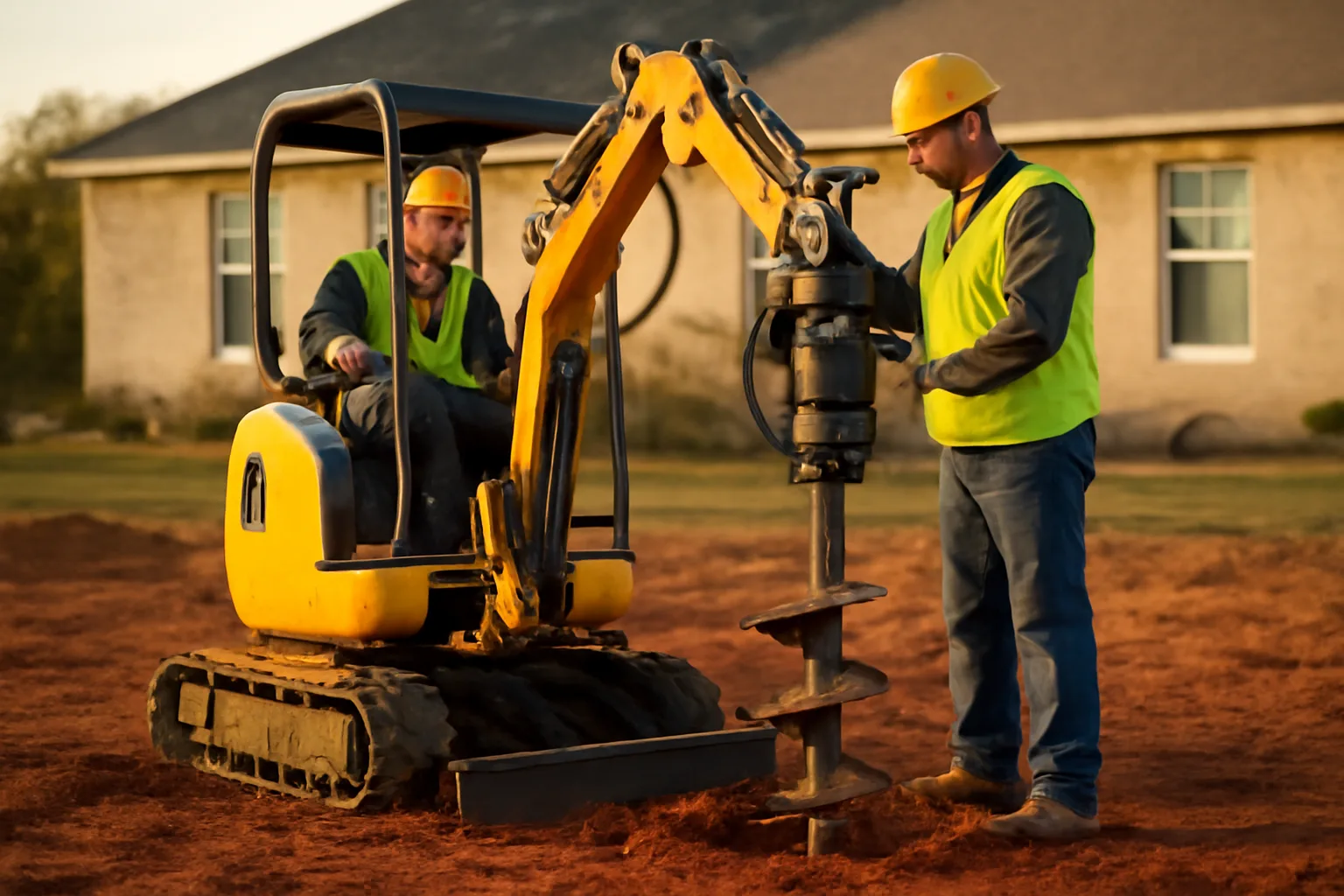
On a typical residential repair with 8 to 12 piers, an experienced two-person crew running a mini-excavator with a hydraulic torque motor installs every pier in one to two days. That assumes reasonable site access and soils that are not wildly variable.
Deeper commercial installs and new construction pile grids take longer. A crew setting 30 to 50 piers for a commercial building pad might run three to five days depending on pier depth and site logistics. Mobilization and setup each day add roughly 1 to 2 hours that never show up in per-pier numbers.
Permit review adds more time than the installation itself. Alabama building departments review at their own pace. Some rural counties turn foundation permits around in 2 to 5 business days. Jefferson County and Mobile County can run 10 to 20 business days on a complete application. Build permit lead time into your schedule, especially on commercial work where the foundation drives everything downstream.
Weather is a real variable here. Alabama averages roughly 56 inches of rain a year, and coastal and southern counties see more [6]. Wet weather does not stop helical pier installation the way it stops concrete pours, but it slows access and messes with torque readings in expansive clay. Northern Alabama's clay-heavy Piedmont soils and the Black Belt's Selma chalk both need careful torque monitoring, which adds time compared to uniform sand.
A realistic total for a residential job in Alabama, from signed contract to final inspection, is 2 to 4 weeks once you account for permit, install, and inspection. Commercial projects with an engineer of record, shop drawing review, and third-party inspection run 4 to 12 weeks from notice to proceed.
What classifications and specialty subcontractor rules apply in Alabama?
Alabama has no separate foundation or piling contractor license class, the way some states do. The ALBGC groups most foundation work under Building Construction (BC) or, for narrower scopes, under a Specialty classification you define at application [2].
If you plan to do only helical pier work and nothing else, you could make a case for a Specialty classification scoped as "helical pier installation and related foundation repair." Some contractors prefer this because the net worth and insurance requirements may be sized to a tighter scope. The risk is real: a Specialty license may not let you self-perform adjacent work like concrete pile caps or grading that often rides along with helical pier jobs. Talk to the ALBGC licensing staff about that trade-off before you apply.
As a sub, you can work under a GC's license without holding your own, as long as the GC pulls the permits and signs the contracts. Plenty of Alabama helical pier crews start this way. It works right up until you want to sign your own contracts or a GC relationship goes sideways. Plan for the license from day one.
Do Alabama helical pier projects need a structural engineer?
It depends on the jurisdiction and the project type, but for commercial work the answer is almost always yes.
Alabama follows the International Building Code as adopted by the state, which requires deep foundation systems to be designed by or under the supervision of a licensed professional engineer when the project falls under IBC's scope [5]. Commercial and multi-family projects trigger this every time. The engineer stamps the pier schedule, sets the torque acceptance criteria, and may require third-party inspection of installation torque records.
Residential repair is grayer. Many Alabama homeowners hire helical pier contractors directly with no engineer, and building departments in smaller counties often issue permits on the contractor's load calculations plus the manufacturer's ICC Evaluation Service (ICC-ES) report for the pier product. That ICC-ES report is the document that lets inspectors trust the product without a custom engineered design for every small residential job [7].
Doing residential work? Keep current ICC-ES reports for every product system you install. They download free from the ICC-ES website and they are the single most useful thing to hand a skeptical building inspector.
What does the Alabama contractor license application process look like step by step?
Here is the actual sequence, in order.
Step 1: Pick your license classification and target license limit. Your target limit sets the net worth your CPA has to hit.
Step 2: Hire a CPA to prepare a reviewed financial statement. Give this 2 to 4 weeks, more if your books are behind.
Step 3: Register for and pass the required PSI exams. Schedule at a PSI test center in Alabama, or remotely if the exam allows it [3]. Add 4 to 6 weeks of study for most first-timers.
Step 4: Get your insurance certificates in order. Your agent names the ALBGC as certificate holder per board requirements.
Step 5: Complete the ALBGC application form. Attach the financial statement, insurance certificates, and experience documentation. Submit with the application fee.
Step 6: The ALBGC reviews. Turnaround varies and the board does not publish a guarantee. Applicants have historically reported 4 to 8 weeks from complete submission to approval, though that is not an official figure, so confirm current timelines directly [2].
Step 7: On approval, pay any remaining license fees and receive your certificate.
Step 8: Register your business entity with the Alabama Secretary of State if you have not already, and get a local business license in every county or city where you operate [8].
Start to finish, from "I decided to get licensed" to "the license is in my hand," this realistically takes 3 to 5 months for most first-time Alabama applicants. Do not sign contracts contingent on the license until you actually hold it.
How does Alabama compare to neighboring states on contractor licensing for foundation work?
Alabama's $50,000 threshold and single-board structure is common across the Southeast. Here is how it lines up against the states most likely to matter if you work near a state line.
| State | Threshold | Board | Separate foundation license? |
|---|---|---|---|
| Alabama | $50,000 | ALBGC | No |
| Georgia | $2,500 (residential) | GCOC | No |
| Mississippi | $50,000 | MSBOC | No |
| Tennessee | $25,000 (commercial) | TDCI | No |
| Florida | $1 (any amount) | DBPR/CILB | No (foundation specialty under GC) |
Georgia's low threshold of $2,500 for residential work means a Georgia job that looks like a small repair still needs a license [9]. Florida requires a license for any amount of work at all. If you are based in Alabama near the Florida panhandle or the Georgia line and plan to take jobs across the border, you license in those states separately. Reciprocity between Alabama and its neighbors is limited and does not automatically transfer your ALBGC license. Confirm reciprocity status with each state's board.
For a closer look at how neighboring states handle this, see helical pier license in Arkansas and helical pier license in Arizona.
What local permits and inspections does Alabama require for helical piers?
Permits and inspections happen at the county or city level in Alabama, not the state level. There is no uniform statewide permit process for foundation work.
Most Alabama building departments require a foundation or structural permit for helical pier installation, whether the job is new construction or repair. The application usually wants a site plan, a description of the work scope, and either the manufacturer's ICC-ES report (residential) or engineer-stamped drawings (commercial).
Inspection rules vary by jurisdiction. Some require a pre-pour inspection after pier installation and before any concrete pile cap goes in. Others want the contractor to submit torque logs from each pier as part of closeout. Ask the local building department exactly what inspection hold points apply before you start work.
Skip a required permit and Alabama can hit you with stop-work orders, fines, and in some cases mandatory removal and reinstallation of work that was never inspected. It also creates real liability on residential jobs, where the homeowner later sells the house and a buyer's inspector flags unpermitted structural work.
For a broader look at business setup in the state, see how to start helical pier in Alabama.
What equipment and insurance do Alabama helical pier contractors typically carry?
The minimum field kit for a helical pier crew in Alabama is a hydraulic torque motor (drive head) rated for your expected torque range, a mini-excavator or skid steer to mount it, a torque indicator, pier sections and extensions in your standard product family, and a mounting bracket or lead section for the drive head.
For residential work, most Alabama crews run a small excavator in the 3 to 6 ton class. A Bobcat E35 or equivalent handles residential access well enough. Commercial sites may need bigger iron. The excavator is owned or rented. Rental rates in Alabama for a mini-excavator with attachments run roughly $500 to $900 per day depending on supplier and region. Ownership starts to pay once you run the machine 15 or more days a month.
Insurance is not optional. Beyond the ALBGC-required general liability, most commercial owners and GCs in Alabama require additional insured endorsements, workers' compensation (mandatory once you have employees under Alabama law [10]), and often an umbrella policy at $1 million or more. Get your certificates of insurance organized before you bid commercial work. A missing COI has killed more bids than a high price ever has.
If you are working out your first-year bid math and want a structured way to calculate your loaded cost per pier, HelicalPath's Stamp + Bid-Math Kit ($199 one-time at /start) covers the exact cost-to-bid framework for foundation specialty work.
What are the most common licensing mistakes Alabama helical pier contractors make?
The first mistake is selling and signing contracts before the license is in hand. It sounds obvious. The pressure to make revenue while the application processes is real, and people cave to it. Alabama law makes it unlawful to contract for work over the threshold without a license, and the ALBGC investigates complaints. More practically, homeowners can void contracts with unlicensed contractors, so you do the work and cannot enforce payment.
The second mistake is picking the wrong classification or license limit on the first application. A limit set too low caps the contracts you can legally sign. Going back to the ALBGC to raise your limit means updated financials and more fees. Have your CPA model where you expect to be in year two or three and size the initial application to match.
The third mistake is ignoring local business licensing. Your ALBGC license is a state credential. Most Alabama counties and cities also require a local business license to operate. The fees are modest, usually $50 to $200 per jurisdiction per year [8], but working without one hands the other side ammunition in any dispute.
The fourth mistake is letting the annual renewal lapse. The ALBGC license expires yearly. A lapsed license means you cannot legally sign new contracts over the threshold, and reinstatement costs more and takes longer than timely renewal. Set a reminder 90 days before expiration.
For contractors planning to expand regionally, see how to start helical pier in Arkansas and helical pier license in Colorado for a sense of how requirements shift state to state.
Frequently asked questions
Do you need a license for helical pier work in Alabama?
Yes, if the contract is $50,000 or more. Alabama Code Section 34-8-1 requires an Alabama Licensing Board for General Contractors (ALBGC) license for any construction contract at or above that threshold. Helical pier installation falls under general contracting scope. Below $50,000, state licensure is not required, but local permits still apply. Working without a required license exposes you to complaints, fines, and unenforceable contracts.
How much does helical pier cost in Alabama?
Residential foundation repair runs roughly $1,500 to $3,500 per pier installed, with most jobs using 8 to 15 piers. Total residential project costs commonly land between $12,000 and $50,000. Commercial work is typically quoted at $200 to $400 per linear foot of pier depth. Steel prices and site conditions move these numbers. Always get a soil report before finalizing a bid.
How long does helical pier installation take in Alabama?
A residential job with 8 to 12 piers typically takes one to two days of field work for a two-person crew. Factor in permit review (2 to 20 business days depending on county) and you are looking at 2 to 4 weeks total from signed contract to final inspection on most residential jobs. Commercial projects with engineer-of-record involvement run 4 to 12 weeks.
What exam do I need for the ALBGC license?
Alabama requires the Business and Law exam administered by PSI Exams for all ALBGC applicants. Most applicants in trade classifications also take a trade exam. Exam fees and scheduling are handled directly through PSI. Plan 4 to 6 weeks of prep time for first-time applicants. Confirm which specific exams your classification requires with the ALBGC before registering.
Is there a separate helical pier contractor license in Alabama?
No. Alabama does not have a separate helical pier, deep foundation, or piling contractor license. Foundation work is covered under the ALBGC's general Building Construction classification or a defined Specialty classification. You apply for the classification that fits your planned scope of work and define it at application. There is no stand-alone foundation installer credential at the state level.
Can I work as a helical pier sub in Alabama without my own license?
Yes, as a subcontractor you can work under a licensed general contractor without holding your own ALBGC license, provided the GC holds the contract and pulls the permits. This is a common entry point. The limitation is that you cannot sign contracts directly with owners until you are licensed. Most helical pier businesses that grow past the startup phase eventually get their own ALBGC license.
Does Alabama require a structural engineer for helical pier installation?
For commercial and multi-family projects, yes. Alabama follows the International Building Code, which requires engineer design for deep foundation systems in commercial scope. For residential repair, many jurisdictions accept the manufacturer's ICC-ES report in lieu of a custom engineered design. Always check with the local building department. A current ICC-ES report for your product line is essential for residential permitting.
How much does the ALBGC license application cost?
The ALBGC charges application fees that vary by license limit tier. Current fees must be confirmed directly with the ALBGC, as they have changed in recent years. Beyond the application fee, budget for CPA-prepared financial statements ($400 to $1,500 depending on complexity), PSI exam fees (roughly $100 to $200 per exam), and insurance costs. Total upfront licensing costs commonly run $1,000 to $3,000.
How long does the ALBGC application take to process?
The ALBGC does not publish a guaranteed turnaround. Applicants have historically reported 4 to 8 weeks from complete submission to approval, but this varies. An incomplete application resets the clock. Submit every required document in the first submission. Do not sign contracts contingent on having the license until the board has confirmed approval in writing.
What net worth do I need to get an Alabama general contractor license?
The ALBGC sets minimum net worth by license limit tier. For the lowest tier (contracts up to $100,000), recent guidance indicates a $10,000 minimum net worth. Higher tiers require proportionally more. Your CPA prepares the reviewed or audited financial statement that demonstrates your net worth. Confirm current requirements with the ALBGC before commissioning the financial statement, as thresholds can change.
Do I need workers' compensation insurance for a helical pier crew in Alabama?
Yes, if you have employees. Alabama law requires employers with five or more employees to carry workers' compensation insurance. Some construction classifications trigger the requirement at fewer employees. Misclassifying workers as independent contractors to avoid the requirement is a common and costly mistake. Confirm your specific threshold with the Alabama Department of Labor before you hire.
Can an Alabama helical pier license be used to work in neighboring states?
Not automatically. Alabama has limited reciprocity agreements with other states, and those agreements do not automatically extend ALBGC licensing to Georgia, Florida, Tennessee, or Mississippi. Each state has its own board and threshold. If you plan to take jobs across state lines, apply for a license in each state where you will sign contracts. Confirm current reciprocity status with each state's licensing board.
What Alabama soils should helical pier contractors know about?
Alabama has three major soil zones relevant to helical pier work. The Piedmont region in the north has clay-heavy residual soils that require careful torque monitoring. The Black Belt prairie across central Alabama sits on expansive Selma chalk that can throw off torque correlation factors. The Coastal Plain and Gulf Coast areas have loose sandy soils where deeper embedment and larger helix diameters are common. Get a geotechnical report on commercial jobs.
Where do I start if I want to build a helical pier business in Alabama?
Start with the ALBGC application process to understand your licensing timeline, then work backward to line up your CPA, PSI exam schedule, and insurance. Register your business entity with the Alabama Secretary of State and pull local business licenses in your target counties. Line up a product supplier and equipment access before you bid your first job. See our full guide at how to start helical pier in Alabama for the complete startup sequence.
Sources
- Alabama Legislature, Code of Alabama Section 34-8-1: Alabama requires a general contractor license for any construction contract of $50,000 or more
- PSI Exams, Alabama Contractor Licensing Exams: PSI administers the Business and Law and trade exams required for Alabama contractor licensing
- U.S. Department of Housing and Urban Development, Residential Foundation Design and Repair Guidance: Helical pier installation cost ranges of $1,500 to $3,500 per pier for residential and $200 to $400 per linear foot for commercial work reflect market pricing for deep foundation repair
- International Code Council, IBC 2021 Chapter 18 Soils and Foundations: IBC requires deep foundation systems to be designed by or under supervision of a licensed professional engineer for commercial projects; torque correlation method for helical piers is referenced
- NOAA National Centers for Environmental Information, U.S. Climate Normals: Alabama averages approximately 56 inches of precipitation per year
- ICC Evaluation Service, Acceptance Criteria for Helical Foundation Systems and Devices (AC358): ICC-ES reports for helical pier products allow residential building departments to approve installations without a custom engineered design
- Alabama Department of Revenue, Business License Information: Alabama counties and municipalities require local business licenses for contractors operating within their jurisdictions
- Georgia Secretary of State, Georgia Contractor Licensing, Residential Threshold: Georgia requires a contractor license for residential work over $2,500, a much lower threshold than Alabama's $50,000
- Alabama Department of Labor, Workers' Compensation Division: Alabama law requires employers to carry workers' compensation insurance, with thresholds tied to number of employees