Last updated 2026-08-18
TL;DR
Arkansas requires helical pier installers to hold a state contractor license through the Arkansas Contractors Licensing Board. Most residential helical pier jobs run $6,000 to $35,000 depending on pier count and soil conditions. Permit pulls and inspections add days to the schedule. Licenses renew annually. Confirm current fees and any CE requirements directly with the ACLB.
Do you need a license for helical pier work in Arkansas?
Yes. Arkansas law requires a contractor license for structural foundation work, and helical pier installation sits squarely inside that category. The Arkansas Contractors Licensing Board (ACLB) is the governing body. Under Arkansas Code Annotated 17-25-101 et seq., any person or company contracting to perform construction work with a total project cost of $2,000 or more must hold a valid state contractor license before starting work [1].
The $2,000 threshold catches almost every helical pier job in existence. Even a two-pier supplemental repair on a small house clears that number once you add labor, equipment mobilization, and materials.
There are two main license tiers to know about. A Residential Contractor license covers one- and two-family dwellings. A Commercial Contractor license (often called a General Contractor license at the state level) covers everything else. Helical pier work under a commercial or multi-family building needs the commercial credential. The ACLB administers both [1].
Subcontractors doing only the helical pier installation under a licensed general contractor still need their own license if they contract directly with the owner or bill the project separately. If you're the sub to a licensed GC and not in direct contract with the owner, call the ACLB about your specific structure before assuming you're covered.
Arkansas also runs a separate Home Inspector registration program, but that's for inspectors, not installers. Don't confuse the two.
How does the ACLB licensing process work for contractors doing helical pier jobs?
The Arkansas Contractors Licensing Board issues licenses by classification. For most helical pier contractors, the relevant classification is either "Building" or "Specialty Contractor" depending on whether you're doing the full foundation repair scope or just the pier installation portion [1].
To get licensed, you submit an application, pass a written examination (the ACLB uses third-party testing), show proof of general liability insurance and workers' compensation coverage, and pay the applicable fee. Confirm current fee amounts directly with the ACLB, because the board adjusts fees periodically and any number printed here could be stale by the time you read it [1].
The exam covers general contracting knowledge, Arkansas statutes, and business and law content. It is not a specialty helical pier exam. Treat it as a baseline contractor competency test.
Once licensed, renewals happen every year. Arkansas contractor licenses expire and must be renewed before the expiration date shown on your certificate. The ACLB sends renewal notices, but a missed notice doesn't excuse a lapse. Mark the date yourself.
If your license lapses, you cannot legally contract for covered work until it's reinstated. The ACLB can assess penalties for working unlicensed. Arkansas Code Annotated 17-25-301 spells out the enforcement authority [1].
For contractors licensed in neighboring states (Missouri, Tennessee, Texas, Oklahoma, Mississippi), Arkansas does not have a general reciprocity agreement for contractor licenses as of this writing. Confirm current reciprocity status with the ACLB before assuming your out-of-state license transfers.
What permits do you need to pull for helical piers in Arkansas?
Permits are a local question in Arkansas. The state sets the building code framework. Permit authority sits with the city or county where the work happens.
Arkansas builds its state code on the International Building Code (IBC) and the International Residential Code (IRC) [2]. Both codes address foundation systems, including deep foundation elements like helical piles. IRC Section R403 covers foundation requirements and generally triggers permit review for structural foundation work [9].
Little Rock, Fayetteville, Fort Smith, Jonesboro, and most incorporated municipalities require a building permit for helical pier installation on any structure. Rural unincorporated areas may not require a permit at all, or may have a county-level requirement. Call the local building department before starting any job.
Permit fees in Arkansas municipalities vary widely. Some cities charge a percentage of project value. Others charge a flat fee per inspection. A residential foundation permit in an Arkansas city might run from $75 to $500 depending on the municipality and project scope. Commercial projects run higher. Confirm with the specific AHJ (Authority Having Jurisdiction).
Inspections generally include a pre-pour or pre-backfill inspection. The inspector confirms pier depth, torque logs, and cap connections before you close everything up. Build that inspection window into your schedule.
How much does helical pier work cost in Arkansas?
Arkansas helical pier pricing sits in the mid-range nationally. The state's geology runs from flat Mississippi Delta alluvial soils in the east to the Ozark Plateau and Ouachita Mountain uplift in the northwest and central regions. Soil type drives pier depth, and depth drives cost more than almost any other factor.
For residential foundation repair and underpinning, most Arkansas contractors price helical piers at $1,500 to $3,500 per pier installed, with most residential projects needing somewhere between 4 and 14 piers [3]. That puts a typical single-family underpinning job at $6,000 to $35,000 depending on severity and pier count. Jobs on expansive clay soils in central Arkansas (around Little Rock and Conway) can need deeper piers and more of them.
New construction helical pile foundations vary more. A small residential slab-on-grade replacement with helical piles might start around $8,000 to $15,000. A commercial project with engineered pile design can run $50,000 to $200,000 or more depending on load requirements and pile count.
The table below shows approximate cost ranges by project type for Arkansas context:
| Project Type | Pier Count (typical) | Cost Range |
|---|---|---|
| Residential underpinning (light) | 4 to 6 piers | $6,000 to $15,000 |
| Residential underpinning (moderate) | 7 to 14 piers | $14,000 to $35,000 |
| New residential helical pile foundation | varies | $8,000 to $20,000 |
| Light commercial underpinning | 10 to 30 piers | $20,000 to $60,000 |
| Commercial new construction deep foundation | engineered | $50,000 to $200,000+ |
These ranges are directional estimates based on industry pricing data and regional market reporting [3]. Your actual cost depends on soil boring data, load requirements, site access, and the contractor's overhead. Get at least three bids with comparable scope definitions before you sign anything.
Materials alone (the piers, brackets, and hardware) run roughly 30 to 50% of total project cost on a typical residential job. The rest is labor, equipment mobilization, and overhead.
How long does a helical pier job take in Arkansas?
Installation is fast. That's one of the real advantages of helical piers over driven concrete piling or poured caissons.
A typical residential underpinning job with 6 to 10 piers runs one to two days of on-site installation time once the crew is mobilized and permits are in hand. Larger jobs with 15 or more piers might run three to four days. The hydraulic drive head installs each pier in minutes once the equipment is set and the crew finds a rhythm.
What stretches the timeline is everything before and after the installation itself. Permit review in Arkansas municipalities ranges from same-day over-the-counter approval (for jurisdictions with electronic permit systems and routine residential scopes) to two or three weeks for commercial projects or overloaded building departments. Little Rock and Fayetteville run online permit portals that can speed up residential turnaround [4].
On the design side, if an engineer needs to specify pier depth and capacity from soil borings, factor in one to three weeks for boring work, lab testing, and engineering report production before you even submit for permit.
Post-installation, the inspector signs off before you backfill or pour any concrete over the pier caps. Scheduling that inspection can add one to three days depending on the jurisdiction's queue.
The realistic total timeline from contract execution to final inspection sign-off on a standard residential job in Arkansas is two to four weeks, with permit and inspection steps eating more time than the actual installation. On a commercial project with engineered design, plan for six to twelve weeks minimum from site investigation to final inspection.
What soil conditions in Arkansas affect helical pier depth and cost?
Arkansas sits on several distinct geological zones, and they behave very differently under a helical pier.
The Mississippi Alluvial Plain in eastern Arkansas (the Delta region) has deep, soft alluvial deposits. Sandy and silty soils with low bearing capacity mean piers often need to reach 30 to 60 feet or deeper to hit competent bearing strata. Deep installs cost more and take more torque to achieve. The USDA Web Soil Survey has county-level soil data for Arkansas that engineers use as a starting point before ordering borings [5].
Central Arkansas around Little Rock sits on a mix of terrace soils, clay-heavy formations, and some rock closer to the surface near the Arkansas River bluffs. Expansive clay is the dominant problem here. Helical piers sized and spaced correctly can isolate a structure from seasonal clay movement, but the engineer has to account for uplift forces, more than downward bearing.
The Ozark Plateau in northwest Arkansas (Benton County, Washington County) has thinner soils over limestone and dolomite bedrock. Piers hit refusal early in some areas. That sounds good, but you have to check that the pier bears on competent rock and not a fractured zone. Karst features (sinkholes, solution cavities) in limestone terrain are a real design consideration in parts of northern Arkansas.
The Ouachita Mountains in central-west Arkansas have folded rock and varying soil depths. Site-specific boring data is non-negotiable on those jobs.
None of this means helical piers don't work in these zones. They work in all of them. But the engineering approach, pier specification, and cost profile shift depending on where in Arkansas the project sits.
What insurance and bonding do Arkansas helical pier contractors need?
The ACLB requires licensed contractors to carry general liability insurance. The minimum limits for licensure are set by the board and change periodically, so confirm current minimums directly with the ACLB [1].
Workers' compensation is mandatory in Arkansas for most employers. Under Arkansas Code Annotated 11-9-401, employers with three or more employees must carry workers' compensation coverage [6]. A helical pier installation crew almost always meets that threshold. If you're a sole operator with no employees, confirm your status with the Arkansas Workers' Compensation Commission.
Bonding is not universally required by the ACLB for every contractor classification, but some municipalities require a contractor bond as a condition of pulling a permit. Check with the local building department in any jurisdiction where you plan to work.
For commercial jobs, owner contracts often require higher insurance limits than the state minimum. A $1M per occurrence / $2M aggregate general liability policy is common in commercial construction. Umbrella coverage on top of that is standard on larger commercial foundation jobs. If you're bidding commercial work, read the contract insurance exhibit carefully before pricing.
How do helical piers compare to other foundation repair methods used in Arkansas?
Contractors in Arkansas use several deep foundation methods. The common alternatives to helical piers are pushed concrete piling (also called pressed piling or slab piers), driven steel pipe piling, and drilled concrete caissons. Each has real tradeoffs.
Pushed concrete piling uses hydraulic pressure to push precast concrete cylinders into the ground, with the structure's weight as reaction. It's common in residential repair across Arkansas, often priced slightly lower per pier than helical systems. The downside: it relies entirely on soil resistance at the time of installation and can't be load-verified by torque correlation the way helical piers can. In soft Delta soils, pushed piles sometimes don't reach adequate depth [3].
Drilled caissons (bored piles with concrete fill) work well in the Ozarks where you can drill into rock. They need more equipment, more time, and generate spoils that have to be managed on site. Cost is generally higher than helical piers for residential work.
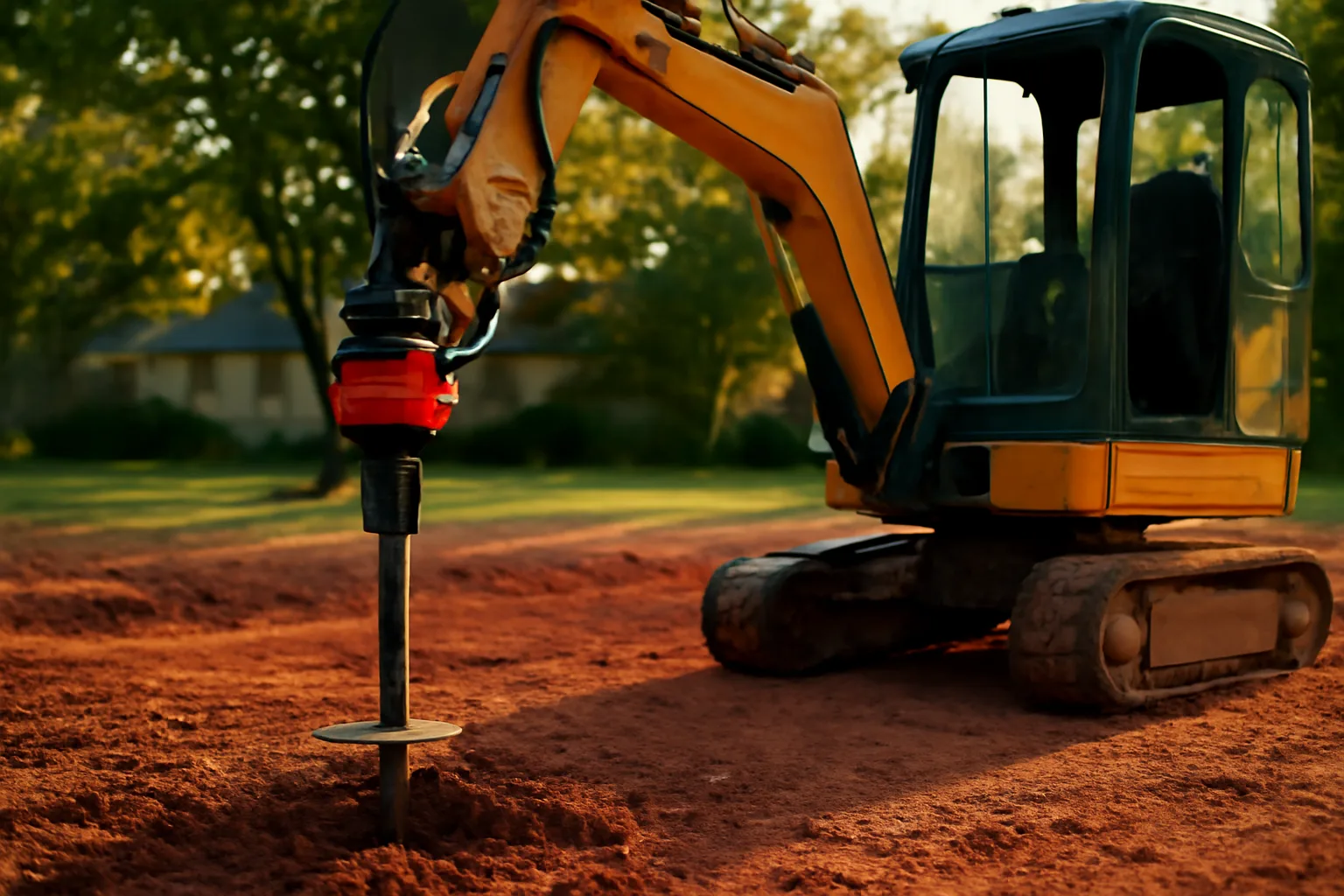
Helical piers win on speed, minimal site disturbance, and access. A hydraulic head mounted on a mini-excavator or track skid steer gets into a crawlspace or a side yard that a caisson drill rig can't reach. They also carry immediate load capacity after installation, verified by torque monitoring.
The honest answer: for most residential foundation repair in central and northwest Arkansas, helical piers are a sound choice and often the best one. In soft eastern Arkansas Delta soils, the required depth pushes costs up, but the method still works. An independent geotechnical engineer, not the contractor selling you a system, is the right person to specify the method.
How does annual license renewal work for Arkansas contractors?
Arkansas contractor licenses are annual. The ACLB issues renewals on a cycle tied to your original licensure date. You'll get a renewal notice, but don't rely on it as your only reminder.
Renewal requires a renewal application, payment of the renewal fee, and confirmation that your insurance is current and meets ACLB minimums. Some contractor classifications carry continuing education requirements tied to renewal. Confirm what applies to your specific classification with the ACLB [1].
If you miss the renewal deadline, the ACLB can assess a late fee. Working past the expiration date without renewing is unlicensed contracting, which carries penalties under state law. The practical risk beyond the legal penalty: insurance claims get complicated if you were operating without a current license.
For companies with multiple licensed employees or a Responsible Managing Employee (RME) structure, track the RME's renewal separately from the company license. Both need to stay current.
Bidding public jobs or working under a GC who wants proof of licensure before adding you to their approved subcontractor list? A lapsed license pulls you off jobs fast. Set a calendar reminder 60 days before your license expires.
The ACLB license lookup tool lets anyone verify license status. Owners and GCs use it. Keep your status clean.
What paperwork and documentation should you keep on every Arkansas helical pier job?
Good documentation on helical pier jobs does three things: it protects you legally, it supports permit inspection sign-off, and it gives the engineer of record the data to verify the installation met the design spec.
The minimum documentation package on any engineered helical pier installation includes torque logs (torque readings at each foot of installation depth), final installation depth per pier, an as-built pier layout compared to the design drawing, material certifications for the pier system, and the final permitted inspection card.
Torque logs are the key quality record. The capacity correlation between installation torque and axial capacity is built into ICC AC358, the acceptance criteria for helical pile systems [7]. If you can't show the torque log, you can't demonstrate the pier met its load requirement.
Keep job files for at least ten years. Foundation work is long-tail liability. A homeowner who sells a house five years after your repair might have a new owner raise a claim. Your torque logs, permit, and inspection card are your defense.
On commercial work, the structural engineer usually requires a special inspector for helical pier installation, and the inspection reports become part of the project closeout documents submitted to the building department. Know that requirement before you price the job.
If you need a system for turning job documentation into consistent bid packages, the HelicalPath Stamp + Bid-Math Kit at helicalpath.com/start is a one-time $199 tool built for exactly this paper path, including torque-to-capacity worksheets formatted for permit submittals.
Where do you find more state-by-state renewal information?
If you work across state lines or you're comparing Arkansas requirements to neighboring states, each state runs its own contractor licensing structure. The paper path varies more than most people expect.
Alabama runs its process through the Alabama Licensing Board for General Contractors, with its own classification and exam system. See our full breakdown at helical pier renewal in alabama.
Florida has a two-tier system (state certified vs. state registered) with different renewal requirements for each. Details at helical pier renewal in florida.
Georgia requires licensure through the Georgia State Licensing Board for Residential and General Contractors and has classification-specific renewal requirements. See helical pier renewal in georgia.
Illinois structures contractor licensing mostly at the local level, which creates a more complex multi-jurisdiction compliance picture. Full breakdown at helical pier renewal in illinois.
Colorado and Arizona both license contractors for structural work, with their own exam and renewal timelines. See helical pier renewal in colorado and helical pier renewal in arizona.
And California, which has arguably the most document-heavy contractor licensing process in the country, runs on the CSLB framework. Renewal requirements are at helical pier renewal in california.
The HelicalPath state guide series covers all 50 states. Each one focuses on the real paper path: what board, what exam, what renewal cycle, and what the common mistakes are. No generic advice.
Frequently asked questions
Do you need a license for helical pier work in Arkansas?
Yes. Arkansas requires a contractor license from the Arkansas Contractors Licensing Board for any construction contract totaling $2,000 or more, which covers virtually all helical pier jobs. The relevant classifications for helical pier installers are typically Building Contractor or Specialty Contractor depending on scope. Confirm the exact classification for your work directly with the ACLB.
How much does helical pier work cost in Arkansas?
Residential helical pier underpinning in Arkansas typically runs $1,500 to $3,500 per pier installed. A full residential job with 6 to 12 piers usually costs $9,000 to $35,000. Soft Delta soils in eastern Arkansas can require deeper piers, pushing costs higher. Commercial projects with engineered pile designs vary widely and can run $50,000 to $200,000 or more. Get at least three comparable-scope bids.
How long does helical pier installation take in Arkansas?
On-site installation is fast: one to three days for a typical residential underpinning job. The full timeline from contract to final inspection runs two to four weeks once you include permit review, pre-installation engineering if required, and post-installation inspection scheduling. Commercial projects with engineered design and soil borings should plan for six to twelve weeks from site investigation to inspection sign-off.
What is the $2,000 threshold under Arkansas contractor licensing law?
Under Arkansas Code Annotated 17-25-101, any person or company contracting to perform construction work with a total project cost of $2,000 or more must hold a valid ACLB contractor license. This threshold applies to total project value including labor and materials, not materials alone. Almost every helical pier job clears it easily.
Does Arkansas have contractor license reciprocity with other states?
As of this writing, Arkansas does not have a general reciprocity agreement for contractor licenses with neighboring states. Contractors licensed in Texas, Oklahoma, Missouri, Tennessee, or Mississippi typically cannot transfer their license directly to Arkansas without meeting ACLB requirements including examination. Verify current reciprocity status directly with the ACLB before assuming any transfer applies.
Do you need a permit for helical piers on residential work in Arkansas?
Permit requirements are set by local authorities, not the state. Most incorporated Arkansas municipalities require a building permit for structural foundation work including helical pier installation. Rural unincorporated areas may not. Contact the building department for the specific city or county where the job sits before starting work. Unpermitted structural work can create problems at inspection and resale.
What insurance does an Arkansas helical pier contractor need?
The ACLB requires proof of general liability insurance to obtain and renew a contractor license. Arkansas also requires workers' compensation for most employers with three or more employees under ACA 11-9-401. Minimum insurance limits are set by the ACLB and change periodically, so confirm current requirements with the board. Commercial contracts often require higher limits than the state minimums.
How do helical pier costs in Arkansas compare to pushed concrete piling?
Pushed concrete piling is often priced slightly lower per pier than helical systems for residential repair work in Arkansas. Helical piers cost more per unit but offer torque-verified load capacity, faster installation, less site disturbance, and the ability to work in tight access areas. In soft Delta soils, pushed piles may not reach adequate depth, making helical piers the more reliable option despite the higher per-pier cost.
What are torque logs and why do they matter on Arkansas helical pier jobs?
Torque logs record installation torque at each foot of depth as a helical pier is driven. The relationship between torque and axial pile capacity is the basis for ICC AC358, the acceptance criteria for helical systems. Torque logs are the primary documentation that a pier met its design load. Inspectors and engineers use them at sign-off. Keep torque logs for at least ten years after project completion.
How deep do helical piers need to go in eastern Arkansas Delta soils?
Eastern Arkansas has deep alluvial deposits with low bearing capacity in the upper soil layers. Helical piers in the Delta region often need to reach 30 to 60 feet or deeper to find competent bearing strata. This increases material cost and installation time compared to jobs in central or northwest Arkansas where bearing soils or rock are shallower. A geotechnical boring report matters especially before designing a Delta-region helical pier job.
What is the Arkansas Contractors Licensing Board and where do you reach them?
The ACLB is the state agency that licenses contractors for construction work in Arkansas. It issues, renews, and enforces contractor licenses under Arkansas Code Annotated Title 17, Chapter 25. Through the board you can verify license status, download applications, and find current fee schedules. For questions about specific license classifications for helical pier work, contact the ACLB directly.
Does Arkansas require continuing education for contractor license renewal?
Some contractor license classifications in Arkansas have continuing education requirements tied to renewal. The specific CE requirements depend on your classification. Your renewal notice will specify what's required for your credential type. Confirm current CE requirements directly with the ACLB when you receive your renewal notice, and don't wait until the last week before expiration to complete any required coursework.
Can a homeowner do their own helical pier installation in Arkansas?
Arkansas allows homeowners to act as their own contractor for work on their primary residence in some circumstances, but the specifics are narrow and the licensing exemptions have conditions. For structural foundation work, the safer approach is to confirm with the ACLB whether a homeowner exemption applies to your specific situation before assuming you can install helical piers without a licensed contractor. Unpermitted structural work can create title and insurance issues on resale.
How do you find a licensed helical pier contractor in Arkansas?
The ACLB's online license lookup lets you verify that a contractor holds a current, valid license before you sign a contract. Search by company name or license number. The Deep Foundations Institute maintains member directories that include contractor members. Always verify state licensure independently, even if the contractor claims to be affiliated with an industry association.
Sources
- Arkansas Contractors Licensing Board: Arkansas requires a contractor license from the ACLB for any construction contract of $2,000 or more; annual renewal with proof of insurance required; enforcement authority under ACA 17-25-301
- Arkansas Department of Labor and Licensing, Division of Building Codes: Arkansas adopted the International Building Code and International Residential Code as the basis for its state building code framework
- Angi, Helical Pier and Foundation Repair Cost Guide: Residential helical pier installation typically costs $1,500 to $3,500 per pier; total residential underpinning projects commonly range from $6,000 to $35,000 depending on pier count and soil conditions
- City of Little Rock, Arkansas: City of Little Rock requires building permits for structural foundation work and offers an online portal that can accelerate residential permit turnaround
- USDA Natural Resources Conservation Service, Web Soil Survey: USDA Web Soil Survey provides county-level soil data for Arkansas including bearing capacity and soil classification used by engineers before ordering geotechnical borings
- Arkansas Workers' Compensation Commission: Arkansas workers' compensation coverage is mandatory for most employers with three or more employees under ACA 11-9-401
- ICC Evaluation Service, AC358 Acceptance Criteria for Helical Foundation Systems and Devices: ICC AC358 establishes the acceptance criteria for helical pile systems including the torque-to-capacity correlation used to verify axial pile capacity from torque logs
- Deep Foundations Institute: The Deep Foundations Institute produces technical guidance on helical pier design, installation torque monitoring, and capacity verification
- International Residential Code 2021, Section R403, Foundation Requirements: IRC Section R403 addresses foundation requirements for one- and two-family dwellings including deep foundation elements like helical piles, and generally requires permit review for structural foundation work