Last updated 2026-08-18
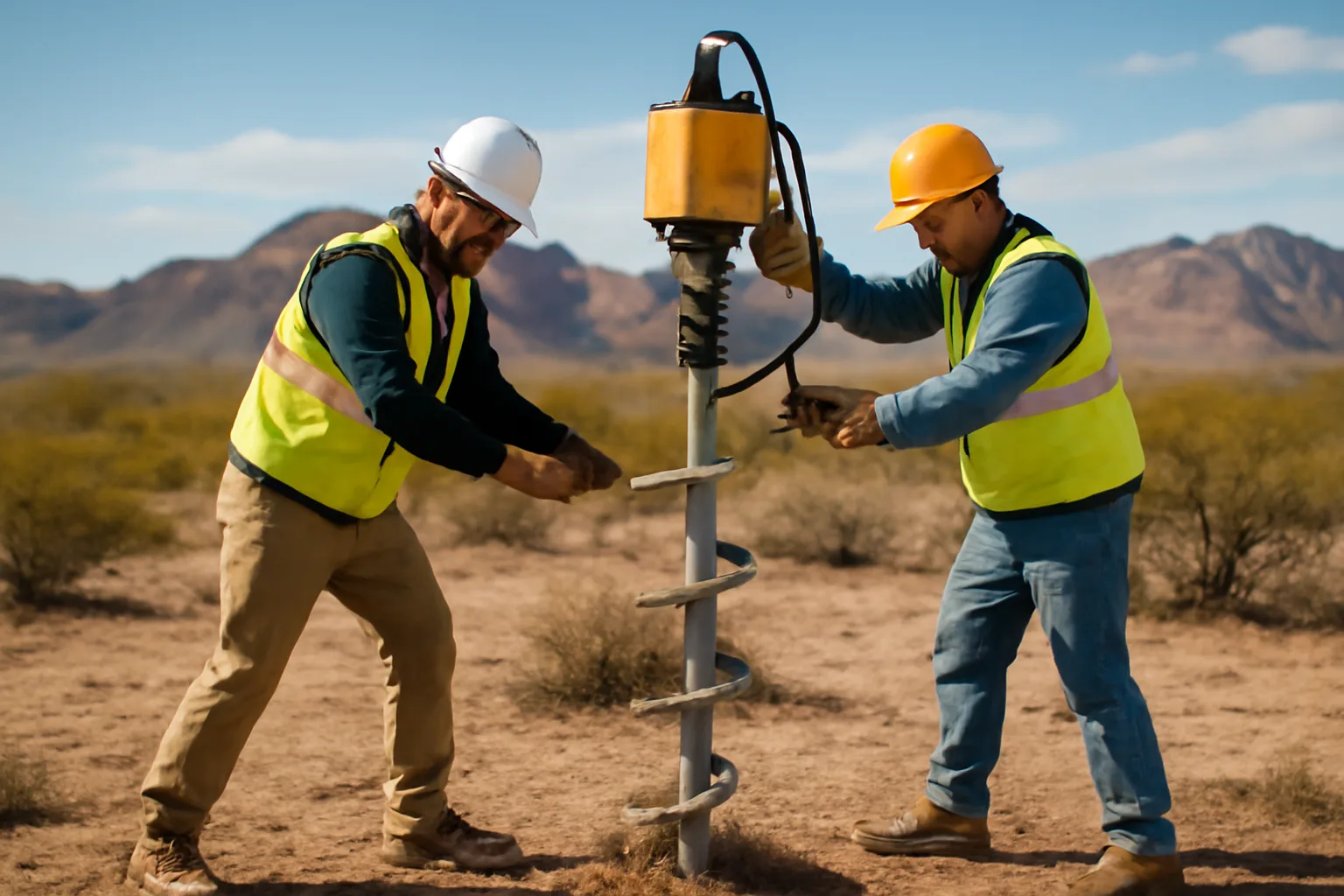
TL;DR
In Arizona, helical pier installation runs under a contractor license from the Arizona Registrar of Contractors (ROC). Most installers hold a CR-9 (Specialty Structures) or a related classification. Licenses renew every two years, cost roughly $150 to $220 in state fees, and require 14 hours of continuing education. Installed pier costs run $1,500 to $3,500 per pier, and a typical residential job takes one to three days.
Do you need a license for helical pier work in Arizona?
Yes. Arizona requires a contractor license for any helical pier installation tied to structural repair, foundation work, or new construction. The Arizona Registrar of Contractors (ROC) is the licensing authority under Arizona Revised Statutes Title 32, Chapter 10 [1]. Contracting without a license on a project above $1,000 in labor and materials is a Class 1 misdemeanor under A.R.S. § 32-1151 [1].
The most common classification for helical pier installers is CR-9 (Specialty Structures and Site Work). Some contractors work under B-1 (General Residential) or B (General Commercial) instead, when piers are one piece of broader foundation work. Confirm the right classification with the ROC before you apply or renew. Picking the wrong one is a common and expensive mistake.
Sole proprietors, partnerships, LLCs, and corporations all need a license before pulling permits. Arizona has no separate "helical pier" classification, so the work falls under whichever general or specialty classification matches your contract scope.
How does the Arizona ROC license renewal process work?
Arizona contractor licenses run on two-year cycles tied to your original issuance date, not a calendar year [2]. The ROC mails a renewal notice to the address on file roughly 90 days before expiration. Don't count on that notice showing up. Address lapses and mail delays are the top reason contractors miss the window.
Here's the renewal sequence:
1. Finish 14 hours of approved continuing education (CE), including mandatory hours in Arizona law and OSHA safety. 2. Verify your bond and liability insurance are current and on file with the ROC. 3. Submit the renewal application online through the AZ ROC Online portal or by mail. 4. Pay the renewal fee.
The ROC's online portal lets you check license status, confirm CE completion, and pay fees in one place [2]. Renew late and a penalty fee applies, plus the license lapses, which means you can't legally contract until it's reinstated. A lapsed license also shows up on the public ROC database, which commercial clients and general contractors check before awarding subcontracts.
If your license has been expired for more than two years, you generally can't renew at all. You reapply from scratch, retake the exam, and meet current net worth requirements [2].
What are the current ROC renewal fees in Arizona?
The ROC sets renewal fees by license classification and entity type. On the most recent published fee schedule, a residential specialty license (CR-series) renews for roughly $150 to $220, and commercial classifications (C or B series) run a little higher [3]. Confirm the exact figure on the ROC fee schedule at renewal time, because the legislature adjusts these periodically.
| License Type | Approx. Renewal Fee |
|---|---|
| CR-9 Residential Specialty | $150 - $165 |
| B-1 General Residential | $180 - $200 |
| B General Commercial | $200 - $220 |
| Late penalty (per cycle) | $25 - $50 additional |
These figures come from the ROC's published fee schedule [3]. The ROC does not prorate fees, so renewing early costs you the same. CE providers bill separately, usually $15 to $40 per credit hour for online courses, so budget another $100 to $200 for the 14-hour CE requirement on top of the state fee.
What continuing education do you need to renew?
Arizona requires 14 hours of ROC-approved CE per renewal cycle for most contractor classifications [4]. Those 14 hours must include:
- At least 3 hours of Arizona state contractor law
- At least 1 hour of OSHA/safety content
- The remainder from any ROC-approved provider
The ROC keeps a list of approved CE providers on its website [4]. Most providers run online self-paced courses, which is the practical choice for a busy installer. In most cases you don't report CE completion to the ROC yourself; the provider reports it electronically. Verify that with your provider, though, because some older ones still make you submit a certificate manually.
Content aimed at helical pier work, like ICC helical foundation design standards or geotechnical load tables, can sometimes count under technical elective hours. Ask your CE provider whether their structural specialty content qualifies before you buy. There's no CE credit for on-the-job training or manufacturer certification programs on their own.
How much does helical pier installation cost in Arizona?
Helical pier costs in Arizona generally run $1,500 to $3,500 per pier for residential foundation repair. Soil conditions, pier depth, load requirements, and site access drive that wide range [5]. A typical Phoenix-area home needing foundation stabilization might take 8 to 12 piers, putting the total between $12,000 and $42,000 before engineering fees.
Arizona's desert soils add complexity. Caliche layers, the calcium carbonate hardpan deposits common throughout Maricopa and Pinal counties, can require specialized cutting heads or pre-drilling, which raises equipment and labor costs [6]. Expansive clay in the Tucson basin creates different torque demands than the sandy alluvial soils of the lower desert.
Engineering adds another layer. Most Arizona municipalities require a licensed engineer's stamp on foundation repair plans before a permit issues. Engineer fees for helical pier projects run $800 to $2,500 depending on complexity. Some specialty foundation contractors fold basic engineering into their bid; others pass it through at cost.
If you're a contractor building out your bidding process, HelicalPath's Stamp + Bid-Math Kit at /start includes torque-to-capacity tables and pre-formatted bid sheets calibrated for variable soil, which cuts estimating time considerably.
For comparison, driven steel push piers in Arizona run $1,200 to $2,200 per pier, but they depend on reaching competent bearing strata and aren't always a fit for Arizona's soil profile. Concrete piers (pressed pilings) run $200 to $500 each and are a different product class entirely.
How long does a helical pier project take in Arizona?
Installation time hangs on the number of piers, soil conditions, and whether pre-drilling is required. A standard residential job of 8 to 12 piers in moderate soil takes one to two days of installation once the permit is in hand [5].
Permitting is where most of the calendar time goes. Phoenix requires a building permit for foundation repairs, and permit turnaround through City of Phoenix Development Services runs two to six weeks for over-the-counter structural permits, longer for complex plans review [7]. Scottsdale, Tempe, and Tucson each have their own timelines. Confirm with the jurisdiction before you give a client a completion date.
Soil delays are real. If a crew hits unexpected caliche at 4 feet when the plan called for 10-foot piers at a set torque, the engineer may need to revise the design before work continues. That adds days, not hours. Build contingency into any client-facing schedule.
Once installation wraps, a city inspector usually needs to sign off before backfill, which adds one to three days depending on inspector scheduling in your jurisdiction.
What bond and insurance does Arizona require for helical pier contractors?
The ROC requires every licensed contractor to keep a surety bond and liability insurance as a condition of licensing and renewal [2]. Bond amounts depend on license classification and net worth. Under current ROC requirements, specialty contractor bonds start at $2,500 and general contractor bonds start at $5,000, with higher amounts tied to financial thresholds [2]. Confirm current bond amounts with the ROC, since these can shift.
Liability insurance minimums are set by the ROC and must name the ROC as certificate holder. Most helical pier contractors carry $1,000,000 per occurrence and $2,000,000 aggregate general liability, which meets or beats what commercial GCs and homeowners ask for on their own certificate requests. Workers' compensation is required separately if you have employees under Arizona law [8].
A lapse in continuous bond or insurance is one of the most common reasons the ROC suspends a license mid-cycle, more often than at renewal. Set calendar reminders for your bond and insurance renewal dates, separate from your ROC renewal date.
What Arizona building code governs helical pier installation?
Arizona works off the International Building Code (IBC) and International Residential Code (IRC), and most jurisdictions adopt them locally with amendments [9]. IBC Section 1810 covers deep foundation elements including helical piles, and spells out installation requirements, load testing protocols, and torque correlation methods [9].
Arizona has no statewide building department. Code enforcement happens at the city and county level. Phoenix, Scottsdale, and Tucson each adopt the IBC/IRC with local amendments, so always pull the local adopted code before you spec a job.
The ICC's AC358 acceptance criteria for helical piles isn't a code itself, but Arizona plan reviewers reference it constantly to evaluate proprietary helical systems [11]. If your piers carry an ICC-ES evaluation report under AC358, approval often moves faster, because the reviewer has a standardized document to work from.
For work on expansive soils, the Maricopa Association of Governments' regional guidelines and Arizona geotechnical research are useful references when you defend your design to an engineer or building official [6].
How does Arizona compare to nearby states for helical pier licensing?
Arizona's two-year renewal cycle and 14-hour CE requirement land roughly in line with its neighbors, but the details differ enough to matter if you work across state lines.
| State | Renewal Cycle | CE Hours | Primary Authority |
|---|---|---|---|
| Arizona | 2 years | 14 hours | AZ Registrar of Contractors |
| California | 2 years | No mandatory CE | CA Contractors State License Board |
| Colorado | 2 years | Varies by class | CO DORA |
| Nevada | 2 years | 8 hours min | NV State Contractors Board |
| New Mexico | 3 years | 14 hours | NM Construction Industries Division |
California's lack of mandatory CE doesn't make it easier overall. California's application and net worth requirements for structural specialty work are far more demanding than Arizona's. Expanding into California? See helical pier renewal in california for how the CSLB process actually runs.
Colorado's requirements swing more by classification. For the full breakdown, helical pier renewal in colorado walks through the DORA process. If your work reaches the southeast corridor, read helical pier renewal in georgia and helical pier renewal in florida before you take on projects there.
What happens if your Arizona ROC license lapses?
A lapsed license in Arizona is not a minor paperwork problem. Under A.R.S. § 32-1151, contracting without a valid license is a criminal offense, and the ROC investigates complaints from homeowners and competitors [1]. The ROC's public license lookup is searchable by anyone, so a lapse is visible to every GC, HOA, and homeowner who checks.
If your license lapses but has been expired less than two years, you can usually pay the renewal fee plus the late penalty and reinstate without retaking the exam. Past two years, you're a new applicant: exam, application, financials, and the full wait [2].
During a lapse, you can't legally sign contracts, pull permits, or supervise licensed work. If you have employees, their work is unlicensed during that period too. Insurance coverage gets tangled when work happened during a lapse, and some insurers will deny claims on that basis. The advice is simple. Set a renewal reminder 90 days out and don't wait for the ROC mailer.
Where to go next: resources and next steps
The Arizona ROC's online portal is the authoritative source for your license status, renewal due date, and current fee schedule [2]. The ROC also publishes its approved CE provider list and formal complaint data, which helps when you vet subcontractors.
For bid prep on Arizona projects, especially jobs in caliche-heavy zones or expansive clay, accurate torque-to-capacity tables and soil correction factors save time and cut the risk of under-speccing. HelicalPath's Stamp + Bid-Math Kit at /start handles exactly that, with pre-formatted bid math for variable Arizona soil.
Expanding into neighboring states? Start where the endorsement process is simplest. Helical pier renewal in colorado and helical pier renewal in nevada are logical next steps given the geographic overlap. For contractors already licensed elsewhere wondering whether Arizona has a fast-track path, the answer is no. Arizona has no formal reciprocity agreements for contractor licenses, so you run the full process regardless [2].
Frequently asked questions
Do you need a license for helical pier work in Arizona?
Yes. Any helical pier installation tied to structural or foundation work over $1,000 in labor and materials requires an active ROC contractor license under A.R.S. § 32-1151. The most common classification is CR-9 (Specialty Structures), though B-1 or B classifications also cover foundation work depending on scope. Working without a license is a Class 1 misdemeanor in Arizona.
How much does helical pier installation cost in Arizona?
Expect $1,500 to $3,500 per pier for residential foundation repair, with soil type, pier depth, and site access driving the range. Caliche hardpan common in Maricopa and Pinal counties pushes costs toward the high end. A typical 8-to-12-pier residential project runs $12,000 to $42,000 before engineering fees, which add $800 to $2,500 depending on complexity.
How long does helical pier installation take in Arizona?
Installation itself takes one to two days for a standard 8-to-12-pier residential job. Permitting adds the most calendar time: Phoenix turnaround for structural foundation work runs two to six weeks. Caliche or unexpected soil can add days if the engineer has to revise the design mid-job. Build permitting and soil contingency into any client-facing schedule.
How often do Arizona ROC contractor licenses need to be renewed?
Every two years. The cycle runs from your original issuance date, not a calendar year. The ROC sends a renewal notice roughly 90 days before expiration, but don't rely on it. Set your own reminder and check your status through the AZ ROC Online portal to confirm your exact expiration date.
How many CE hours are required for Arizona ROC renewal?
14 hours per two-year renewal cycle. At least 3 hours must cover Arizona contractor law and at least 1 hour must cover OSHA or safety topics. The rest can come from any ROC-approved provider. Most providers offer online self-paced courses. Providers usually report CE completion electronically, but confirm your provider's process.
What is the penalty for renewing an Arizona ROC license late?
The ROC charges a late penalty on top of the standard renewal fee, currently in the $25 to $50 range per cycle. More seriously, your license shows as expired on the public ROC database during the lapse, visible to any client or GC who checks. Licenses expired more than two years cannot be renewed and require a full reapplication.
Does Arizona have reciprocity for contractor licenses from other states?
No. Arizona has no formal reciprocity agreements for contractor licenses. Contractors licensed elsewhere run the full ROC application process, including the trade exam and financial documentation. There's no fast-track or endorsement path based on an existing out-of-state license.
What bond amount does Arizona require for a specialty contractor license?
Bond requirements start at $2,500 for specialty contractor classifications and $5,000 for general contractor classifications, with higher amounts tied to net worth and project volume. Confirm the current figure with the ROC at renewal, as these thresholds can change. The bond must stay continuous; a lapse can trigger a mid-cycle license suspension.
What building code covers helical piers in Arizona?
Arizona jurisdictions adopt the International Building Code (IBC) and International Residential Code (IRC) locally with amendments. IBC Section 1810 governs deep foundations including helical piles. Code enforcement is local, not statewide, so pull the adopted code for each city or county where you work. Phoenix, Scottsdale, and Tucson each have their own amendment sets.
Do Arizona helical pier jobs require engineering plans?
Most Arizona municipalities require a licensed engineer's stamp on foundation repair plans before issuing a permit. Engineering fees for helical pier projects run $800 to $2,500. Some specialty contractors include basic engineering in their bids; others pass it through at cost. Check each jurisdiction's building department for its specific submittal requirements.
How does caliche affect helical pier costs in Arizona?
Caliche is a calcium carbonate hardpan layer common throughout Maricopa and Pinal counties. It can require specialized cutting heads, pre-drilling, or hydraulic heads with higher torque capacity, all of which raise equipment and labor costs. Projects in known caliche zones should include a soil contingency in the bid and confirm pier specs with the engineer before mobilizing.
Where can I check my Arizona ROC license status and renewal date?
The AZ ROC Online portal lets you search license status, confirm your expiration date, view CE completion on file, and pay renewal fees. The public license lookup on the same portal is searchable by any third party, so your status is visible to clients and general contractors.
Can I operate as a sole proprietor with an Arizona ROC helical pier license?
Yes. The ROC issues licenses to sole proprietors, partnerships, LLCs, and corporations. Each structure has its own application requirements for financial documentation and qualifying party designation. A sole proprietor is typically the qualifying party themselves, meaning the person who passed the trade exam has to be the business owner doing the work.
What insurance does Arizona require for helical pier contractors?
The ROC requires liability insurance with the ROC named as certificate holder, plus workers' compensation if you have employees. Most helical pier contractors carry $1,000,000 per occurrence and $2,000,000 aggregate general liability, which also satisfies most commercial GC requirements. Insurance must stay continuous; a lapse can suspend your license mid-cycle.
Sources
- Arizona Legislature, A.R.S. § 32-1151: Contracting without a license on a project over $1,000 in labor and materials is a Class 1 misdemeanor in Arizona
- Arizona Registrar of Contractors, License Renewal Information: Arizona ROC licenses renew every two years; late and lapsed license penalties and reinstatement rules
- Arizona Registrar of Contractors, Fee Schedule: ROC renewal fees by license classification, ranging approximately $150 to $220 for residential and commercial specialty licenses
- Arizona Registrar of Contractors, Continuing Education Requirements: 14 hours of ROC-approved CE required per renewal cycle, including mandatory Arizona law and OSHA safety hours
- HomeAdvisor / Angi, Helical Pier Cost Guide: Helical pier installation costs $1,500 to $3,500 per pier for residential foundation repair; typical project timeline one to two days for 8-12 piers
- City of Phoenix Planning and Development Department, Permit Services: Phoenix requires a building permit for foundation repairs; permit turnaround runs two to six weeks for structural permits
- Arizona Industrial Commission, Workers Compensation Coverage Requirements: Workers' compensation insurance is required for Arizona contractors with employees
- International Code Council, 2018 IBC Section 1810, Deep Foundations: IBC Section 1810 governs deep foundation elements including helical piles, covering installation, load testing, and torque correlation
- Arizona Department of Fire, Building and Life Safety, Building Codes: Arizona provides the framework for local IBC and IRC adoption; code enforcement is handled at city and county level
- ICC Evaluation Service, AC358 Acceptance Criteria for Helical Pile Systems: AC358 is the acceptance criteria widely referenced by Arizona plan reviewers to evaluate proprietary helical pile systems