Last updated 2026-08-18
TL;DR
To do helical pier work in Arkansas you need a state contractor license from the Arkansas Contractors Licensing Board. That means passing a Prometric trade exam, posting a surety bond ($10,000 minimum), and carrying general liability insurance. Residential and commercial jobs trigger different thresholds. Plan 6 to 12 weeks for the full cycle. No separate "helical pier" license exists; the work falls under general or specialty classifications.
Do you need a license for helical pier in Arkansas?
Yes. Arkansas requires a contractor license for almost any foundation or structural work, and helical pier installation is structural work by any honest reading of the statute. The Arkansas Contractors Licensing Board (ACLB) runs the show. Under Arkansas Code Annotated 17-25-101 et seq., anyone who contracts to construct, alter, repair, or improve a structure must be licensed when the contract value tops $2,000 for residential work or $20,000 for commercial work. [1]
There is no license category called "helical pier contractor." The work usually lands in one of two buckets: a Residential Building Contractor license for single-family and small residential projects, or a Commercial Contractor license for anything larger. Some operators also hold a specialty subcontractor classification. Which path you need depends on who you're billing and how large the jobs are. If you plan to sub your helical pier services to a general contractor on commercial sites, the GC's license may cover the work, but you still need your own license if you're pulling permits or signing contracts directly with property owners.
Confirm the exact classification with the ACLB before you apply. Classifications shift, and the board's staff can tell you in one phone call which bucket your work lands in. Their offices are in Little Rock.
Here's the trap. Arkansas does not have a "home improvement" carve-out broad enough to skip the license on helical pier depth work. The structural nature of the job puts it squarely inside the licensing requirement. Don't lean on the $2,000 residential threshold as a workaround either. The ACLB looks at the total project value, more than your slice of it.
What contractor license classification covers helical pier work?
Arkansas uses a tiered classification system. The two you'll deal with most are the residential and commercial tracks, and they split on contract value. Here's the shape of it:
| Classification | Typical Job Type | Contract Threshold |
|---|---|---|
| Residential Building Contractor | Single-family, duplexes, small residential | Over $2,000 |
| Commercial Contractor (Class A/B) | Commercial buildings, multifamily, industrial | Over $20,000 |
| Specialty Contractor (Subcontractor) | Structural specialties, sub to a GC | Varies |
Class A commercial licenses have no upper limit on contract size. Class B licenses cap at $300,000 per contract, though confirm current thresholds with the board because they can be adjusted by rule. [1]
For most people starting a helical pier business in Arkansas, the Residential Building Contractor path is the entry point. You can still do commercial sub work under many arrangements, but if you want to prime commercial jobs directly, you'll need the commercial track. The residential exam and the commercial exam are different tests, and you have to pass the one that matches your classification.
Some helical pier operators in neighboring states carry both a residential and a limited commercial license. That gives you the most room on bid day. See how helical pier licensing in Alabama handles a similar tiered system if you want a comparison baseline.
What are the steps to get an Arkansas contractor license?
The sequence is fairly linear. Here's the actual path:
1. Choose your classification (residential vs. commercial, as above). 2. Gather your documents: proof of business entity formation, federal EIN, insurance certificates, and financial statements if you're applying for a commercial Class A license. 3. Register a business entity with the Arkansas Secretary of State if you haven't already. An LLC is the common choice. The Secretary of State filing fee is $50 for online formation of a domestic LLC. [2] 4. Get general liability insurance. The ACLB requires proof of coverage. Minimum amounts vary by classification; confirm current minimums with the board. 5. Post a surety bond. The statutory minimum is $10,000 for most residential contractor classifications under ACA 17-25-103. [1] Commercial classifications may require higher bond amounts. 6. Pass the required trade examination. Arkansas uses third-party testing through Prometric. [3] The exam covers business and law and, depending on your classification, a trade knowledge component. 7. Submit the completed application with all supporting documents and pay the application fee. 8. Wait for board review and approval.
The exam is the piece most people underestimate. The business and law section covers Arkansas-specific contractor statutes, lien law, OSHA basics, and contract fundamentals. Study the Arkansas material, not generic contractor exam prep. Prometric's site posts the candidate information bulletin for Arkansas, which lists the exact reference books the exam pulls from. [3]
Once you're licensed, keep your workers' compensation coverage in place if you have employees. Workers' comp is mandatory for any employer with three or more employees in Arkansas under ACA 11-9-401. [4]
How much does it cost to get licensed for helical pier in Arkansas?
Here's the honest breakdown of what you'll spend just getting through the door. These are the documented fee categories; confirm current dollar amounts with the ACLB because they adjust fees periodically.
| Cost Item | Estimated Range | Notes |
|---|---|---|
| ACLB application fee | $100-$300 | Varies by classification; confirm with board [1] |
| Prometric exam fee | ~$100-$150 per attempt | Confirm current fee on Prometric site [3] |
| Surety bond (annual premium) | $100-$400 for a $10,000 bond | Depends on credit; bond itself is $10,000 minimum [1] |
| General liability insurance | $1,500-$3,500/year | Varies by coverage limit and experience |
| LLC formation (Secretary of State) | $50 online | Domestic LLC filing [2] |
| Registered agent | $0-$150/year | Can serve as your own agent |
Add it up and your first-year entry cost for licensing alone runs roughly $2,000 to $4,500 before you buy a single tool. That's the paper side. Equipment is a completely different number (covered in a later section).
Arkansas license renewal is annual. The renewal fee is lower than the initial fee, but you'll carry the bond and insurance every year regardless.
One thing people miss: fail the Prometric exam and you pay the exam fee again on the retake. Study before you schedule. First-time pass rates on contractor exams nationally run around 50 to 60 percent depending on the section, though Arkansas-specific data isn't published. Budget for one retake as a contingency.
How long does the Arkansas contractor license process take?
Realistically, 6 to 12 weeks from the day you decide to start until you have an active license in hand. That range comes from adding up the parts, not from any official ACLB guarantee, and the board does not publish official processing timelines.
Here's where the time goes:
Business formation takes 3 to 7 business days for an LLC if you file online with the Arkansas Secretary of State. [2] Insurance underwriting and bond issuance usually takes 3 to 10 business days once you've submitted your application to a carrier. Getting a Prometric exam seat can take 2 to 4 weeks depending on availability in your area. Then you have to actually take and pass the exam before submitting your full license application. ACLB application review, once they have a complete package, typically takes several weeks. If anything is missing from your application, the clock stops while you gather it.
The honest answer is that people who work the steps in parallel (getting insurance quotes while studying for the exam, forming the LLC while shopping for a bond) compress this to the 6-week end. People who work sequentially often hit 12 to 16 weeks.
There is no expedited processing option published by the ACLB. Confirm current processing times directly with the board before making any commitments to a customer.
How much does helical pier installation cost in Arkansas?
As a contractor, knowing what the market charges shapes your pricing. As a homeowner or GC reading this, it sets your expectations.
Helical pier pricing in Arkansas tracks national contractor patterns closely. The typical installed cost per pier runs $300 to $600 for residential applications, with final project costs shaped by pier depth, soil conditions, number of piers, and access difficulty. [5] A typical residential foundation stabilization project in the mid-South uses 8 to 15 piers, putting a full job in the $3,000 to $9,000 range before any concurrent concrete or drainage work.
Arkansas soil is not uniform. The alluvial soils in the Delta region (east Arkansas, Mississippi River corridor) can require deeper installation to reach bearing capacity than the rocky or clay-heavy soils in the Ozarks or Ouachita foothills. Deeper installations mean more material and more time per pier. Don't price a Delta county job using Ozark assumptions.
Commercial pier pricing runs higher, typically $500 to $1,500+ per pier installed, depending on load capacity specifications and engineer stamp requirements. Those are market observations; your actual costs depend on your steel sourcing, labor, and equipment finance structure.
If you're building your first bid sheet and want a structured way to work backwards from material and labor costs to a margin, the HelicalPath Stamp + Bid-Math Kit at $199 one time is worth a look. It's a calculation framework, not a license shortcut.
Material costs for helical piers (the steel shafts and helix plates) have tracked steel commodity prices, which swung hard between 2020 and 2023 and have partially stabilized. Get current quotes from at least two distributors before building any fixed-price contract.
What equipment do you actually need to start?
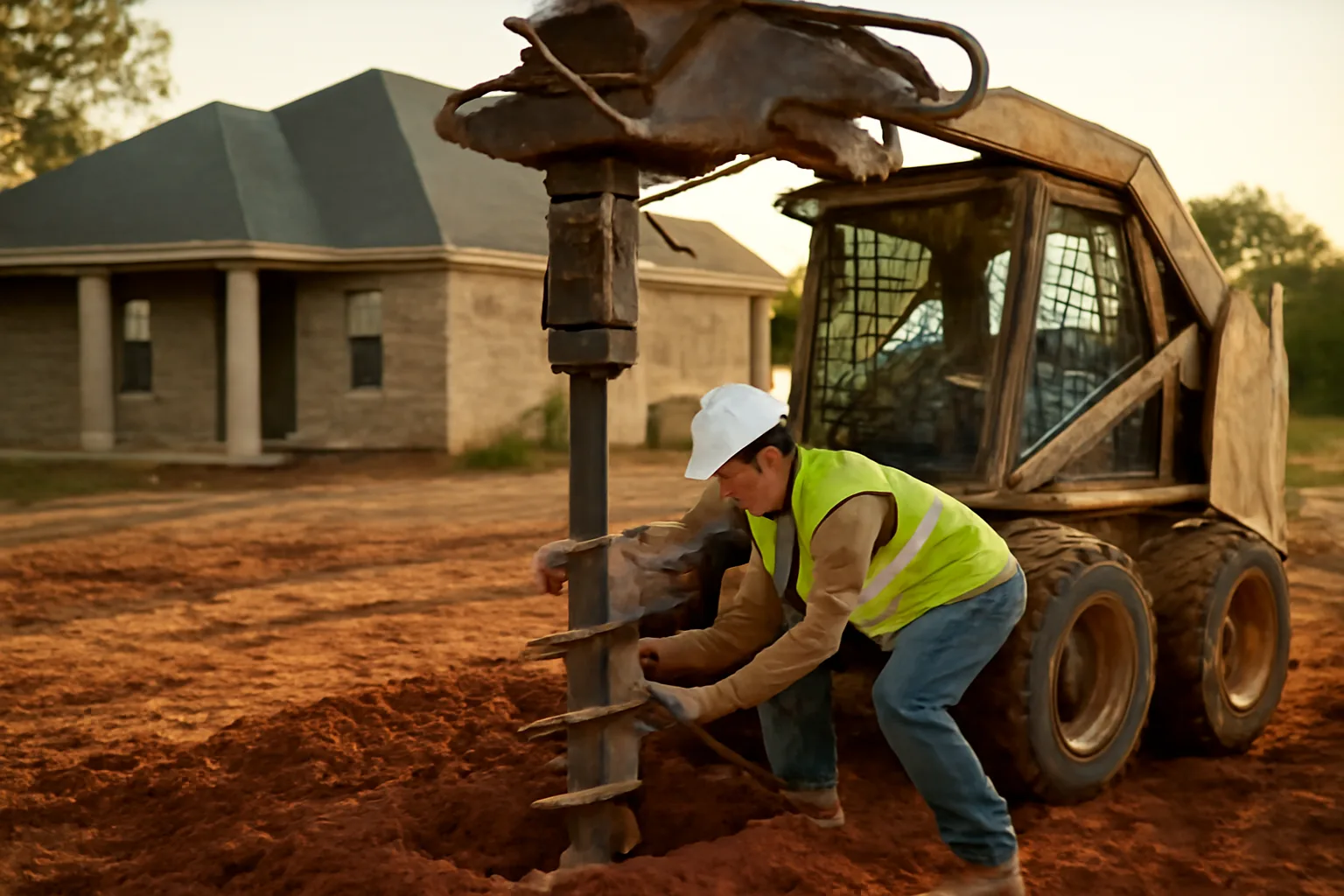
The minimum viable setup for a helical pier company is a hydraulic torque motor, a drive head matched to your pier diameter, a skid steer or excavator to mount it on, and a torque indicator or monitoring system.
You don't need to own the machine to start. Renting a skid steer with the right flow rate for a hydraulic motor is a common entry strategy. Rental rates for a skid steer in Arkansas run roughly $350 to $600 per day depending on size and the rental company. [6] A hydraulic torque motor attachment rents from specialty equipment dealers for $200 to $500 per day in many markets, though availability in Arkansas specifically is thinner than in bigger metros.
Buying your own equipment changes the math fast. A used skid steer capable of driving helical piers costs $25,000 to $60,000 depending on age and hydraulic flow specs. A quality torque motor drive head runs $8,000 to $20,000 new. These are capital costs, not licensing costs, and they deserve their own financing analysis before you commit.
One practical note: hydraulic flow rate matters. Helical pier installation motors typically need 18 to 35 GPM at 3,000 to 4,000 PSI. Many smaller skid steers don't hit that spec. Confirm compatibility before you rent or buy.
Some new operators in Arkansas sub their first few jobs to an established installer while they build capital, then buy equipment after revenue proves the demand. That's not the only path, but it's a sound one.
Do you need a PE stamp for helical pier work in Arkansas?
It depends on the job. Residential projects using standard manufacturer-specified helical piers for typical load conditions often don't need a licensed Professional Engineer to stamp the design. Commercial projects almost always do, and any residential project with unusual loads, poor soil reports, or a lender requiring a structural engineer will need a PE too.
Arkansas licenses Professional Engineers through the Arkansas State Board of Licensure for Professional Engineers and Professional Surveyors. [7] You don't need to be a PE to install helical piers. You do need to provide a PE-stamped plan when the project calls for one.
Build a relationship with a structural PE who understands helical pier capacity calculations early. Many helical pier contractors keep one or two engineers on their contact list for referrals. Some manufacturers also provide engineering support or stamped generic load tables for their products, which can satisfy certain permit requirements.
Arkansas follows the International Building Code (IBC) with state amendments for commercial construction. The IBC has specific provisions for deep foundation design under Chapter 18. [8] County and municipal building departments have the final say on what documentation they require for permits. Verify with the local jurisdiction before you price a job.
What permits do helical pier jobs require in Arkansas?
Building permits are required for foundation work in virtually every Arkansas jurisdiction with an active building department. Arkansas adopted the International Residential Code for One- and Two-Family Dwellings (IRC) and the International Building Code for commercial construction, with local amendments. [8]
Permit requirements and fees vary by county and city. In larger cities like Little Rock, Fayetteville, and Fort Smith, the building department processes permits and has inspectors familiar with specialty foundation work. In rural counties the process may be less formal, but that doesn't mean you can skip it. Unpermitted foundation work creates liability problems at resale and against your bond.
As the licensed contractor pulling the permit, you're responsible for inspection scheduling and code compliance. Inspectors will want to see the torque readings log (the primary field verification method for helical pier capacity) at minimum. Some jurisdictions require the torque monitoring to be witnessed or certified. Ask the local building official what they expect before the crew arrives.
Permit fees in Arkansas for structural repair or foundation work typically run $75 to $300 for residential jobs, but this varies widely. Some cities charge based on project value. Budget conservatively.
How does Arkansas compare to neighboring states for helical pier licensing?
Arkansas sits in the middle of the regional pack for licensing complexity. It's more demanding than some states and less demanding than others. Here's the regional picture:
| State | License Type | Separate Helical Pier License? | Bond Minimum |
|---|---|---|---|
| Arkansas | State contractor license (ACLB) | No | $10,000 [1] |
| Alabama | State contractor license (ALCLB) | No | Varies by class [9] |
| Tennessee | State contractor license (BCLPE) | No | Varies by class |
| Louisiana | State contractor license (LSLBC) | No | $10,000 |
| Mississippi | State contractor license (MSBOC) | No | $10,000 |
| Texas | No state contractor license for most residential | No | N/A |
Texas is the regional outlier: no statewide contractor license for residential work, though some Texas cities and counties have local requirements. That makes Texas a lower-friction entry market and a less regulated one. Arkansas's licensing requirement adds steps, but it also builds a barrier to entry that shields licensed operators from unlicensed low-ball competition.
If you're already licensed in another state and want to work in Arkansas, the ACLB does not have a formal reciprocity agreement with other states as of the last available information. Confirm current reciprocity status with the board directly. [1]
For a look at how a neighboring state handles this, see how to start helical pier in Alabama or the helical pier license in Alabama detail page.
What insurance does an Arkansas helical pier contractor actually need?
The ACLB requires proof of general liability insurance as part of your license application. Beyond that requirement, here's what a working helical pier operation actually carries:
General Liability: This covers property damage and bodily injury on job sites. Most contractor policies start at $1 million per occurrence / $2 million aggregate. Expect $1,500 to $3,500 per year at that limit, depending on your payroll, revenue, and claims history.
Workers' Compensation: Mandatory in Arkansas if you have three or more employees under ACA 11-9-401. [4] Even with two employees, carrying it protects you from personal liability if someone gets hurt. Rates depend on job classification codes; foundation work costs more than office work.
Commercial Auto: If your crews drive company vehicles to job sites, you need commercial auto, not personal auto. Personal auto policies typically exclude business use.
Equipment/Inland Marine: Covers your torque motor, pier inventory, and attachments in transit or on site. This is optional but practical for any equipment worth more than a few thousand dollars.
Some helical pier manufacturers or distributors require proof of insurance before they'll extend a dealer or installer relationship. Get your certificates organized early.
What's the realistic first-year revenue picture in Arkansas?
Nobody has great market-size data specifically for helical pier contractors in Arkansas. The closest useful proxy is the broader foundation repair and waterproofing contractor market nationally, which IBISWorld tracks at roughly $3.5 billion in annual revenue across about 5,000 U.S. firms. [10] Arkansas is not a huge market by population, but it has conditions that generate steady demand: expansive clay soils, older housing stock especially in the Delta and along river corridors, and a construction market that's grown with the northwest Arkansas tech and logistics boom.
A realistic first-year solo operator picture: 2 to 4 jobs per month at an average ticket of $5,000 to $8,000 puts you at $120,000 to $384,000 in gross revenue. Labor, materials, equipment, and overhead will eat 50 to 65 percent of that in most first-year operations. That leaves a thin margin while you build volume and referral networks.
The jobs come from three sources in this trade: referrals from real estate agents and home inspectors, relationships with foundation waterproofing companies who don't do helical work themselves, and direct response from homeowners who've been told they have a foundation problem. All three take time to build. Marketing spend in year one is real money, not optional.
If you want a structured way to price jobs so you're not guessing at margin, the HelicalPath Stamp + Bid-Math Kit covers the bid math for helical pier jobs specifically, including how to account for variable installation depth in your per-pier pricing.
Frequently asked questions
Do you need a license for helical pier in Arkansas?
Yes. The Arkansas Contractors Licensing Board requires a state contractor license for any foundation or structural work on projects over $2,000 (residential) or $20,000 (commercial). There's no separate helical pier license; the work falls under residential building contractor or commercial contractor classifications. Confirm the exact classification for your planned jobs with the ACLB before applying.
How much does helical pier installation cost in Arkansas?
Installed cost per pier typically runs $300 to $600 for residential work. A full residential foundation stabilization project using 8 to 15 piers lands in the $3,000 to $9,000 range. Arkansas's variable soils, especially the deep alluvial deposits in the Delta region, can push costs higher when installation must reach greater depth to find bearing capacity.
How long does helical pier take in Arkansas?
The licensing process takes 6 to 12 weeks from start to active license, depending on how fast you pass the Prometric exam and assemble your insurance and bond documents. Actual installation time per project is 1 to 3 days for a typical residential job. The ACLB does not publish official processing timelines; confirm current wait times with the board directly.
What exam do you have to pass for an Arkansas contractor license?
Arkansas uses third-party testing through Prometric. The exam has a business and law section and, depending on your classification, a trade section. The business and law portion covers Arkansas contractor statutes, lien law, OSHA basics, and contract law. You must study Arkansas-specific material. Prometric's candidate information bulletin lists the exact reference books.
What is the bond requirement for a contractor license in Arkansas?
The minimum surety bond under Arkansas Code Annotated 17-25-103 is $10,000 for most residential contractor classifications. The annual premium you pay for that bond depends on your personal credit and typically runs $100 to $400 per year. Commercial classifications may require larger bond amounts; confirm with the ACLB.
Can an out-of-state helical pier contractor work in Arkansas?
You still need an Arkansas contractor license. The ACLB does not have published reciprocity agreements with other states as of the most recent available information. You'll generally need to meet the same exam and documentation requirements as an Arkansas-based applicant. Confirm current reciprocity status directly with the board before planning any cross-state work.
Does helical pier work in Arkansas require a PE stamp?
Not always. Standard residential installations with typical loads often proceed without a PE stamp. Commercial projects almost always require one. Any residential job with unusual loads, weak soil conditions, or a lender requiring structural documentation will also need a licensed PE. Build a working relationship with a structural engineer early in your business setup.
What insurance does an Arkansas helical pier contractor need?
At minimum: general liability insurance (the ACLB requires proof with your application) and workers' compensation if you have three or more employees (Arkansas Code 11-9-401). Most operators also carry commercial auto and an inland marine policy covering tools and equipment. General liability typically starts around $1,500 to $3,500 per year at $1M/$2M limits.
How much does it cost to start a helical pier business in Arkansas?
Licensing costs alone (application fee, exam, bond, and insurance) typically run $2,000 to $4,500 in year one. Equipment is separate: a used skid steer capable of driving piers costs $25,000 to $60,000 and a torque motor drive head adds $8,000 to $20,000 new. Some new operators rent equipment on early jobs to reduce startup capital.
Do helical pier jobs in Arkansas require building permits?
Yes, in virtually every jurisdiction with an active building department. Arkansas follows the IRC and IBC with local amendments. Permit requirements and fees vary by county and city; residential permits for structural work typically run $75 to $300. As the licensed contractor pulling the permit, you're responsible for inspections. Ask the local building official what documentation they require before the job starts.
Is the Arkansas contractor license required for helical piers on commercial jobs?
Yes, and at a higher classification level. Commercial projects above $20,000 require a commercial contractor license (Class A or Class B) rather than a residential building contractor license. Class A has no upper contract limit; Class B caps at $300,000 per contract (confirm current thresholds with the ACLB). The commercial exam and application requirements are more demanding than the residential track.
What soils should I know about before pricing helical pier work in Arkansas?
Arkansas has two very different soil environments. The Delta region in eastern Arkansas has deep alluvial soils where piers may need to go deeper to reach bearing capacity, which raises material and time costs per pier. The Ozarks and Ouachita highlands have rocky or clay-heavy soils with shorter installation depth but potential for obstructions. Always get soil information before finalizing a bid.
Can I subcontract helical pier work under someone else's license in Arkansas?
If a licensed general contractor pulls the permit and you're working as their sub, the GC's license may cover the work on that specific project. But if you're signing direct contracts with property owners, pulling your own permits, or marketing as a standalone business, you need your own contractor license. Operating without one when required exposes you to fines and license denial later.
Sources
- Arkansas Contractors Licensing Board: Arkansas contractor licensing authority covering threshold requirements, bond minimums of $10,000 under ACA 17-25-103, and ACLB authority over structural contractors
- Arkansas Secretary of State, Business Entity Filing Fees: Arkansas domestic LLC online formation fee of $50
- Prometric, Arkansas Contractor Licensing Examinations: Arkansas uses Prometric as its third-party exam administrator for contractor licensing
- Arkansas Code Annotated Title 11, Chapter 9 (Workers' Compensation): Workers' compensation is mandatory in Arkansas for employers with three or more employees
- HomeAdvisor (Angi), Helical Pier Installation Cost Guide: Typical installed cost per helical pier runs $300 to $600 for residential applications nationally
- United Rentals, Skid Steer Loaders: Skid steer daily rental rates as a reference for equipment cost estimation
- Arkansas State Board of Licensure for Professional Engineers and Professional Surveyors: Arkansas licenses Professional Engineers through the state board; PE stamp required for structural engineering submissions
- International Code Council, International Building Code Chapter 18 (Soils and Foundations): The International Building Code governs deep foundation design under Chapter 18, adopted by Arkansas for commercial construction
- IBISWorld, Foundation, Structure, and Building Exterior Contractors industry report: U.S. foundation repair and waterproofing contractor market is approximately $3.5 billion annually across roughly 5,000 firms