Last updated 2026-08-18
TL;DR
In Arkansas, helical pier installation almost always needs a contractor license. The Arkansas Contractors Licensing Board issues residential and commercial licenses, with exam, net worth, and insurance requirements. Residential piers run $1,500 to $3,500 each installed, so a full repair job lands around $12,000 to $45,000. Most residential jobs finish in one to three days.
Do you need a license for helical pier work in Arkansas?
Yes, with very few exceptions. Arkansas requires contractor licensing for any person or company that contracts to perform construction, alteration, repair, or demolition on a project valued above $2,000 [1]. Helical pier installation, whether it's foundation repair, new construction underpinning, or tieback anchoring, counts as specialty structural work and clears that threshold on almost every job.
The Arkansas Contractors Licensing Board (ACLB) issues two license types that matter here. A Residential Contractor license covers work on one- and two-family dwellings. A Commercial (General) Contractor license covers everything else, including multi-family and commercial structures. Foundation repair crews working single-family homes usually apply under the Residential Contractor category, sometimes with a specialty classification. Anyone touching commercial structures needs the Commercial license.
There's one narrow exemption. Owners building or improving their own single-family residence for their own occupancy don't have to hold a license. That exemption stops the moment money changes hands. If you're a sub being hired by a GC or a homeowner, you need your own license.
Here's what trips people up. The ACLB isn't the only agency in the picture. Some Arkansas cities add a local business license or trade permit on top of the state license. Check with the city or county where the job sits before you pull a permit. The state license is the floor, not the ceiling.
Which Arkansas contractor license covers helical pier installation?
The ACLB splits its licenses into residential and commercial tracks, then allows specialty classifications inside each track. For helical pier and foundation work, two paths cover almost everyone:
- Residential Contractor (specialty endorsement in structural/foundation repair, or general residential)
- Commercial Contractor (specialty or general, depending on scope)
The board updates its classification list and specialty codes periodically, so confirm the current available classifications with the ACLB before you file [1]. Arkansas has no standalone "helical pier" classification the way some states break out deep foundation work. You fit your scope into the closest structural specialty, or you carry the full residential or commercial license.
Do you run both residential repair and commercial new-construction underpinning? Then you may need both license types, or you may need to structure your entity so each scope is covered. Have that conversation with the board or a licensed contractor in your market before you set up shop.
For helical pier work in neighboring states, the classification structure looks similar, but the exam and net-worth requirements differ enough that your Arkansas license won't just transfer.
What are the Arkansas contractor license requirements?
The ACLB posts its application requirements online. Here's the practical summary of what you'll assemble [1] [2]:
Financial net worth. Arkansas sets minimum net worth thresholds by license category and project dollar limit. Residential contractors typically need a demonstrated net worth in the $10,000 to $20,000 range depending on tier; commercial contractors chasing larger projects face higher thresholds. Confirm the current figures with the board, because they adjust them.
Exam. The ACLB requires a written exam for most license categories. Prometric administers it, the same national testing vendor several other state boards use. It covers business and law alongside trade knowledge. Residential applicants take a different exam than commercial applicants.
Insurance. You'll need general liability insurance and, once you have employees, workers' compensation coverage. The board sets minimum liability limits. Verify the current minimums on the ACLB application pages.
Application and fees. The ACLB charges application and license fees that vary by category. Residential contractor fees run in the range of a few hundred dollars; commercial fees scale with the license's project dollar limit. Pull the current fee schedule from the board directly, because these figures change [1].
Entity registration. Your business entity (LLC, corporation, sole proprietorship) has to be registered with the Arkansas Secretary of State before the ACLB will issue a license to it [3].
Renewal. Arkansas contractor licenses renew annually or biennially depending on type. Continuing education may apply. Confirm the current renewal cycle with the board.
How much does helical pier cost in Arkansas?
Every homeowner asks this, and the honest answer is that it depends on soil conditions, load requirements, depth to bearing stratum, and access to the structure. Real Arkansas projects still land in a fairly tight band.
Residential helical piers in Arkansas typically cost $1,500 to $3,500 per pier installed, with most jobs clustering around $2,000 to $2,500 [4]. A typical single-family repair needs 8 to 15 piers, which puts most residential projects between $12,000 and $45,000 depending on size and severity.
Commercial and new-construction work gets priced differently. Deep foundation contractors often bid by the linear foot of shaft or by torque-verified capacity, and per-pier pricing can run $3,500 to $10,000 or more once you account for larger shaft diameters, higher loads, and engineering documentation.
| Project type | Typical per-pier cost | Typical total range |
|---|---|---|
| Residential repair (small house, 8-10 piers) | $1,500 - $2,500 | $12,000 - $25,000 |
| Residential repair (larger/severe, 12-18 piers) | $2,000 - $3,500 | $24,000 - $63,000 |
| Light commercial underpinning | $2,500 - $6,000 | $20,000 - $120,000+ |
| New construction deep foundation | $3,500 - $10,000+ | Varies widely |
These ranges come from industry cost data across the South-Central region [4] [5]. Clay-heavy soils in the Mississippi Alluvial Plain and the expansive clays in central Arkansas often need deeper installation than average, which pushes per-pier cost toward the top of the range. Rocky terrain in the Ozarks and Ouachitas changes installation time and cost too.
Engineering fees sit separate from installation. A licensed geotechnical or structural engineer may need to specify pier locations, depths, and load targets, especially on commercial jobs. Budget $1,500 to $5,000 for engineering depending on complexity.
Get at least three quotes. Pier count, shaft diameter, and installation depth vary by estimator, and those three variables drive most of the difference between bids.
How long does helical pier installation take in Arkansas?
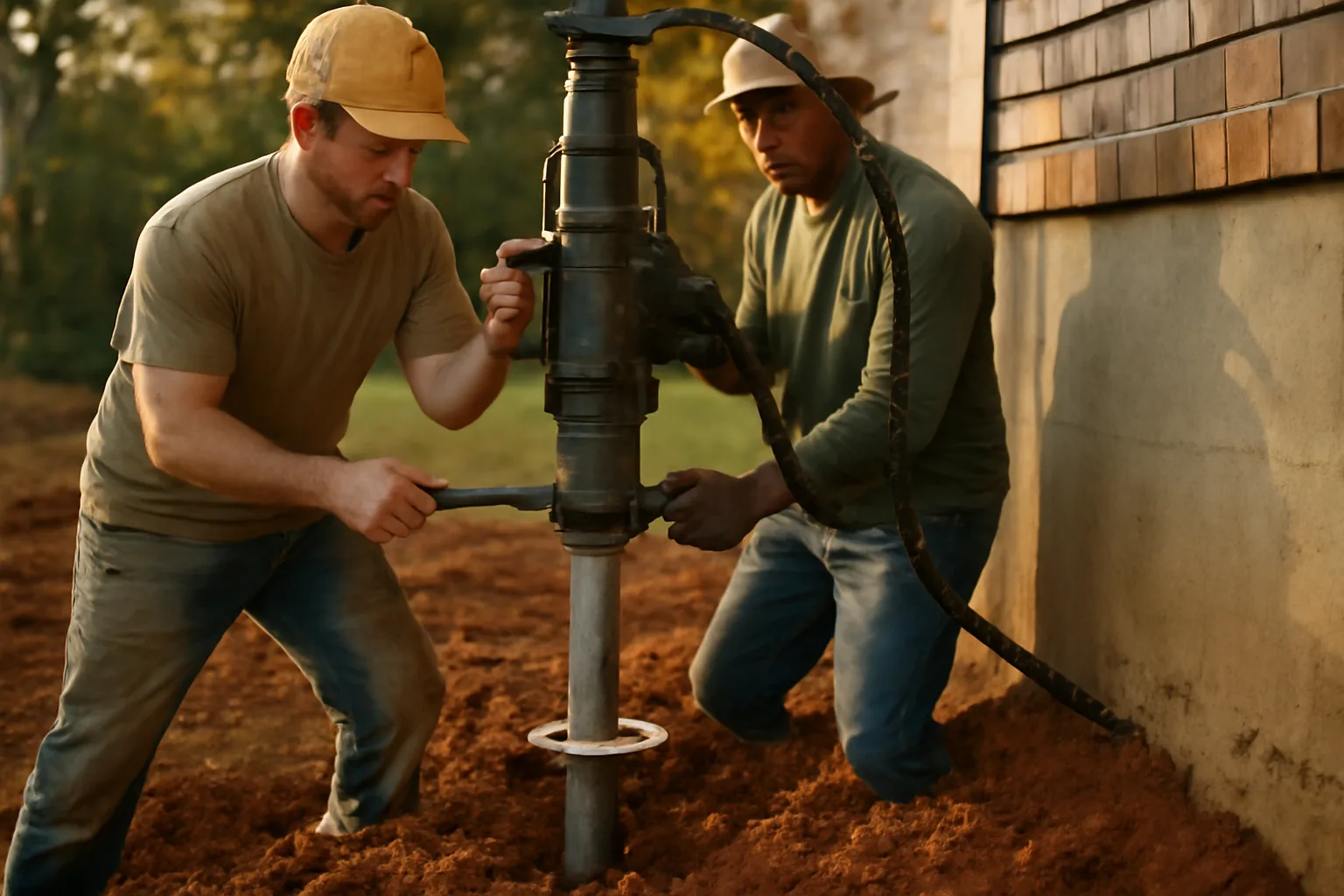
Plan on one to three days of installation for a typical residential foundation repair once the crew is on site. An 8- to 12-pier job often finishes in a single day with an experienced two- or three-person crew. Larger or more complex jobs stretch to two days.
Commercial and new-construction projects scale with scope. A 30-pier commercial job might take a week. A large industrial or bridge abutment project with dozens of high-capacity shafts could run several weeks.
Pier count usually isn't what controls the timeline. Access is. Arkansas homes with low crawl spaces, tight side-yard clearance, or interior piers in finished basements take longer per pier, because the hydraulic driver won't fit into cramped spaces without adapters or hand-excavation. Interior piers mean breaking and replacing concrete floor, which adds time and a separate trade.
Permitting timelines vary by jurisdiction. Some rural counties issue permits over the counter. Larger cities like Little Rock, Fayetteville, and Fort Smith can take one to four weeks for a residential foundation permit. Build that into your schedule. The installation is fast. The paper trail sometimes isn't.
If you're building out a bid process and want to understand how project duration feeds labor costing, the HelicalPath Stamp + Bid-Math Kit includes torque-to-capacity worksheets and a per-pier cost model that accounts for installation time by soil type.
Weather matters less for helical piers than for poured concrete. Crews can install in most conditions short of saturated, actively flooding soil or frozen ground. Arkansas winters stay mild, so most of the year is workable.
How do you register a helical pier business in Arkansas?
You need a legal business entity before you apply to the ACLB. For most new contractors that means forming an LLC or corporation with the Arkansas Secretary of State [3]. The online filing portal handles LLC formation, and the filing fee runs $45 for an LLC filed online, though confirm the current fee on the portal because it changes [3].
Once your entity is active, you'll need an Employer Identification Number from the IRS if you have employees or if your entity is a corporation or multi-member LLC [6]. That's free and issues immediately online.
Next comes the ACLB application. The board wants your entity registration documents, financial statements showing required net worth, proof of insurance, exam scores, and the application fee. Processing times swing around. Some applicants report four to six weeks after a complete application, but the board's queue moves at its own pace. Don't count on a specific date.
You'll also register for Arkansas sales tax if you sell any tangible goods (like materials billed separately) through the Arkansas Department of Finance and Administration [7].
For the operations side, the how to start a helical pier business in Arkansas guide walks through equipment acquisition, insurance structuring, and first-year cash flow planning.
What insurance does Arkansas require for helical pier contractors?
The ACLB requires proof of general liability insurance as part of the license application, at minimum limits set by the board that apply at application and renewal. Your customers, your general contractors, and commercial job specs will often demand more. $1 million per occurrence / $2 million aggregate is a common floor in commercial contracts, and some owners require $5 million.
Workers' compensation is mandatory in Arkansas for employers with three or more employees [8]. Arkansas Code Annotated 11-9-401 sets the obligation. Single-member LLC owners can elect to exclude themselves, but the moment you add employees, coverage is required. The Arkansas Workers' Compensation Commission administers it.
Some helical pier contractors also carry contractor's professional liability (errors and omissions), especially those who provide installation load certifications or run projects where their torque logs double as engineering documentation. That's not a board requirement, but it's worth a conversation with your broker if you're doing commercial work.
Carry an installation floater or inland marine policy for your hydraulic drive unit and tooling. A damaged or stolen rotary drive on a construction site costs $15,000 to $40,000 to replace, and a standard commercial auto policy may not cover tools in a truck bed.
What does the Arkansas permit process look like for a helical pier job?
Permits for helical pier installation in Arkansas get pulled at the local level, not the state level. The state building code (the Arkansas Fire Prevention Code and the adopted editions of the International Building Code and International Residential Code) governs the work, but local building departments issue the permits [9].
Most jurisdictions require a building permit for residential foundation repair. The application typically includes the address, scope of work, contractor license number, and sometimes an engineer's letter specifying pier locations and load requirements. Some smaller counties with limited inspection staff ask for lighter documentation. Verify locally.
For new construction, helical piers as part of a foundation system fall under the main building permit. The structural drawings show pier specifications, and the engineer of record signs those drawings.
Inspections vary. Some jurisdictions require a footing/foundation inspection before you pour a slab or backfill. The inspector may want to see your torque logs, the installation records showing final torque for each pier. Keep those records. They're your proof of capacity and your liability protection.
International Building Code Section 1810 covers deep foundations including helical piles, and Arkansas's adoption of the IBC means those provisions apply [9]. Section 1810.3.3.1.9 specifically addresses helical pile capacity verification through installation torque.
How does Arkansas contractor licensing compare to neighboring states?
Knowing where Arkansas sits against Tennessee, Missouri, Oklahoma, Louisiana, Mississippi, and Texas helps when you're deciding where to expand or how high the entry bar is.
| State | Licensing authority | Residential threshold | Commercial exam | Reciprocity with AR |
|---|---|---|---|---|
| Arkansas | ACLB | $2,000 project value | Yes (Prometric) | Check with ACLB |
| Tennessee | TDCI / CLSB | $25,000 project value | Yes | Limited |
| Oklahoma | Construction Industries Board | No statewide residential license | Yes | No formal |
| Missouri | No statewide contractor license | N/A | No statewide | N/A |
| Louisiana | LSLBC | $75,000 commercial | Yes | No formal |
| Mississippi | MSBOC | $50,000 project value | Yes | Check with boards |
| Texas | No statewide general contractor license | N/A | No statewide | N/A |
Arkansas's $2,000 threshold is low by regional standards, so the licensing requirement kicks in on almost every helical pier job. Missouri and Texas have no statewide general contractor license, which sounds easier but shifts enforcement to local jurisdictions and leaves you working a patchwork rather than one board. Oklahoma's Construction Industries Board does require licensing for specialty work including foundation contractors. Confirm current requirements with that board.
Already licensed in Alabama or Colorado? Ask the ACLB about reciprocity options. Some states run endorsement or waiver paths for out-of-state licensees with comparable credentials, but Arkansas has no blanket reciprocity agreement with most neighboring states under current published policy.
What are the continuing education and renewal requirements in Arkansas?
Arkansas contractor licenses have to be renewed, and the ACLB may require continuing education as a condition of renewal depending on license type. The specific CE hour requirements and approved course providers come from the board and change periodically, so pull the current renewal checklist from the ACLB rather than trusting any third-party summary [1].
Late renewals cost penalty fees. If a license lapses entirely, reinstatement may require re-examination depending on how long the lapse runs. Don't lose a license on a technicality. Set a calendar reminder well before the expiration date.
Many helical pier contractors also pursue manufacturer certifications from companies like Hubbell/Chance, MacLean Power Systems, or similar, separate from state licensing. Those certifications document that you've trained on specific pier systems, torque verification methods, and installation procedures. They're not legally required in Arkansas, but they carry weight with structural engineers specifying work and with commercial owners evaluating bids.
Where can you take the Arkansas contractor licensing exam?
The ACLB contracts with Prometric to administer licensing exams. Prometric runs testing centers in Little Rock and other Arkansas cities, and offers remote proctored testing for some exam types. You schedule through the Prometric website after you get an authorization to test from the ACLB [2].
The exam covers Arkansas contractor law, business management, and trade knowledge. Study materials come through the ACLB and third-party exam prep providers. The board sets passing scores and the number of attempts allowed before a waiting period applies.
Budget two to six weeks from the time you get your authorization to land a test date that works, especially during busy periods. Factor that into your timeline if you're trying to be licensed before a specific project start.
Already passed an exam in another state? Ask the ACLB whether any credit or waiver applies. Some boards accept scores from reciprocal exams. Arkansas's current policy on this is worth a direct inquiry.
What do helical pier contractors in Arkansas actually earn in year one?
Honest answer: year-one revenue swings hard, and nobody has good statewide data on startup helical pier contractors specifically. The closest comparable numbers come from the Bureau of Labor Statistics and specialty contractor surveys.
A solo residential foundation repair contractor in Arkansas doing steady work might generate $200,000 to $400,000 in gross revenue in year one if they lock in consistent referrals from structural engineers, real estate agents, and home inspectors. Gross margin on helical pier installation runs roughly 30% to 50% before overhead, depending on equipment ownership versus rental and crew structure [5].
The big year-one cost is equipment. A new hydraulic drive unit with enough torque for residential work costs roughly $15,000 to $40,000. Extensions, lead sections, and bracket inventory add another $10,000 to $25,000. If you're financing equipment, run the monthly debt service into your break-even math before you price your first job.
Marketing to structural engineers pays off more per dollar than most other channels. Engineers specify pier systems and refer work. A relationship with two or three active structural engineers in your market can keep a single crew busy for a year. The HelicalPath Stamp + Bid-Math Kit at $199 includes a bid template and cost model that helps you set minimum job pricing before you underbid your first few jobs, the most common year-one mistake.
For a fuller look at the business side, see how to start a helical pier business in Arkansas.
Frequently asked questions
Do you need a license for helical pier work in Arkansas?
Yes. Arkansas requires a contractor license for any project valued above $2,000, which covers virtually every helical pier installation. The Arkansas Contractors Licensing Board issues both Residential and Commercial Contractor licenses. Working without a license on a covered project is a misdemeanor and can bring fines and removal from the job site.
How much does helical pier cost in Arkansas?
Residential helical piers in Arkansas typically cost $1,500 to $3,500 per pier installed. A standard foundation repair job with 8 to 15 piers usually totals $12,000 to $45,000. Commercial and new-construction projects run higher per pier because of larger shaft diameters and higher load requirements. Arkansas clay soils sometimes need deeper installation, pushing costs up.
How long does helical pier installation take in Arkansas?
Most residential foundation repair jobs take one to three days of installation. An 8- to 12-pier job with good access often finishes in a single day. Permit processing adds time: some rural counties issue permits quickly; Little Rock and Fayetteville can take one to four weeks. Factor permitting into your schedule more than the installation day count.
What is the Arkansas Contractors Licensing Board and how do you contact them?
The ACLB is the state agency that issues and regulates contractor licenses in Arkansas. Its main office sits in Little Rock. You can reach the board through its website at aclb.arkansas.gov. It handles applications, exams, renewals, complaints, and license verifications. For current fees, processing times, and classification lists, contact the board directly, because third-party summaries may be out of date.
Can a homeowner install helical piers on their own house in Arkansas without a license?
Arkansas exempts owner-builders constructing or improving their own single-family residence for their personal occupancy from the contractor licensing requirement. If you own the house and do the work yourself, you may qualify. The exemption does not apply if you hire someone to do it or if the home is rental property. Confirm with the ACLB and your local building department before relying on it.
Does Arkansas have reciprocity with other states for contractor licensing?
Arkansas does not have broad reciprocity agreements with most neighboring states. Some exam credit or waiver options may exist for applicants with comparable credentials from other states, but you have to ask the ACLB directly about your situation. Don't assume your Tennessee or Oklahoma license transfers without checking first.
What exam do you take for an Arkansas contractor license?
The ACLB uses Prometric to administer licensing exams. After the board approves your application and issues an authorization to test, you schedule through the Prometric website. Testing centers operate in Little Rock and other cities; remote proctored options may be available for some exam types. The exam covers Arkansas contractor law, business management, and relevant trade knowledge.
What insurance does an Arkansas helical pier contractor need?
The ACLB requires general liability insurance at board-specified minimums as a condition of licensing. Workers' compensation is mandatory once you have three or more employees under Arkansas Code 11-9-401. Commercial contracts often require higher liability limits than the board minimum. An installation floater covering your hydraulic drive unit is worth carrying separately; standard auto policies often exclude high-value tools and equipment.
Are helical piers covered under the Arkansas building code?
Yes. Arkansas has adopted the International Building Code, and IBC Section 1810 covers deep foundations including helical piles. Section 1810.3.3.1.9 addresses capacity verification through installation torque. Local building departments issue permits and run inspections; requirements vary by municipality. Keeping detailed torque installation logs for every pier is both a code compliance tool and your liability documentation.
How do helical pier costs in Arkansas compare to other Southern states?
Arkansas residential helical pier costs ($1,500 to $3,500 per pier) fall in the mid-range for the South. Markets with higher labor costs like coastal Louisiana or Florida often run higher. Rural markets in Mississippi or parts of Oklahoma may run slightly lower. Soil conditions and depth to bearing stratum drive more of the per-pier cost difference than geography alone.
Do you need an engineer to specify helical piers in Arkansas?
For residential foundation repair, some contractors work from manufacturer design tables without project-specific engineering, though local permit offices increasingly ask for an engineer's letter. For commercial work and new construction, a licensed geotechnical or structural engineer typically signs off on pier specifications, locations, and load targets. Budget $1,500 to $5,000 for engineering depending on project size and complexity.
How do you register a business to do helical pier work in Arkansas?
Form your entity (LLC or corporation) with the Arkansas Secretary of State's online portal. Get an EIN from the IRS. Then apply to the ACLB for your contractor license, providing entity registration documents, financial statements, proof of insurance, and exam scores. Register for Arkansas sales tax with the Department of Finance and Administration if you'll bill materials separately. Processing through the ACLB varies; plan for several weeks after a complete application.
What is the minimum project value that triggers Arkansas contractor licensing?
Arkansas requires contractor licensing for projects valued above $2,000. This threshold is low relative to most neighboring states (Tennessee is $25,000; Mississippi is $50,000 for commercial). In practice, that means virtually every helical pier job in the state requires a licensed contractor. The $2,000 figure is set by Arkansas law; confirm the current threshold with the ACLB in case it has been updated.
How many helical piers does a typical Arkansas foundation repair job need?
Most residential foundation repair jobs in Arkansas use 8 to 18 piers depending on the size of the structure, the extent of settling, and the soil bearing conditions. A small pier-and-beam cottage might need 6 to 8 piers. A larger slab-on-grade home with significant differential settlement can require 15 to 20 or more. The structural engineer or an experienced contractor specifies pier count from load calculations and a site assessment.
Sources
- Arkansas Contractors Licensing Board, License Application and Requirements: Arkansas requires contractor licensing for projects valued above $2,000; ACLB issues residential and commercial contractor licenses with exam, net worth, and insurance requirements
- Prometric, Arkansas Contractors Licensing Board Exam Information: ACLB contracts with Prometric to administer contractor licensing exams in Arkansas
- Arkansas Secretary of State, Business Entity Filing: Business entities must register with the Arkansas Secretary of State; LLC online filing fee is $45
- HomeAdvisor (Angi), Helical Pier Cost Guide: Residential helical piers typically cost $1,500 to $3,500 per pier installed; total residential repair projects often range from $12,000 to $63,000 depending on pier count
- Bureau of Labor Statistics, Occupational Employment and Wage Statistics, Foundation, Structure, and Building Exterior Contractors: BLS specialty construction wage and employment data provides a baseline for estimating contractor labor cost and margin
- IRS, Apply for an Employer Identification Number Online: EIN is required for corporations, multi-member LLCs, and employers; issues immediately through the IRS online portal at no cost
- Arkansas Department of Finance and Administration, Sales and Use Tax: Contractors who sell tangible goods or bill materials separately must register for Arkansas sales tax with the Department of Finance and Administration
- Arkansas Workers' Compensation Commission, Arkansas Code Annotated 11-9-401: Workers' compensation coverage is mandatory in Arkansas for employers with three or more employees under Arkansas Code Annotated 11-9-401
- International Code Council, 2021 International Building Code Section 1810, Deep Foundations: IBC Section 1810 governs deep foundations including helical piles; Section 1810.3.3.1.9 addresses capacity verification through installation torque; Arkansas has adopted the IBC
- Bureau of Labor Statistics, Occupational Employment and Wage Statistics, Construction Specialty Trades: BLS data provides a baseline for specialty construction contractor revenue and wage benchmarks used in estimating year-one contractor earnings