Last updated 2026-08-18
TL;DR
Starting a helical pier business in Alabama needs a state contractor license from the Alabama Licensing Board for General Contractors. Most helical pier work falls under a specialty classification. Startup costs run $8,000 to $40,000 or more depending on equipment. The exam and application process takes two to four months. Confirm current fees and requirements directly with the board.
Do you need a license for helical pier work in Alabama?
Yes. Alabama requires a contractor's license for most commercial and residential foundation work, and that includes helical pier installation. The Alabama Licensing Board for General Contractors (ALBGC) is the governing body. Under Alabama Code Section 34-8-1, contracting for construction work above the threshold without a license is a misdemeanor [1].
The threshold matters here. Any commercial project with a contract price of $50,000 or more requires a state license [2]. Residential work runs on a separate track through the Home Builders Licensure Board (HBLB) if you're doing new construction or significant structural work on homes [3].
So the real question is which jobs you're chasing. Commercial or industrial helical pier projects above $50,000 need ALBGC licensure. Residential foundation repair or underpinning may fall under the HBLB instead. Some contractors carry both. Talk to both boards before you assume one covers you.
Helical pier installation involves deep foundation elements, so it almost always sits under specialty contractor classifications. The ALBGC uses a classification system. Specialty subcontractors who work under a general contractor may have different requirements than prime contractors. Confirm which classification fits your scope with the board before filing.
What are the ALBGC license requirements for specialty foundation work?
The ALBGC issues licenses in several classifications. For foundation specialty work, you'll typically look at the General Contractor license or a specialty subcontractor designation, depending on your business model [2].
Core requirements to apply include:
- Proof of financial solvency (balance sheet or financial statement)
- Passing a written examination (the ALBGC uses the Prometric testing platform)
- Proof of liability insurance and workers' compensation coverage
- Application fee (confirm current amount with the board, since fees change)
- Designated qualifier who passes the exam
The exam covers construction law, project management, and technical content. The ALBGC publishes a reference list for the exam. Study time is real. Most people spend 60 to 120 hours preparing, depending on their background.
Here's what trips people up. The qualifier (the person whose exam score the license rides on) must have verifiable experience. The board wants documentation, more than a resume. Pull together pay stubs, project records, and reference letters before you apply, not after.
Residential work runs through the Alabama Home Builders Licensure Board as a parallel track with its own exam and insurance requirements [3]. If you want to work both commercial and residential jobs without carrying general contractor overhead, read the HBLB rules carefully.
Alabama has no statewide journeyman or apprenticeship credential tied specifically to helical pier installation. But individual municipalities can add local permit requirements on top of the state license. Birmingham, Huntsville, and Mobile each run their own building departments that issue permits for foundation work.
How long does getting licensed in Alabama take?
Plan on two to four months from the day you start gathering documents to the day you hold a license. That range is honest. Some applicants move faster with clean financials and prior exam experience. Others drag past six months because of incomplete applications or exam retakes.
The rough timeline breaks down like this:
| Phase | Typical time |
|---|---|
| Gather financials, insurance, references | 2 to 4 weeks |
| Submit ALBGC application | 1 to 2 weeks to compile |
| Board review and exam scheduling | 4 to 8 weeks |
| Prometric exam (pass on first try) | Immediate result |
| License issuance after approval | 2 to 4 weeks |
The board meets on a set schedule, so applications that miss a meeting cycle wait for the next one. Check the ALBGC meeting calendar when you submit [2].
Exam retakes add time. The ALBGC allows retakes, but there's usually a waiting period between attempts. If the qualifier fails the first time, you're looking at another four to eight weeks minimum.
The installations themselves are fast compared to other deep foundation methods. A typical residential underpinning job runs one to three days. A larger commercial project with dozens of piers might take one to two weeks. The machine does most of the work. Your crew's experience with torque readings and installation logs is what separates a clean job from a problem.
How much does starting a helical pier business in Alabama cost?
Startup costs split into two buckets: licensing and compliance, and equipment. Licensing costs stay small. Equipment is where the real money goes.
Licensing and compliance rough costs (confirm all fees with the board):
- ALBGC application fee: confirm with board (historically in the $150 to $300 range for specialty categories)
- General liability insurance: $2,000 to $6,000 per year depending on coverage limits and your claims history
- Workers' compensation: varies by payroll; Alabama requires it once you have five or more employees, but carriers want it earlier in construction [4]
- Business entity formation (LLC or corporation): $100 to $200 in Alabama filing fees [5]
- Local business licenses: typically $50 to $200 per municipality
Equipment is where the real decision lives. A basic setup for residential helical pier work needs at minimum a hydraulic drive head, a skid steer or mini excavator to power it, and a torque indicator. Here's a realistic range:
| Equipment | New cost | Used cost |
|---|---|---|
| Mini excavator (small, 1.7 to 3.5 ton) | $30,000, $55,000 | $12,000, $28,000 |
| Hydraulic helical drive head | $8,000, $18,000 | $3,500, $9,000 |
| Starter helical pier inventory (steel) | $3,000, $8,000 | N/A |
| Torque indicator / data logger | $1,500, $4,000 | varies |
| Trailer and transport | $3,000, $8,000 | $1,500, $4,000 |
A lean startup buying used equipment might get into production for $25,000 to $35,000. A new-equipment setup runs $60,000 to $100,000 or more before you add a work truck.
Most first-year operators in the south buy their pier supply through a distributor rather than stocking heavily. That keeps cash tied up in inventory low and lets you learn your volumes before you commit.
On the revenue side, residential helical pier jobs in Alabama run $1,500 to $3,500 per pier installed, depending on depth, soil, and job size. Nobody has clean statewide data on this. Those figures come from national distributor guides and regional contractor discussions, not a formal survey.
What equipment do you actually need to start?
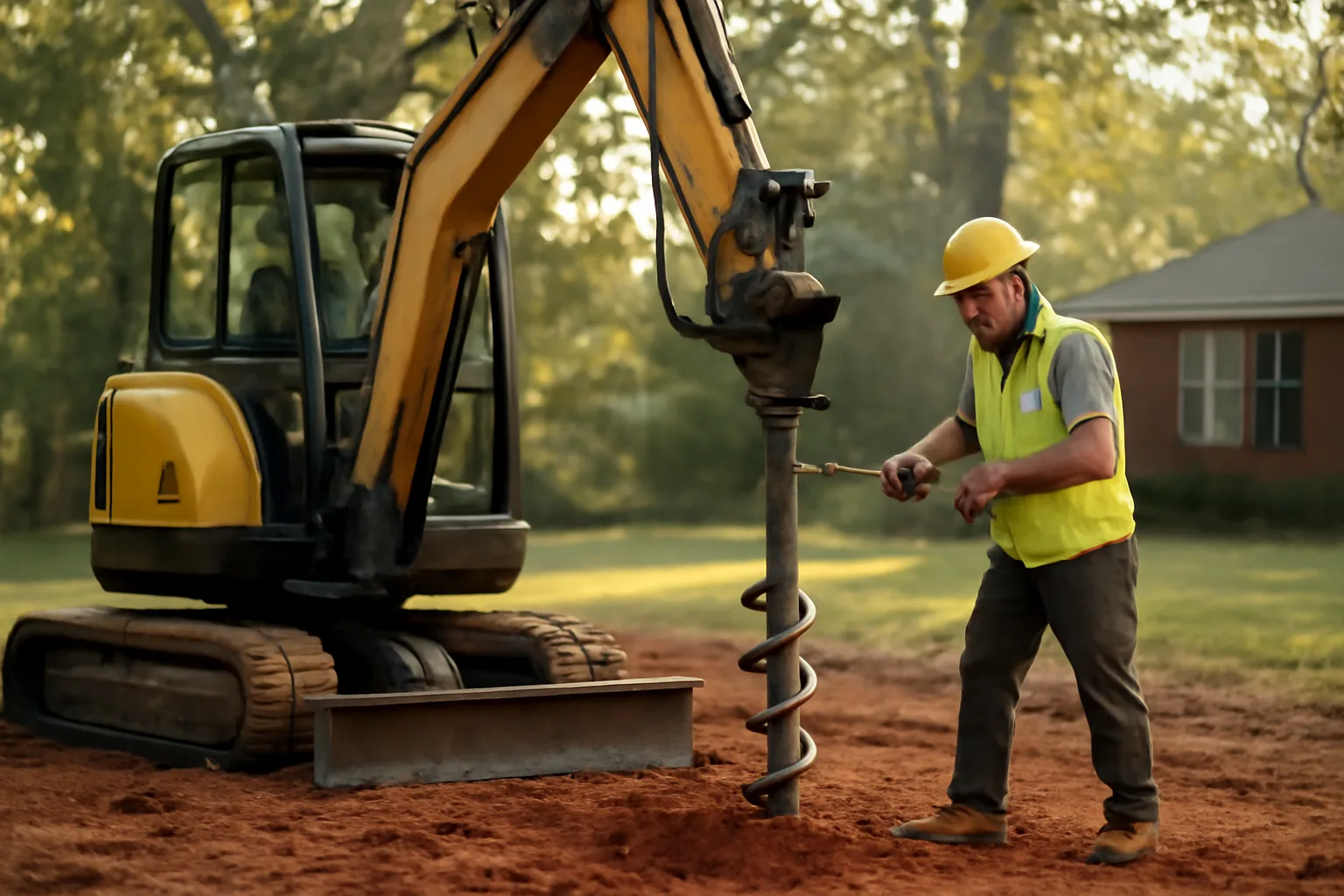
The minimum viable setup for most residential and light commercial work is a hydraulic torque motor (drive head), a carrier machine that can supply hydraulic flow, and a continuous torque monitoring system. That's the core.
Most new operators start with a skid steer if access is tight (crawl spaces, side yards) or a mini excavator if they're working open commercial sites. Skid steers cost less and flex better for tight residential work, but they have lower hydraulic flow, which caps the size of pier you can install efficiently.
Helical piers from major manufacturers like Chance (now part of Hubbell) or MacLean come in standard shaft diameters (1.5-inch, 1.75-inch, 2.0-inch round shaft, plus various square shaft sizes). The diameter you can install depends on your drive head's torque rating and your carrier's hydraulic output [6].
Alabama's soils shape your inventory. The state has heavy clay content in the central and northern regions, and coastal plain soils in the south. Clay can be soft and expansive, which creates steady demand for helical piers in foundation repair. You'll need piers long enough to reach stable bearing strata, which in some Alabama clay regions means 20 to 40 feet of depth. That drives your extension inventory.
The International Code Council publishes acceptance criteria that most engineers and building departments reference [7]. Get familiar with ICC acceptance criteria AC358 before your first engineered job.
How do you actually get your first helical pier jobs in Alabama?
The fastest path to first revenue in Alabama is foundation repair subcontracting. Established waterproofing and foundation repair companies often need installation capacity and will sub work out to a licensed operator with equipment. That gets you paid work while you build direct relationships with structural engineers and general contractors.
Alabama's humid climate and expansive clay soils mean foundation movement is common. The demand is real. Engineers who do foundation assessments are a key referral source. Meeting local structural and geotechnical engineers is worth more than any advertising spend in your first year.
A few channels that actually produce work for new operators:
- Local structural engineering firms (show up, leave a card, follow up with a spec sheet)
- General contractors doing commercial renovation or additions (helical piers for additions are common)
- Foundation repair networks and national franchise referral programs
- Municipal contractors doing utility work who need helical anchors for earth retention
Alabama has no single dominant contractor database that makes prospecting easy, but the ALBGC license lookup is public [2]. That means you can see who holds general contractor licenses in your area and contact them directly.
One thing matters more than most new operators expect: your installation documentation. Every job should produce an installation log showing final torque, depth, and the correlation to load capacity. Engineers require it. Hand them a clean log with calibrated torque data, and you become someone they want to work with again.
What does Alabama's soil and climate mean for your business model?
Alabama sits in a geologically mixed position. The northern part of the state has residual soils from Appalachian bedrock that can be competent but variable. Central Alabama, including the Black Belt region, holds some of the highest-plasticity clay in the country, the kind that swells when wet and shrinks when dry [8]. That movement is exactly what drives foundation repair demand.
The coastal plain in the south (Mobile area) has softer, layered soils closer to the Gulf, where bearing capacity can be inconsistent and helical piers have to reach deeper.
For your business model, this variation means:
- Central Alabama (Birmingham, Tuscaloosa, Montgomery) has the densest foundation repair market because of the Black Belt clay.
- North Alabama (Huntsville, Decatur) has a mix of residential and commercial activity tied to aerospace and manufacturing, where you'll see more commercial foundation work.
- South Alabama (Mobile) has more moisture-related foundation issues and a soil profile that needs longer piers on average.
You don't need to serve all three regions on day one. Most successful first-year operators pick one metro, get density there, and expand from that base.
Alabama's building permit data isn't centralized at the state level the way some states do it, so you can't easily pull permit counts by type. The U.S. Census Bureau's Building Permits Survey covers Alabama at the state and county level but doesn't break out specialty foundation work separately [9].
What insurance does Alabama require for helical pier contractors?
Alabama requires general liability insurance as a condition of ALBGC licensure. The board sets minimum coverage limits. Confirm the current minimums when you apply, since boards update these requirements from time to time [2].
Workers' compensation is required by Alabama law for employers with five or more employees. Alabama Code Section 25-5-1 governs the workers' compensation system [4]. Construction is a high-risk classification, so workers' comp premiums in the trades run higher than office work. Expect rates in the range of 8% to 15% of payroll for foundation specialty work, though your actual rate depends on your experience modifier and carrier.
If you're a sole operator with no employees, you can potentially exempt yourself from workers' comp. But that's worth discussing with an insurance broker who knows Alabama construction, not a general agent.
Two other coverages deserve serious thought even if they aren't technically mandated:
- Commercial auto on your work vehicles (required if you have any business use, which you do)
- Equipment floater or inland marine coverage on your drive head and excavator (your general liability policy almost certainly excludes your own equipment)
Total annual insurance cost for a small helical pier operation in Alabama commonly runs $4,000 to $10,000 per year depending on revenue, equipment values, and claims history. That's a real operating cost. Budget for it.
How do you price helical pier jobs in Alabama?
Pricing helical pier work is a function of pier count, depth, material cost, mobilization, and overhead recovery. Alabama has no state-mandated or union rate.
A simple per-pier pricing model works for most residential jobs. Your price per pier needs to cover:
- Steel pier material (your actual cost from the distributor)
- Lead section, extensions, and bracket hardware
- Machine time (cost-per-hour including depreciation and maintenance)
- Labor (including any helper)
- Mobilization and fuel
- Overhead allocation
- Profit margin
A rough production rate for residential underpinning in moderate Alabama soils is three to eight piers per day depending on depth, access, and crew experience. Install five piers per day with a two-person crew, put your true cost per pier (materials plus time) at $800 to $1,200, and a selling price of $1,800 to $2,800 per pier gives you a reasonable margin.
Commercial jobs get bid on a lump-sum or unit-price basis with an engineered specification. Those jobs require you to read the geotech report, understand the load tables, and price accordingly.
The HelicalPath Stamp + Bid-Math Kit is built for exactly this step. It gives you a structured way to build a per-pier cost model so your bids come from your actual numbers rather than what competitors seem to be charging.
Don't underprice to win early jobs. The contractors who survive the first two years in specialty foundation work are the ones who know their cost per pier and hold their price.
What are the ongoing compliance requirements after you're licensed?
ALBGC licenses require annual renewal. The board publishes renewal deadlines and fees. Confirm the current schedule directly [2]. Letting a license lapse is a real problem. You can't legally contract work above the threshold without an active license, and reinstating a lapsed license takes time you can't afford if you have jobs lined up.
Continuing education requirements for ALBGC licensees depend on your license classification. Check your specific requirements with the board. Not all classifications carry the same CE hours.
For residential work under HBLB, the renewal and CE requirements are separate from ALBGC. Hold both, and you track both renewal cycles.
Beyond the license itself:
- Keep your insurance certificates current and make sure the board is listed as a certificate holder if required
- Renew your local business licenses in each municipality you work in
- Maintain calibration records on your torque equipment (some engineers and building departments ask for this)
- Keep your installation logs for every job (the statute of limitations on construction defect claims in Alabama is seven years under Alabama Code Section 6-5-221) [10]
That last point is not bureaucratic caution. Helical piers done correctly and documented correctly have a strong performance record. If someone ever claims a pier failed, your installation log is your primary defense.
Is starting a helical pier business in Alabama worth it financially?
That depends on your equipment strategy and your patience for the first-year ramp. The Alabama foundation repair market is real and not going away. The state has a big housing stock with clay-related movement issues, and new construction keeps going in all major metros.
The economics can work. A two-person crew installing 200 to 400 piers per year at an average net margin of $600 to $900 per pier (after materials, labor, and overhead) is a $120,000 to $360,000 gross profit operation. That's a wide range because soil, job density, and pricing discipline vary enormously.
The risks are real too. Equipment breakdown on a production job is expensive. One bad hire who damages a customer's foundation can trigger a claim that eats your margin on ten jobs. And the first six months almost always run heavier on licensing and sales than on installation.
Most successful small operators in the region say year one barely breaks even, year two starts to generate real income, and year three is when the referral base is strong enough to sustain growth without constant new-customer marketing. That's an honest expectation, not a guarantee.
If you want a structured way to model whether the numbers work for your situation before you spend on equipment, the HelicalPath Stamp + Bid-Math Kit walks through cost-per-pier modeling and break-even analysis. It's a one-time reference tool, not a service.
For a comparison of how Alabama's requirements stack up against neighboring states, see how to start helical pier in Arkansas.
Frequently asked questions
Do you need a license for helical pier work in Alabama?
Yes. Alabama requires a contractor's license from either the Alabama Licensing Board for General Contractors (ALBGC) for commercial work above $50,000, or the Home Builders Licensure Board (HBLB) for residential construction and repair. Installing helical piers without the right license on qualifying projects is a misdemeanor under Alabama Code Section 34-8-1. Confirm which board covers your specific scope before you start.
How much does helical pier installation cost in Alabama?
For homeowners hiring a contractor, helical pier installation in Alabama runs $1,500 to $3,500 per pier depending on depth, soil, and job size. A full residential underpinning project with 8 to 12 piers can run $15,000 to $40,000 or more. These are market estimates from distributor guides and regional contractor discussions, not a formal survey. Get at least two bids from licensed contractors for any specific project.
How long does helical pier installation take in Alabama?
A typical residential helical pier job in Alabama takes one to three days. A small crew can often install six to twelve piers in a single day under good access conditions. Larger commercial projects with engineered specifications and dozens of piers may run one to two weeks. Depth requirements in Alabama's expansive clay soils sometimes push piers 20 to 40 feet deep, which slows production per pier compared to shallower installs.
What is the ALBGC license threshold for Alabama contractors?
The Alabama Licensing Board for General Contractors requires a state license for any commercial construction project with a contract price of $50,000 or more. Below that threshold on commercial work, a state license is not required, though local permits may still apply. Residential work thresholds and requirements are governed separately by the Home Builders Licensure Board. Confirm current thresholds with the boards before contracting.
Do I need workers' compensation insurance to start a helical pier business in Alabama?
Alabama requires workers' compensation coverage once you have five or more employees, under Alabama Code Section 25-5-1. Construction is a high-risk classification. If you operate as a sole proprietor with no employees, you may be exempt, but confirm with an insurance broker who knows Alabama construction law. Most carriers and general contractors will ask for a workers' comp certificate regardless of your employee count.
How long does it take to get an ALBGC license in Alabama?
Plan on two to four months from gathering documents to receiving your license. The timeline includes two to four weeks for preparing financials and insurance, four to eight weeks for board review and exam scheduling, and two to four weeks for license issuance after passing. Exam retakes add time. Applications that miss a board meeting cycle wait for the next meeting, so submitting early in the cycle helps.
What soil conditions affect helical pier depth in Alabama?
Alabama's Black Belt region in the center of the state holds some of the highest-plasticity expansive clay in the country, which swells and shrinks with moisture. Piers in these areas often need to reach 20 to 40 feet to hit stable bearing strata. Northern Alabama has residual soils from Appalachian geology that can be variable. South Alabama near the coast has softer layered soils. Soil conditions affect pier length, material cost, and installation time on every job.
Can I subcontract helical pier work under a general contractor's license in Alabama?
Specialty subcontractors working under a licensed general contractor have different licensing requirements than prime contractors in Alabama. Depending on your scope and contract structure, you may be able to work as a sub without holding a full ALBGC general contractor license. The ALBGC classifies specialty subcontractors separately. Confirm which classification applies to your specific work arrangement directly with the board before signing subcontracts.
What equipment do I need to start a helical pier business in Alabama?
The minimum setup is a hydraulic drive head, a carrier machine (skid steer or mini excavator) with adequate hydraulic flow, and a continuous torque monitoring system. Used equipment for a lean residential startup runs $25,000 to $35,000. A new-equipment setup is $60,000 to $100,000 or more. You also need pier inventory (lead sections, extensions, brackets) from a distributor and a work truck or trailer for transport.
How do Alabama helical pier licensing requirements compare to neighboring states?
Alabama's ALBGC structure is broadly similar to other southern states in that it requires a state contractor license for work above a dollar threshold. Arkansas runs its own Contractors Licensing Board with different classifications and thresholds. See the guide on how to start helical pier in Arkansas for a direct comparison. Requirements vary enough that you should not assume your Alabama license covers you in any neighboring state.
What are the ongoing renewal requirements for an Alabama contractor license?
ALBGC licenses require annual renewal. Fees and continuing education requirements depend on your license classification. Letting a license lapse means you cannot legally contract work above the threshold, and reinstatement takes time. Confirm your specific renewal schedule, fees, and CE hours with the ALBGC. If you also hold an HBLB residential license, that carries a separate renewal cycle you track independently.
How long should I keep helical pier installation records in Alabama?
Keep installation logs for at least seven years. Alabama Code Section 6-5-221 sets a seven-year statute of limitations on construction defect claims. Your installation log, showing torque readings, depth, and the engineer's capacity correlation, is your primary defense if a pier's performance is disputed. Some operators keep records indefinitely given the low storage cost of digital files relative to the risk of a later claim.
What is the ICC AC358 acceptance criteria and why does it matter in Alabama?
ICC AC358 is the International Code Council's acceptance criteria for helical foundation systems. It governs how helical piers can be specified and inspected for code compliance in jurisdictions that adopt the IBC or IRC. Most Alabama municipal building departments reference ICC standards. Meeting AC358 requirements, including proper torque monitoring and installation documentation, is what allows an engineer to certify your pier installation for permitted work.
Sources
- Alabama Legislature, Alabama Code Section 34-8-1: Contracting for construction work above the threshold without a license is a misdemeanor under Alabama law
- Alabama Home Builders Licensure Board, Official Website: HBLB governs residential builder and remodeler licensing in Alabama for structural work on homes
- Alabama Legislature, Alabama Code Section 25-5-1, Workers Compensation: Alabama requires workers' compensation coverage for employers with five or more employees, with construction classified as high-risk
- Hubbell Power Systems / Chance Civil Construction: Helical pier shaft diameters and torque capacity ratings for standard round and square shaft product lines
- ICC Evaluation Service, Acceptance Criteria AC358 for Helical Foundation Systems: AC358 governs acceptance criteria for helical foundation systems referenced by building departments adopting IBC or IRC
- USDA Natural Resources Conservation Service, Web Soil Survey: Alabama's Black Belt region contains high-plasticity expansive clay soils that swell and shrink with moisture changes
- U.S. Census Bureau, Building Permits Survey: Alabama building permit data at state and county level from the Census Bureau annual survey
- Alabama Legislature, Alabama Code Section 6-5-221, Statute of Repose for Construction: Alabama sets a seven-year statute of limitations on construction defect claims
- Deep Foundations Institute: DFI publishes installation standards and best practices for helical pier torque monitoring and documentation