Last updated 2026-08-18
TL;DR
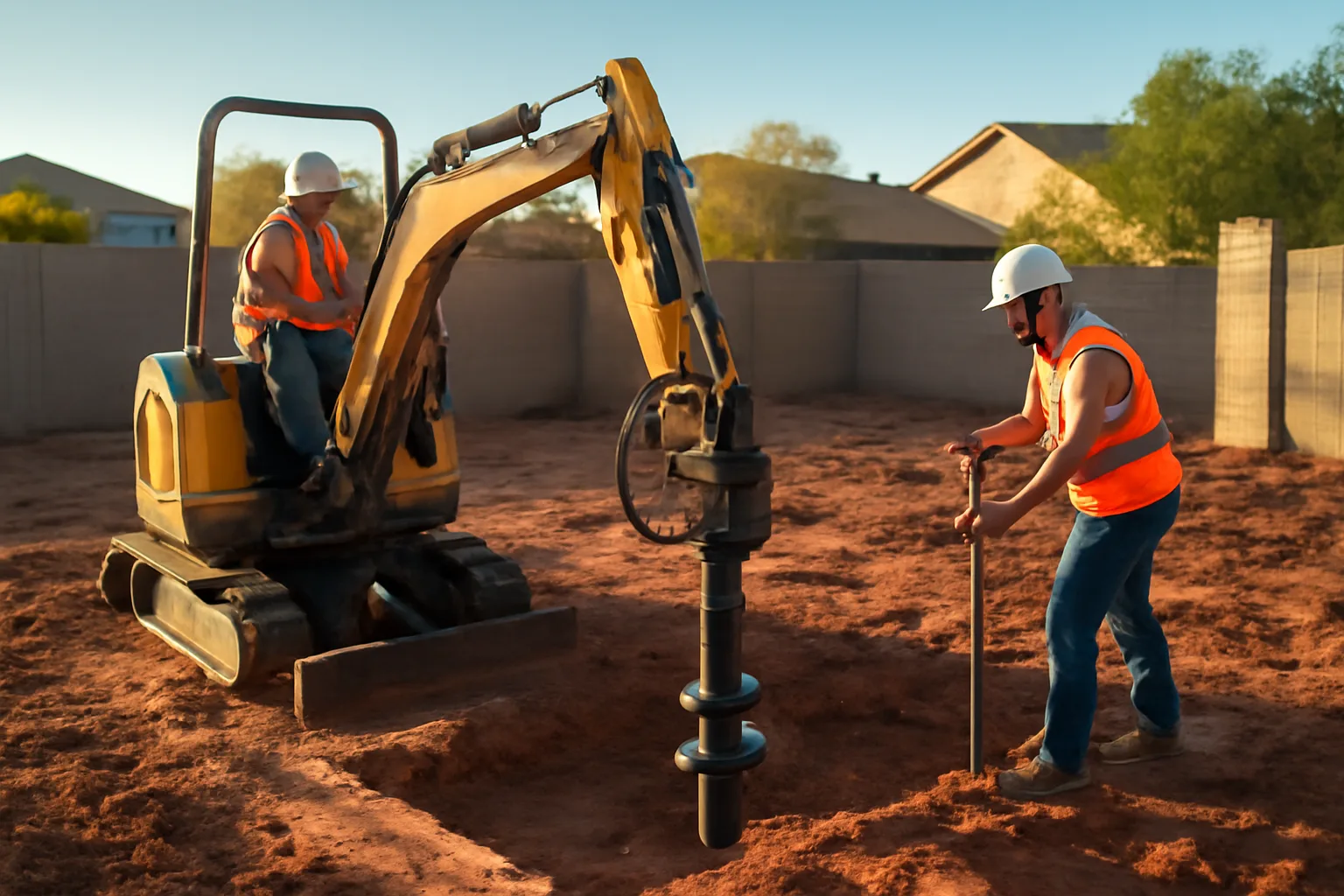
Arizona regulates helical pier installation through the Registrar of Contractors (ROC). You need an ROC license before you can pull permits or bid commercial work. Per-pier costs in Arizona typically run $150 to $350 installed, and a residential job with 8 to 12 piers usually wraps in one to two days. Confirm current fees and exam requirements directly with the Arizona ROC.
Who regulates helical pier work in Arizona?
The Arizona Registrar of Contractors (ROC) is the single licensing authority for structural specialty work in the state, and that includes deep-foundation systems like helical piers. There is no separate "helical pier board" the way a few states run dedicated foundation boards. The ROC handles applications, exams, bond requirements, and complaints under Arizona Revised Statutes Title 32, Chapter 10 [1].
The ROC sorts licenses into two buckets: residential (R licenses) and commercial (C licenses). Helical pier contractors most often go after the CR-9 classification, which covers concrete and masonry specialty work including deep foundations. Some pursue the General Commercial (B-1) or General Residential (B) license if they want to handle the full scope of a repair project [2]. Planning to subcontract pier installation under a general contractor's license? Confirm with the ROC whether your scope still triggers its own specialty license requirement. It usually does.
The ROC's physical offices are in Phoenix and Tucson, with processing centralized in Phoenix. Current fee schedules, exam dates, and bond minimums live at roc.az.gov. Treat anything you read in a third-party article (this one included) as a starting point, not a substitute for confirming with the board directly.
Do you need a license for helical pier work in Arizona?
Yes. Arizona law makes it a misdemeanor to perform contractor work valued above $1,000 without a valid ROC license, and structural foundation work like helical pier installation is covered [1]. The $1,000 threshold includes both labor and materials, so a single residential pier installation almost always clears it.
The license requirement applies whether you're installing piers for new construction, underpinning an existing foundation, or doing slope stabilization. Property owners can sometimes pull permits for work on their own primary residence under a homeowner exemption, but that exemption does not let them hire unlicensed subs. If you're setting up a company to sell helical pier services, the ROC license goes in your name or in the name of a qualifying party (the person who passed the exam and whose experience backs the application).
One practical wrinkle: Arizona's expansive soils and caliche layers make helical piers unusually common here compared to most states. ROC examiners and inspectors know the work well. That helps you once you're licensed. Before you're licensed, it also means they know exactly what to look for.
What ROC license classification covers helical piers in Arizona?
The classification that fits tightest is CR-9, Concrete and Masonry Specialty Contractor. The ROC describes this scope as covering work that is "incidental and supplemental" to a project where concrete or masonry forms the primary material, and deep-foundation pier installation falls inside that scope [2].
Some contractors carry a B (General Residential) or B-1 (General Commercial) license instead, which lets them perform or subcontract the full range of work on a project. Those licenses carry higher experience and financial requirements than a specialty CR-9, so they cost more to get and keep. A third path: if you're doing foundation repair specifically, look at CR-37 (House Moving and Shoring). ROC classification descriptions shift when the board revises its rules, so pull the current classification list from roc.az.gov before you commit to an exam prep track.
Here's the short version of what the ROC requires for most specialty licenses [2][3]:
| Requirement | Typical Threshold (confirm with ROC) |
|---|---|
| Experience (in trade) | 4 years documented |
| Written exam | Trade exam + business management exam |
| Surety bond | $5,000 minimum for residential specialty |
| Liability insurance | $500,000 general liability (varies by class) |
| Application fee | Confirm current amount at roc.az.gov |
| License renewal | Every two years |
How much does helical pier cost in Arizona?
Installed helical pier costs in Arizona typically land between $150 and $350 per pier for residential foundation repair. The wide range comes from pier depth, soil conditions, mobilization distance, and how many piers are on the job [4]. A small house in the Phoenix metro that needs 8 to 12 piers to stabilize a settling foundation commonly runs $2,500 to $6,000 all-in. Jobs with difficult caliche layers or deep load-bearing soil push higher.
Arizona's geology adds a real variable. Caliche, the calcium carbonate hardpan found across the Sonoran Desert, can demand hydraulic torque heads rated above what standard equipment delivers, and that specialty rental or ownership cost gets passed to the customer. Contractors working regularly in Tucson or the Prescott Valley often own higher-torque drive heads because of local soil.
Commercial helical pier work is priced differently, usually by the engineer's load specification and total linear footage of shaft rather than a flat per-pier rate. On a small commercial project you might see per-pier costs of $300 to $800 or more depending on shaft diameter, helix configuration, and load capacity.
Driven concrete pile installation in Arizona typically starts around $400 to $600 per pile installed [4]. That gap explains why helical piers have become the default for residential repair. They install faster, need no curing time, and run on smaller equipment that works better in tight residential lots.
How long does a helical pier job take in Arizona?
For a typical residential foundation repair, the installation itself takes one to two days on site. A crew of two or three can set 8 to 15 piers in a day under normal conditions. That timeline assumes the engineer has already stamped the design, permits are in hand, and the site is accessible for a skid-steer or mini-excavator [5].
The total project timeline, from signed contract to final inspection, usually runs two to four weeks. The delay is almost never the installation. It's the sequence: soil report or geotech review, engineer's pier schedule, permit application at the local municipality, permit approval (which varies by city and county in Arizona), installation, then final inspection.
Municipal permit timelines in Arizona vary a lot. The City of Phoenix Building Services processes many permits online and can turn around straightforward structural permits in a few days. Smaller jurisdictions in rural Arizona or Maricopa County unincorporated areas may take longer. Check with the specific authority having jurisdiction (AHJ) for your project location. Nobody can honestly guarantee permit speed.
Weather rarely shuts down helical pier installation in Arizona the way it does up north. Summer heat affects crew scheduling and early-morning start times, but it doesn't stop the work. Winter is the most productive installation season in the low desert.
What is the ROC application process in Arizona?
The application process at the Arizona ROC runs in a predictable sequence, though processing times shift with application volume [3].
Start by verifying which license classification fits your planned scope of work. The ROC publishes a classification list online and staffs a helpline for classification questions. Next, document your experience. You need four years in the trade (for most specialty licenses), and the ROC wants specific project references showing that work, more than an employer letter. Then pass two exams: a trade-specific exam covering technical knowledge and a business management exam covering Arizona contractor law, lien law, and safety. The trade exam for foundation or concrete specialty work covers soil behavior, load transfer, and relevant code. Secure your surety bond and certificate of insurance before you submit. Then submit the application with fees. Current fee amounts are at roc.az.gov because they change by legislative session [3].
The ROC also runs a license lookup tool at roc.az.gov where anyone can verify a contractor's current license status, bond status, and complaint history. Homeowners use it. Building departments use it. Get licensed and make sure your entry looks clean before you solicit work.
Do Arizona helical pier jobs require an engineer's stamp?
Most commercial helical pier installations in Arizona require a stamp from a Professional Engineer (PE) registered in Arizona. The engineer specifies the pier schedule: shaft diameter, helix configuration, target installation torque, and depth to bearing strata [5].
Residential work is more variable. Some municipalities require an engineer's stamp on any foundation repair, full stop. Others accept a manufacturer's load chart and a prescriptive design if the pier model is ICC-approved. The International Building Code (IBC), which Arizona adopts with local amendments, addresses deep foundation design in Chapter 18. The specific edition your local authority has adopted drives what the permit desk will accept, so confirm the current edition and any amendments with your local building department [5].
If you're building a helical pier contracting business, a relationship with one or two geotechnical or structural PEs in your market area is money well spent. Jobs move faster, engineers who know your crew are easier to deal with, and the paper trail protects you if a foundation problem surfaces later.
For contractors putting together bid packages, the HelicalPath Stamp + Bid-Math Kit at helicalpath.com/start is one reference tool for structuring the documents an engineer and a permit desk will actually accept, at $199 one-time.
How does Arizona compare to neighboring states for helical pier licensing?
Arizona's ROC model is more centralized than some neighbors and looser than others.
Colorado runs a similar statewide contractor registration system but layers in local licensing in many municipalities, so you can be Colorado-registered and still need a city license in Denver or Colorado Springs see helical pier board in colorado. California's Contractors State License Board (CSLB) is often cited as the most demanding in the west, with its own classification structure and higher bond requirements see helical pier board in california.
Florida regulates foundation contractors at the state level with separate specialty classifications and continuing education requirements see helical pier board in florida. Georgia and Alabama run lighter-touch state licensing but strong county-level permit requirements see helical pier board in georgia and helical pier board in alabama.
For someone deciding where to base a helical pier contracting business, Arizona's ROC is relatively straightforward: one board, clear classifications, online systems, and no continuing education requirement at renewal (unlike some states). The main friction is the exam itself, specifically the business management portion, which covers Arizona-specific lien law in detail.
| State | Licensing body | CE required at renewal? | Separate foundation classification? |
|---|---|---|---|
| Arizona | ROC | No | CR-9 specialty |
| California | CSLB | No | C-61/D-12 specialty |
| Colorado | DORA + local | Varies | Yes, local variance |
| Florida | DBPR | Yes (14 hrs) | Yes |
| Georgia | State Licensing Board | No | General + county |
| Alabama | ALBC | No | General license |
What bond and insurance does Arizona require for helical pier contractors?
The Arizona ROC requires a surety bond as part of the license application. For residential specialty licenses like CR-9, the minimum bond amount is set by statute and the board can raise it. Recent published schedules put the residential specialty minimum at $5,000, though commercial classifications carry higher bond requirements [1][3]. These numbers change, so treat them as a floor and confirm the current requirement with the ROC before you buy your bond.
The bond protects consumers, not you. It gives a homeowner a limited recovery path if you abandon a job or cause damage and can't or won't pay. A $5,000 bond does not cover a serious foundation repair gone wrong, which is why your general liability policy matters more as real protection. The ROC requires proof of general liability insurance at minimum coverage levels that vary by license class.
Workers' compensation is separate. Arizona requires it for any employer with employees [7]. Operate as a sole proprietor with no employees and you can apply for an exemption from the Arizona Industrial Commission, but the moment you hire even part-time help on a job, you need coverage.
Many helical pier contractors in Arizona carry $1,000,000 per occurrence / $2,000,000 aggregate on their GL policy. That's not an ROC requirement for specialty licenses. It's what larger general contractors and commercial clients require before letting you on their site.
What soil conditions in Arizona affect helical pier design?
Arizona has some of the most variable soils in the country for foundation work, and they hit pier design and cost directly.
Expansive clays are common across the greater Phoenix metro and in parts of Tucson. Maricopa County soils include montmorillonite-rich clays that can swell six percent or more by volume when wetted [8]. Helical piers have to reach below the active zone (the depth where soil moisture swings seasonally) to anchor in stable material. In some Phoenix-area neighborhoods, that means 15 to 25 feet of shaft.
Caliche, layered across the Sonoran Desert, is the other big variable. Dense caliche can stop a standard helical pier drive head cold. In caliche-heavy areas, predrilling through the hardpan before setting the pier is sometimes the only practical approach. That predrilling adds time and equipment cost.
Collapsible soils, particularly alluvial fan deposits in the Phoenix basin, behave the opposite way. They're strong until saturated, then compress suddenly. Helical piers work well here because they drive through collapsible layers into competent gravel below without disturbing the existing foundation.
Any helical pier job in Arizona without a geotech report is taking a real risk. The soil variability is too high to design blind.
Where can you take the Arizona ROC contractor exam?
Arizona ROC exams are administered by PSI Exams, a national testing company [10]. You schedule through PSI's online portal after your ROC application is accepted or while you're still preparing (you don't have to wait for approval to schedule). Testing centers are open in Phoenix, Tucson, and Flagstaff, with some availability elsewhere.
The two exams you need are the trade exam (specific to your classification, e.g., concrete/masonry specialty) and the Arizona Business Management exam. The business management exam covers Arizona contractor licensing law, the Arizona mechanics' lien law under Title 33, OSHA requirements, and contract basics [1].
Study materials come from PSI and several private exam prep providers. The lien law section catches a lot of first-time test takers because Arizona's preliminary notice and lien deadline rules are specific and tested in detail. Under A.R.S. Section 33-992.01, a contractor must serve a preliminary 20-day notice on the owner and construction lender within 20 days of first furnishing labor or materials to preserve lien rights [9]. That kind of procedural rule shows up on the exam and in real practice.
Passing scores and attempt limits are set by the ROC and published on roc.az.gov. Confirm those when you register.
How do you look up a licensed helical pier contractor in Arizona?
The ROC's online license lookup at roc.az.gov lets anyone search by contractor name, ROC license number, business name, or owner name [3]. Results show license classification, current status (active, expired, suspended), bond status, and any complaint or disciplinary history.
For homeowners hiring a helical pier contractor, the ROC lookup is the single most useful due-diligence step. A license can be expired or suspended even while the contractor is actively marketing. Bond lapses are common, and they mean you lose the consumer protection the bond was supposed to provide.
Building departments in Arizona routinely check ROC status before issuing permits. If a contractor's license lapses mid-project, you can end up with a stop-work order until the issue is resolved. That's a delay nobody needs on an active foundation repair.
For contractors in other states eyeing Arizona expansion, the ROC's reciprocity policy is limited. Arizona does not have broad reciprocal licensing agreements with other states for specialty contractor classifications, so a California or Colorado license does not automatically qualify you here. You go through the standard application process. Details at roc.az.gov.
Getting your paperwork right before you bid
The biggest mistake new helical pier contractors make in Arizona is winning their first job before their paper is in order. You need your ROC license active, your bond and insurance certificates current, and your preliminary notice process understood before you sign a contract.
Bidding the job correctly is the other half. Helical pier bids carry real variables: mobilization, pier count, target depth, soil report costs, permit fees, and the engineer's fee if required. Underestimate any of those on a fixed-price contract and it's a direct loss.
The HelicalPath Stamp + Bid-Math Kit (helicalpath.com/start, $199 one-time) is built around this exact problem, with bid-building math and the document checklist that permit desks and engineers expect. It's not a substitute for legal advice or for confirming current ROC requirements, but it gives you a structured starting point when you're putting together your first serious package.
Frequently asked questions
Do you need a license for helical pier work in Arizona?
Yes. Arizona Revised Statutes Title 32, Chapter 10 requires a Registrar of Contractors (ROC) license for any structural specialty work including helical pier installation where the job value exceeds $1,000. The closest classification is CR-9 (Concrete and Masonry Specialty). Working without a license is a misdemeanor. Confirm current requirements at roc.az.gov.
How much does helical pier cost in Arizona?
Residential helical pier installation in Arizona typically runs $150 to $350 per pier installed. A standard foundation repair job with 8 to 12 piers comes to roughly $2,500 to $6,000 all-in. Costs rise with deep caliche layers, long mobilization distances, or commercial load requirements. Commercial jobs are often priced by shaft footage and engineering specification, not a flat per-pier rate.
How long does a helical pier job take in Arizona?
Installation itself is one to two days for a typical residential job of 8 to 15 piers. Total project time from contract to final inspection is usually two to four weeks, with most of the delay coming from the permit process, not the installation. Municipal permit speed varies significantly across Arizona, so check with your specific building department.
What ROC license classification covers helical piers?
CR-9, the Concrete and Masonry Specialty Contractor classification, is the most common fit for helical pier installation. Some contractors carry a General Residential (B) or General Commercial (B-1) license instead, which requires meeting higher experience and financial thresholds. CR-37 (House Moving and Shoring) sometimes applies to foundation repair scopes. Confirm the right classification for your specific work with the ROC.
How much is the ROC license fee in Arizona?
The ROC fee schedule changes periodically and is set by statute and board rule. Do not rely on third-party articles for a current number. Check roc.az.gov for the current application fee, exam fee, and renewal fee for your license classification. As a general reference, specialty contractor application fees at most state boards run in the low hundreds of dollars, but confirm directly.
Does Arizona require continuing education to renew an ROC license?
As of the most recent published requirements, Arizona does not mandate continuing education for most ROC specialty contractor license renewals, which is different from states like Florida. Renewal is required every two years and requires keeping your bond and insurance current. Confirm at roc.az.gov because board rules can change between publication dates.
Does Arizona have reciprocal licensing for contractors from other states?
Arizona does not have broad reciprocal licensing agreements for specialty contractor classifications. A license from California, Colorado, or another state does not qualify you to work in Arizona. You must go through the standard ROC application process including the trade exam and business management exam. Contact the ROC for details on any narrow agreements that may exist.
Do helical pier jobs in Arizona require an engineer's stamp?
Commercial helical pier installations almost always require a stamp from a licensed Arizona PE. Residential requirements vary by municipality. Some cities require an engineer's stamp on any foundation repair; others accept a manufacturer's load chart for prescriptive designs. The applicable IBC edition adopted by your local authority having jurisdiction determines the permit desk's requirements.
What bond does a helical pier contractor need in Arizona?
The ROC requires a surety bond as part of the license application. For residential specialty licenses, the published minimum has been $5,000, though commercial classifications carry higher requirements. Bond minimums are set by statute and can change. Confirm the current amount with the ROC before purchasing your bond. The bond protects consumers, not the contractor.
How does Arizona's caliche affect helical pier installation?
Caliche, the calcium carbonate hardpan common across the Sonoran Desert, can stop standard helical pier drive heads. Contractors working in caliche-heavy areas sometimes need to predrill through the layer before setting the pier, adding time and equipment cost. This is one reason per-pier costs in parts of Arizona run toward the high end of the national range.
Where do I take the Arizona ROC contractor exam?
ROC exams are administered by PSI Exams at testing centers in Phoenix, Tucson, Flagstaff, and other locations. You need to pass both the trade exam for your classification and the Arizona Business Management exam. Schedule through PSI's online portal. The business management exam covers Arizona lien law in detail, including the 20-day preliminary notice requirement.
How do I verify a helical pier contractor's license in Arizona?
Use the free license lookup tool at roc.az.gov. Search by contractor name, business name, or ROC number. The results show license status, classification, bond status, and any complaint history. Always check before signing a contract, because a license can be expired or suspended even while a contractor is actively marketing.
Can a homeowner do their own helical pier installation in Arizona?
A homeowner exemption exists under Arizona law for work on a primary owner-occupied residence, but it is narrow and does not allow hiring unlicensed subcontractors. Practically speaking, most homeowners lack the equipment (skid-steer with a hydraulic torque head) and engineering knowledge to install piers safely. Most Arizona building departments also require a permit and inspection for any foundation work.
What is the Arizona ROC's preliminary 20-day notice requirement?
Under A.R.S. Section 33-992.01, a contractor must serve a preliminary 20-day notice on the owner and construction lender within 20 days of first furnishing labor or materials on a project to preserve mechanics' lien rights. Missing this deadline eliminates your lien rights regardless of how much you're owed. This rule is tested on the ROC business management exam and matters in real practice.
Sources
- Arizona Revised Statutes, Title 32 Chapter 10, Registrar of Contractors: Arizona requires an ROC license for contractor work over $1,000 and working without one is a misdemeanor under Title 32 Chapter 10
- Arizona Registrar of Contractors, License Classifications: CR-9 Concrete and Masonry Specialty Contractor classification covers deep foundation work including helical piers
- Arizona Registrar of Contractors, Licensing Information: ROC application process, exam requirements through PSI, bond minimums, and fee schedules for specialty contractor licenses
- RS Means Building Construction Cost Data, 2024 Edition (Gordian): Installed helical pier costs for residential foundation repair typically range from $150 to $350 per pier; driven concrete piles typically start at $400 to $600 per pile
- International Code Council, International Building Code 2018, Chapter 18 Soils and Foundations: IBC Chapter 18 governs deep foundation design including engineer specification requirements for helical piers on commercial projects
- Arizona Industrial Commission, Workers' Compensation Requirements: Arizona requires workers' compensation insurance for any employer with employees; sole proprietors with no employees may apply for exemption
- Arizona State University, Ira A. Fulton Schools of Engineering, Geotechnical Engineering Research: Maricopa County soils include montmorillonite-rich expansive clays documented to swell six percent or more by volume when wetted
- Arizona Revised Statutes, Section 33-992.01, Preliminary Notice Requirement: Contractors must serve a preliminary 20-day notice on owner and lender within 20 days of first furnishing labor or materials to preserve mechanics' lien rights
- PSI Exams, Arizona Registrar of Contractors Candidate Information: PSI Exams administers ROC trade and business management exams at testing centers in Phoenix, Tucson, Flagstaff, and other Arizona locations