Last updated 2026-08-18
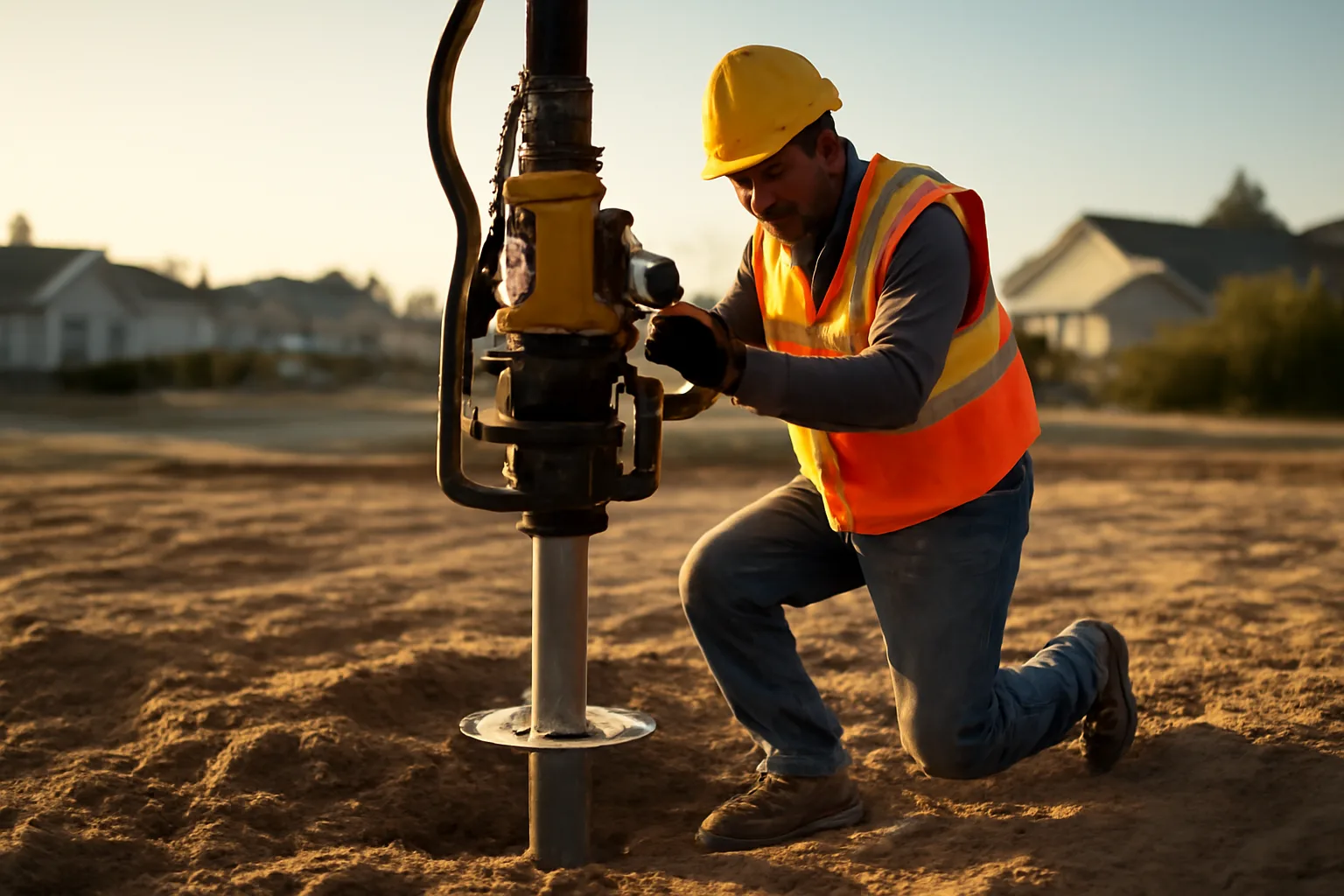
TL;DR
In California, helical pier installation is contractor work regulated by the Contractors State License Board (CSLB). You need at minimum a Class B General Building contractor license, or a C-12 Earthwork and Paving specialty license, before you can legally contract for helical pier jobs. Expect roughly $450 to $600 in CSLB application and license fees, plus a $15,000 surety bond. Confirm current fees with the CSLB before filing.
Do you need a license to install helical piers in California?
Yes. Full stop.
Helical pier installation involves excavation, structural foundation work, and often ground-penetrating drilling. California treats this as licensed contractor work under the Contractors State License Law, California Business and Professions Code sections 7000-7191.10. [1] Contracting without a valid CSLB license on a job over $500 in combined labor and materials is a misdemeanor under B&P Code section 7028. [2]
Two license classifications cover helical pier work most directly: the Class B General Building Contractor license and the C-12 Earthwork and Paving Specialty Contractor license. C-12 covers excavation, grading, and substructure work including driven and drilled piles. If your business will do primarily helical pier installation as a specialty trade (and not frame or finish work), C-12 is the tighter fit. If you plan to offer broader foundation repair, seismic retrofitting, or building stabilization alongside pier installation, a Class B may serve you better because it lets you self-perform specialty trades that make up less than half the contract value. [1]
Some helical pier contractors in California hold both. That is not unusual for firms doing commercial work where general contractors expect you to carry a B.
If you work as a W-2 employee of a licensed contractor, you do not personally need a license. The contractor of record carries it. This distinction matters a lot for people entering the trade through a single employer before branching out.
Which CSLB license classification is right for helical pier work?
The CSLB publishes a classification description for each license. [3] For helical pier contractors, the practical choice comes down to three options.
| License | What it covers | Best for |
|---|---|---|
| C-12 Earthwork and Paving | Excavation, grading, driven/drilled piling, substructure work | Pure helical pier specialty contractors |
| C-61/D-06 Concrete Related Services | Concrete repair and related substructure; narrower scope | Rare; unlikely to cover full pier installation |
| Class B General Building | Broad construction; can subcontract specialty trades or self-perform if <50% of contract value | Full-service foundation repair or retrofit firms |
The CSLB defines the C-12 scope this way: "Excavation, grading, trench excavation...and the placing of riprap and other protective covers, the construction and installation of underground utilities...and includes all piling work." [3] Helical piers are piling work. That language fits.
Unsure which classification your planned work falls under? CSLB has a classification lookup tool and a legal division that issues written interpretations. Use them. Getting licensed in the wrong classification and then performing out-of-scope work is still a violation.
One more thing. California requires that the Responsible Managing Employee (RME) or Responsible Managing Officer (RMO) who qualifies the license have at least four years of journey-level experience in the classification within the past ten years. [4] "Journey-level" means you were doing the actual trade work, more than managing it. The CSLB can and does audit this.
What are the CSLB exam and application requirements?
Every CSLB license has two exams: a Law and Business exam (required for everyone) and a Trade exam (specific to your classification). Both run through PSI Services under contract with the CSLB. [4]
The Law and Business exam covers contract law, business management, safety, lien law, and workers' compensation basics. The Trade exam for C-12 covers earthwork and piling methods, equipment, soil mechanics, safety codes, and project management. You can prepare with CSLB-approved study materials, but the exams themselves are closed-book, timed, and computer-administered at PSI test centers.
To apply, you file a CSLB application (the Original Application for Contractor License, Form 13A-11), pay the application fee, submit your experience verification, and wait for approval to test. As of the most recent published CSLB fee schedule, the initial application fee is $450 and the initial license fee (paid after passing) runs in the $200 range depending on license type. Confirm the exact current figures at cslb.ca.gov before filing. CSLB fees change, and the board is the only authoritative source. [4]
California also requires you to show workers' compensation insurance (or a valid exemption if you have zero employees) and a $15,000 contractor's surety bond before a license will issue. [5] The bond is not a one-time fee. It's an annual premium, usually $100 to $200 per year for a clean applicant.
How much does a helical pier license cost in California?
There's no single number, because the cost stacks across several line items. Here's an honest estimate of what you'll spend getting licensed, more than the filing fees.
Application fee to CSLB: about $450 (confirm current figure with CSLB). [4]
Initial license fee after passing: about $200 (again, confirm). [4]
PSI exam scheduling fee: varies by exam. Budget $60 to $100 per sitting. Fail and reschedule, and that fee repeats.
Contractor's surety bond ($15,000 bond): roughly $100 to $200 per year depending on your credit. [5]
General liability insurance: California doesn't set a statutory GL minimum for most license classes, but virtually every commercial or residential customer will require at least $1 million per occurrence. Annual premiums for a small specialty foundation contractor in California run $3,000 to $8,000 or more depending on payroll, revenue, and loss history. Get quotes from contractors' insurance specialists, not general agents.
Study materials: CSLB-approved prep ranges from free (CSLB's own practice materials) to $300 to $500 for third-party courses.
So the realistic first-year cost to become a licensed California helical pier contractor, before you buy a single tool or truck, is roughly $4,000 to $10,000 once you include insurance. The filing fees alone are manageable. Insurance is where new entrants consistently underestimate.
The CSLB license renews every two years. Renewal fees are currently in the $450 range for active licenses. Dormant licenses cost less but restrict what you can contract. [4]
How long does getting a helical pier license in California take?
Plan for four to six months minimum from the day you mail your application to the day you hold an active license. That estimate assumes no complications.
Here's roughly how it breaks down. CSLB application review currently takes eight to ten weeks for a complete application, though processing times move around and the board posts current estimates on its website. [4] Once your application clears, you receive an Authorization to Test letter. You then schedule your exams through PSI. Availability varies by test center and season, but you can often get a slot within two to four weeks. Results come immediately on computer-administered exams.
After you pass both exams, you submit your bond and insurance documents and pay the license fee. CSLB issues the active license, usually within two to four weeks of receiving complete post-exam paperwork.
The most common delay is an incomplete application: missing experience verification, an RME/RMO whose four-year experience documentation doesn't fully satisfy the board, or fingerprint clearance issues. Fingerprinting through CSLB is required for all applicants (DOJ and FBI), and background clearance can add four to eight weeks if there are any records to review. [4]
Fail the Trade exam and there's a waiting period before you can retest. That can add months. CSLB does not publish pass rates for specialty contractor exams, so there's no reliable base rate to quote here. Study seriously.
Do you need a C-12 license or a general contractor B license for helical piers?
This is the question most new California helical pier contractors wrestle with, and the honest answer is: it depends on your business model.
If you plan to be a pure-play specialty subcontractor, bidding helical pier work to GCs and foundation repair firms, C-12 is the cleaner path. Your scope is tight, your exam is trade-focused, and you're not operating outside your classification.
Want to take projects direct from homeowners or building owners that include more than the pier installation but also the crawl space repair, concrete work, or structural framing around it? You probably need a B. Under California law, a B contractor can self-perform specialty trades on a project as long as no single specialty trade makes up more than half the contract value. [1] That's useful for foundation repair jobs that blend earthwork, concrete, and light framing.
Some contractors hold a B and a C-12. That's not overreach. It's common for firms that do both GC-level foundation projects and also bid as specialty subs when that's the better margin.
What you should not do: get a C-12 and then start doing work that clearly exceeds its scope (concrete slab work, structural framing) without qualifying for the additional classification. The CSLB investigates complaints, and working out of classification can result in license suspension.
What are the insurance and bond requirements for California helical pier contractors?
California mandates a $15,000 contractor's surety bond for all licensed contractors. [5] This bond protects consumers if you abandon a project or violate the Contractors State License Law, not if you cause property damage. It's no substitute for general liability insurance.
General liability insurance is not mandated by the CSLB for most license classes, but the market requires it anyway. Homeowners, property managers, and general contractors will ask for a certificate of insurance before signing anything. For helical pier work, you want coverage that specifically does not exclude "earth movement" or "subsidence," because that's exactly the work you're doing. Many standard GL policies contain earth movement exclusions. Specialty contractors' policies written for foundation work typically delete or modify those exclusions. Read the policy, more than the price.
Workers' compensation is required if you have any employees. [5] If you're a sole owner with no employees, you can file a workers' comp exemption with the CSLB, but the moment you hire someone, you must have coverage.
For commercial work, contract-required insurance limits often run $2 million per occurrence and $5 million aggregate. Price GL insurance accordingly. You don't want to win a commercial bid and then find out your $1M policy won't satisfy the contract.
Some helical pier specialty contractors in California also carry professional liability (errors and omissions) insurance, particularly if they provide engineered designs or load calculations alongside installation. E&O for contractors is a separate policy form and runs $2,000 to $5,000 per year for small firms. It's optional unless a client requires it, but worth evaluating.
How much does helical pier installation cost in California as a project?
This answers the question from the customer's side, which is useful context for contractors pricing their first California bids.
Helical pier installation costs in California vary by soil conditions, project depth, load requirements, and whether the local building department requires engineering drawings. Industry sources put typical residential helical pier costs nationally at $1,500 to $3,000 per pier installed, with California markets often running higher because of labor costs, permit requirements, and seismic engineering reviews. [6]
A standard residential foundation repair using helical piers might need 6 to 15 piers depending on the structure's load and the extent of settling. That puts a typical California residential project in the $10,000 to $45,000 range before permits and engineering. Commercial projects scale up from there.
For the contractor, California's prevailing wage laws apply to public works projects over $1,000 in total value. [7] Do any public works (school districts, municipalities, utilities) and you must pay prevailing wages for the applicable trade classification and file certified payroll records. The Department of Industrial Relations publishes current prevailing wage determinations by county. [7] This matters enormously for job costing. Prevailing wage for heavy construction equipment operators and laborers in California can exceed $80 to $100 per hour in total package value.
California also requires public works contractors to register with the Department of Industrial Relations (DIR) as a Public Works Contractor before bidding public work. [8] The registration fee is $400 per year (confirm current amount with DIR). This is separate from your CSLB license.
What other California registrations or permits does a helical pier contractor need?
Your CSLB license is the baseline, not the complete picture for operating a helical pier business in California.
City and county business licenses: most California cities and many counties require a local business license separate from your state contractor's license. These typically run $50 to $200 per year and are administered by the city or county clerk. Some cities (Los Angeles, for one) have their own contractor registration requirements on top of the CSLB license.
Building permits: helical pier installation almost always requires a building permit. [9] The permit is pulled for the specific project, usually by the contractor (though the property owner can pull it in some jurisdictions). Permit fees vary by local agency. In California they're often based on project valuation and range from a few hundred to several thousand dollars per project. Engineered plans are frequently required for commercial work and for residential work exceeding certain depths or loads.
California Environmental Quality Act (CEQA): for large commercial or public projects, environmental review may be triggered. This is uncommon for standard residential helical pier work but worth knowing for larger contracts.
Public Works Contractor Registration (DIR): required to bid any public works project, as noted above. [8]
Seller's permit from the California Department of Tax and Fee Administration (CDTFA): if you sell materials as a separate line item on contracts (some contractors do), you may need a seller's permit. Most specialty contractors in California structure work as a lump-sum construction contract, which has different sales tax treatment. Talk to a California CPA familiar with contractor taxation before deciding how to structure your contracts.
How does California's CSLB license compare to neighboring states?
Looking at California and wondering how it stacks up against nearby states for entry difficulty? Here's a practical comparison.
| State | Primary License | Exam Required | Bond | Notes |
|---|---|---|---|---|
| California | C-12 or B (CSLB) | Yes, Law+Trade | $15,000 | Strictest in region; four-year experience requirement |
| Arizona | ROC specialty or general contractor | Yes | $5,000-$15,000 | ROC license; reciprocity with some states |
| Nevada | C-12A or B-2 (NSCB) | Yes | $50,000 | Higher bond; active experience verification |
| Oregon | CCB General or Specialty | Yes | $15,000-$20,000 | CCB license; LCB exam |
California is broadly considered among the harder states to license in because of exam difficulty, the four-year experience documentation requirement, and the processing timeline. Nevada requires a higher bond but processes applications somewhat faster. Arizona's ROC has a reputation for responsive application review.
None of these states have license reciprocity with California, meaning a California CSLB license does not waive exam requirements in other states, and vice versa. You start from scratch in each state you want to work. [10]
Deciding whether to start operations in California or a neighboring state first? Be honest about where your experience documentation is strongest and where your first customers are. Licensing in the right state on your first try saves months.
If you're mapping out first-year operational costs and bid math before you file, the Helical Pier Stamp + Bid-Math Kit at HelicalPath is built for exactly that pre-application stage: one flat fee, and it walks you through the numbers before you commit to a state.
What are the continuing education and renewal requirements for California helical pier licenses?
California does not require continuing education for most contractor license classifications as a condition of renewal. [4] That's different from many other professional licenses in California (real estate or insurance, for example) and from contractor licenses in some other states.
Your CSLB license renews every two years. The renewal is administrative: you pay the renewal fee (currently in the $450 range for an active license; confirm with CSLB), your bond must stay active, and your workers' compensation coverage must stay current if you have employees. No re-examination at renewal.
The one place ongoing training matters for California helical pier contractors is OSHA. Cal/OSHA (California's state OSHA program) sets excavation, trenching, and shoring safety standards that apply to helical pier work. [11] Cal/OSHA enforces these standards and inspects worksites. There's no annual CE requirement from the CSLB for your license, but staying current on Cal/OSHA's Title 8 excavation standards (specifically sections 1541 and 1541.1) is not optional in practice. It's how you avoid citations, fines, and liability when something goes wrong on a job site.
Many helical pier contractors in California pursue manufacturer-specific training through pier system makers (Chance, Hubbell, MacLean, and others run installer certification programs). These aren't required by the CSLB, but they can matter for warranty coverage on installed systems and for differentiation when bidding engineered projects.
Ready to map your first year: what to do before you file
Before you fill out a CSLB application, do three things.
First, audit your experience documentation. The four-year journey-level experience requirement is where applications die. Pull your old W-2s, call former employers, and get letters now. The CSLB may verify directly with your listed employers. Gaps in documentation are hard to patch after you've filed.
Second, get real insurance quotes. Call two or three contractors' specialty insurance brokers and get actual quotes for GL coverage that covers earth movement and pile installation in California. The gap between what people guess this costs and what it actually costs is large enough to change whether your first year turns a profit.
Third, build your bid math before you win your first job. Overhead allocation, prevailing wage triggers, permit allowances, and mobilization costs are where new California helical pier contractors consistently under-price early projects. HelicalPath's Stamp + Bid-Math Kit (/start) won't file your license for you, but it's a solid tool for running those first-year numbers before you commit.
For contractors in neighboring states comparing entry paths, the helical pier license in Arizona guide and how to start helical pier in Colorado walk through comparable requirements.
Frequently asked questions
Do you need a license for helical pier installation in California?
Yes. California requires a valid CSLB contractor's license for any work over $500 in combined labor and materials. For helical pier installation, the C-12 Earthwork and Paving specialty classification or a Class B General Building Contractor license covers this work. Contracting without a license is a misdemeanor under California Business and Professions Code section 7028. Confirm current requirements at cslb.ca.gov.
What CSLB classification covers helical pier work?
The C-12 Earthwork and Paving classification most directly covers helical pier installation because it includes all piling work and substructure excavation. A Class B General Building Contractor license also covers helical pier installation within broader construction projects. Some contractors hold both. The right choice depends on whether you plan to specialize in piers only or also handle broader foundation repair and structural work.
How much does a CSLB contractor license cost in California?
The CSLB application fee is about $450 and the initial license fee after passing is about $200, though both figures change and you should confirm current amounts at cslb.ca.gov. Add a $15,000 surety bond (roughly $100 to $200 per year in premiums), PSI exam fees, and general liability insurance. Realistic first-year licensing costs including insurance range from $4,000 to $10,000 or more.
How long does it take to get a CSLB license in California?
Four to six months is a realistic minimum for a complete application with no complications. CSLB application review currently takes roughly eight to ten weeks, followed by exam scheduling, exam sittings, and post-exam paperwork. Incomplete experience documentation, fingerprint clearance delays, or a failed exam sitting can add months. Check current CSLB processing estimates at cslb.ca.gov before planning your business launch date.
How much does helical pier installation cost in California?
Residential helical pier installation in California typically runs $1,500 to $3,000 per pier installed, with California labor markets pushing costs toward the higher end nationally. A standard residential foundation repair using 6 to 15 piers often totals $10,000 to $45,000 before permits and engineering. Commercial projects and those requiring engineered plans cost more. Prevailing wage requirements apply to public works projects regardless of scale.
Does California require continuing education to renew a CSLB contractor license?
No. California does not require continuing education as a condition of renewing most contractor license classifications, including C-12 and Class B. Renewal is administrative: pay the fee, maintain your bond, and keep workers' compensation current if you have employees. Licenses renew every two years. That said, staying current on Cal/OSHA's excavation and trenching standards under Title 8 is practically essential for safe and compliant operations.
Do I need to register with the California DIR separately from my CSLB license?
Yes, if you bid on any public works projects. California requires Public Works Contractor Registration with the Department of Industrial Relations before you can bid or work on public projects over $1,000. The registration fee is currently $400 per year; confirm the current amount with DIR. This registration is separate from your CSLB license and must be renewed annually. Prevailing wage requirements also apply to all public works.
Can I use my California CSLB license to work in Arizona or Nevada?
No. California does not have reciprocity agreements with Arizona or Nevada for contractor licenses. A CSLB license does not waive exam or application requirements in other states. If you want to contract for helical pier work in Arizona, you'll apply to the Arizona Registrar of Contractors. For Nevada, you apply to the Nevada State Contractors Board. Each state is a fresh start. Plan licensing timelines accordingly if you're expanding across state lines.
What is the experience requirement to qualify a California C-12 license?
The Responsible Managing Employee or Responsible Managing Officer who qualifies a CSLB license must document at least four years of journey-level experience in the C-12 classification within the ten years before applying. Journey-level means hands-on trade work, more than supervisory or management experience. The CSLB may verify experience claims directly with former employers, so assemble documentation before filing. Gaps or ambiguous documentation are the most common cause of application delays.
Does a helical pier installer in California need a building permit for each project?
In almost all cases, yes. Helical pier installation is structural foundation work and triggers building permit requirements under local codes in California. The contractor typically pulls the permit. Permit fees are set by local agencies and vary by project valuation and jurisdiction. Commercial projects and projects exceeding certain depths or loads almost always require engineered plans submitted with the permit application. Confirm with the local building department before starting any job.
Is a $15,000 surety bond enough for California helical pier work?
The $15,000 bond is the CSLB's statutory minimum for licensure; it's not sized to cover large project losses. The bond protects consumers from contractor law violations, not from construction defects or property damage. For project protection, general liability insurance (typically $1 million per occurrence minimum) is what matters. Many commercial contracts require $2 million or more. Buy insurance scaled to your project sizes, more than the statutory bond minimum.
What is the difference between a C-12 and a C-61/D-06 license for piling work?
C-12 (Earthwork and Paving) explicitly includes all piling work and is the standard classification for helical pier installation in California. C-61/D-06 (Concrete Related Services) is a limited specialty license narrower in scope, focused on concrete repair and related work. C-61 licenses are more restrictive about what you can self-perform. Most helical pier contractors operating in California who want to bid pile installation as their primary trade should target C-12, not a C-61 specialty.
How do prevailing wage laws affect helical pier contractors in California?
California's prevailing wage laws apply to public works projects valued over $1,000 in total value. If you do any public works, you must pay the applicable prevailing wage for your trade classification and file certified payroll records with the project awarding body. Prevailing wages for relevant classifications (laborers, equipment operators) in California often exceed $80 to $100 per hour in total package value. You must also register with the DIR as a Public Works Contractor before bidding.
Sources
- California Legislative Information, Business and Professions Code section 7057: Class B General Building Contractor can self-perform specialty trades when no single specialty makes up more than half the contract value; contractor license law governs helical pier work
- California Legislative Information, Business and Professions Code section 7028: Operating as a contractor without a valid CSLB license on a project over $500 is a misdemeanor in California
- California Contractors State License Board, C-12 Earthwork and Paving Classification Description: C-12 license covers all piling work including driven and drilled piles; scope includes excavation, grading, and underground substructure work
- California Contractors State License Board: CSLB requires four years journey-level experience; application fees, license fees, exam requirements, renewal cycle, and current processing times for contractor license applications
- California Legislative Information, Business and Professions Code section 7071.6: $15,000 contractor's bond required for all licensed contractors; workers' compensation insurance required for any licensee with employees
- International Association of Foundation Drilling (ADSC): Typical residential helical pier installation costs nationally range from approximately $1,500 to $3,000 per pier installed
- California Department of Industrial Relations, Prevailing Wage: California prevailing wage laws apply to public works projects over $1,000; DIR publishes prevailing wage determinations by county and trade classification
- California Department of Industrial Relations, Public Works Contractor Registration: Contractors must register with DIR as a Public Works Contractor before bidding or working on California public works projects; registration fee is $400 per year
- California Building Standards Commission, California Building Code (CBC) Title 24: Helical pier installation as structural foundation work requires building permits under California Building Code requirements
- California Contractors State License Board, Reciprocity: California has limited contractor license reciprocity and out-of-state licensees must complete CSLB application and exam requirements
- California Department of Industrial Relations, Cal/OSHA Title 8 Section 1541 Excavations: Cal/OSHA Title 8 sections 1541 and 1541.1 set excavation, trenching, and shoring safety standards applicable to helical pier installation worksites