Last updated 2026-08-19
TL;DR
To start helical pier work in Georgia you form a company, get tax IDs, carry insurance, and hold a residential or general contractor license from the Georgia State Licensing Board for Residential and General Contractors for nearly any job priced at $2,500 or more. There is no separate state helical pier license. Manufacturer training helps you install. It does not replace the board card. Confirm current fees and experience rules with the board before you file.
Do you need a license for helical pier in Georgia?
Yes, for almost every real job. Georgia does not sell a helical pier license. Once the bid or contract hits $2,500 or more, the work is treated as residential or general contracting under the State Licensing Board for Residential and General Contractors.[1][2]
That is the whole fight, and it is not close. Sell the job, take the deposit, or hold yourself out as the company putting steel in the ground, and you are the contractor. An employee on someone else's crew is not.
O.C.G.A. § 43-41-17 says: "No person shall have the right to engage in the business of residential contracting or general contracting unless such person has a current, valid residential contractor license or general contractor license, respectively, issued by the division pursuant to this chapter."[1]
Manufacturer installer cards are fine. They are not the board card. A weekend class in a hotel ballroom is not the board card either.
Local occupational tax certificates still stack on top. Atlanta, Gwinnett, Cobb, DeKalb, and most other counties want their own business paper. Confirm those fees at the city or county revenue office. They move, so I will not pretend a blog number is current.
Unlicensed contracting over the threshold is a bad trade. The board can pursue it. A general contractor can drop you mid-job. An insurer can walk away from a claim. Georgia law requires a current residential or general contractor license to engage in that business (O.C.G.A. § 43-41-17).[1] Get licensed, or stay a true employee until you qualify.
What license actually covers helical pier work in Georgia?
Use a residential or general contractor license that matches the buildings you will underpin. Georgia has no helical-only classification. House work usually sits on a residential contractor license. Commercial and mixed structural work usually needs the general contractor path. Confirm current class names and limits on the board application, not on a forum post.[2][3]
The board lives at the Georgia Secretary of State as the Georgia State Licensing Board for Residential and General Contractors.[3] Experience, exams, financial statements, and background checks are in that packet. I am not going to recite a year count or a net-worth figure that may have changed. Open the current forms. If you cannot qualify as the qualifying agent, you are not ready to be the company.
A Georgia professional engineer license is a different statute. Most permitted helical pier jobs need a PE for capacity and drawings. You hire that person. You do not become that person on a dare. Unlicensed engineering is its own offense.[4]
| Path | Typical helical work | Who licenses it | What you confirm |
|---|---|---|---|
| Residential contractor | Houses, townhouses, residential underpinning | Georgia RGC board | Current class, exam, experience rules |
| General contractor | Commercial buildings, larger structural scopes | Georgia RGC board | Financial statement and exam rules |
| Employee on a licensed crew | Learning years, no owner contracts | Employer's board license | That you are a real employee |
| Professional engineer | Capacity, sealed drawings | Georgia PE board | You buy this stamp, you do not fake it |
Work across the line and the Georgia number stops traveling. Read how to start helical pier in Alabama before you assume it does.
How much does helical pier cost in Georgia?
There are two bills, and people mash them together. The homeowner bill is the job. Your bill is the company. Georgia does not publish a statewide helical pier price list. Job price moves with pier count, depth, torque, access, lift, and engineering. No board-quality study pins one Georgia number, and I will not invent one.
Startup cash is more honest if you stick to filings you can actually open.
Georgia Articles of Organization for an LLC are listed at $100 on the Secretary of State how-to guide.[5] Confirm that figure on the live page before you write a check. The IRS EIN is free on IRS.gov.[6] State sales tax starts at 4 percent under O.C.G.A. § 48-8-30, and local add-ons sit on top.[7] Annual registration with the Corporations Division is a separate yearly filing. Confirm the current annual amount on the SOS corporations pages.
Contractor application and exam fees change. Confirm them on the board's current list. Do not budget from a 2019 screenshot.
Insurance will dwarf the filing fees. Foundation and deep-foundation class codes are not cheap. Once you regularly run three or more employees, workers' compensation becomes mandatory under O.C.G.A. § 34-9-2.[8] A used skid steer, a hydraulic drive head, and a torque logger are the real iron bill. Used machine prices swing so hard that a single number would be a lie. Price the rig first.
HelicalPath sells a $199 Stamp + Bid-Math Kit at /start if you want a takeoff worksheet. Every legal step in this article works without it.
Build your Georgia job prices from steel, labor hours, engineering, mobilization, and risk. Not from a national average in an ad.
How long does helical pier take in Georgia?
A normal residential helical pier visit often finishes in one to three field days after the engineer, the permit, and the 811 ticket are in hand. Starting the company takes longer than that first job. Formation can happen in days. The contractor license waits on your experience, the exam date, and the board's backlog. Nobody honest will quote you an approval clock.
Call 811 before you turn a shaft. Georgia's Utility Facility Protection Act requires advance notice before mechanized excavating.[9] Confirm the current notice window on Georgia 811. Do not drill next to a gas service because a homeowner is impatient.
Still short on qualifying experience? Then the clock runs in years of documented work, not a long weekend. If you already qualify, your bottleneck is studying, testing, assembling financials, and waiting. Confirm current processing language with the board. I will not guess a week count.
Permits sit with the local building department. Some metro counties crawl. Some rural offices move same week. Special inspection of helical piles, where the adopted IBC requires it, adds another person on site.[10] Put that day on the calendar.
Steel lead times can wreck a start date worse than the license office. Order shafts after you know depths. Not after a sales call.
How do you form the company before you touch a pier?
Form the entity first. Then tax IDs. Then local business paper. Then insurance. Then the contractor application. That order keeps one legal name on every form.
Most crews use a Georgia LLC. File Articles of Organization with the Secretary of State. The how-to guide lists a $100 filing fee. Confirm it when you file.[5] Get an EIN on the IRS site. The Service says, "Applying for an EIN is a free service offered by the Internal Revenue Service."[6]
Register with the Georgia Department of Revenue if you owe sales and use tax accounts.[7] Hire people, and you open withholding and unemployment accounts too. Confirm current DOR and Labor Department steps on those sites. Portal buttons change. Statutes last longer.
Pick a registered agent who actually picks up mail. The board and SOS send real deadlines there. Use the exact legal name on the license application, the insurance binders, and the permits. Mismatched names are how draws get held.
Skip the trademark lawyer in year one unless someone is already confusing you with a national brand. That money buys better torque monitoring.
What insurance and workers' compensation rules hit first-year crews?
Carry general liability before the first shaft. Auto coverage on the truck and trailer too. Run three or more employees in Georgia on a regular basis and workers' compensation stops being optional. O.C.G.A. § 34-9-2 sets the workers' compensation coverage trigger at three employees.[8]
"Fewer than three" is not a loophole for fake 1099s. Control the work, the hours, and the method, and you likely have employees. Misclassification is how you meet a Labor audit and an injury with no coverage in the same week.
GCs will ask for a certificate naming them additional insured. Many want $1 million per occurrence. That figure is market practice, not a statute I can point to. Ask an agent what foundation-repair and deep-foundation class codes cost this year. Premiums move.
Rented-equipment coverage matters the first time you borrow a larger drive head. One snapped motor can wipe a month of profit.
I would not open a helical pier shop in Georgia on a personal auto policy and a hope. The first claim is a house.
Do helical pier jobs in Georgia need an engineer and a permit?
Most permitted jobs need both. Georgia enforces statewide minimum construction codes through the Department of Community Affairs, and local departments issue the permits.[11] Helical piles live in the International Building Code deep-foundation rules. Capacity and layout should come from a Georgia-licensed professional engineer.[4]
Do not let a manufacturer printout replace a PE stamp when the building official wants a stamp. The software is a tool. The PE takes the responsibility.
IBC Chapter 17 includes special inspection language for helical pile foundations. The inspector checks installation against the approved documents, including torque and depth.[10] ICC-ES AC358 is the acceptance criteria most evaluation reports use for helical pile systems.[12] Keep that report on the truck.
Call 811. Photograph the ticket. Photograph torque. Photograph finished brackets. That packet is what the special inspector actually wants.
Interior underpinning in a finished basement still needs a permit in most jurisdictions. "It is just steel screws" does not work at Cobb or Fulton. If a local official says no permit is required, get that in writing. I would still want an engineer if you are picking up a footing.
What equipment and manufacturer paperwork do you actually need?
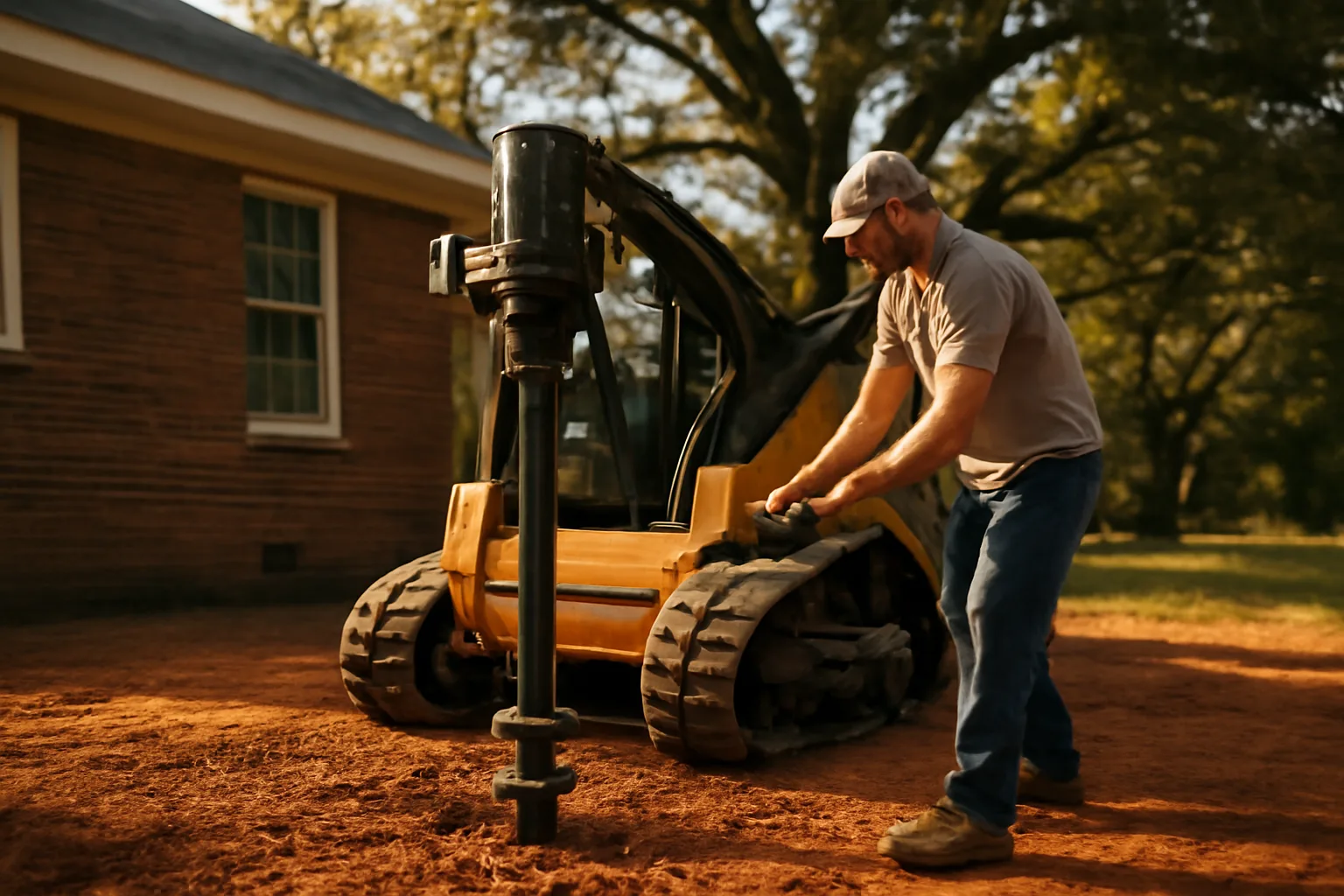
You need a way to apply and measure torque, steel that matches an evaluation report, and brackets that match the engineer. A skid steer or compact track loader with a hydraulic drive head is the usual rig on Georgia residential lots. Tight interiors sometimes need portable drive equipment.
Torque is the control. If you cannot record it, you cannot prove capacity. Buy or rent a logger. Analog-only setups make arguments you will lose.
Manufacturer certified-installer programs are worth a week. They are still not a Georgia license. They help you stay inside the ICC-ES report when you order shafts.[12]
I would not finance a shiny new fleet before you have licensed work. Rent for the first jobs if cash is thin. Watch mobilization math. A two-pier backyard job cannot carry a 90 minute drive and a rented machine unless the price says so.
Safety gear is OSHA Construction under 29 CFR 1926, not a suggestion.[13] Helical work is quieter than driven piles. You still have pinch points, hoses, and holes.
Skip the vinyl wrap until the license number is real.
Can you start as a subcontractor without a state contractor license?
Sometimes, if you are a true employee or you only furnish labor to a licensed contractor who holds the owner contract. Bid the owner, take the deposit, or advertise as the helical pier company, and you are in the licensed activity.[1][2]
Plenty of shops try to live as install-only subs. Some GCs will not let an unlicensed specialty touch a structural scope. Some will. I would not build a company on that maybe.
Want to learn? Get on a licensed crew and keep a job log. Dates, addresses, torque, your supervisor's license number. That file is what the board wants later.
Working next door is a different board. See helical pier license in Alabama if that border work is real. Arkansas is another paper pile entirely. Start with how to start helical pier in Arkansas and helical pier license in Arkansas before you trailer west.
What first-year paper trail do inspectors and GCs ask for?
Expect a stack. State contractor license, or the GC's license if you are truly under them. Local business license. Proof of general liability and workers' comp. EIN. W-9. 811 ticket. Engineer's letter or sealed drawings. ICC-ES report for the pile system. Torque logs. Special inspection reports when required. Lien waivers if you want to get paid on commercial work.
Keep digital copies named by job address. Paper in a wet truck is how you lose the only proof you hit design torque.
Sales tax exemption certificates from GCs get abused. If the steel is taxable, collect or pay it. Confirm current rules with DOR.[7]
OSHA does not mail you a Georgia helical permit. They show up after someone gets hurt. Have the 1926 basics in the truck: a competent person, water, first aid, and trench awareness if you open a pit.[13]
I keep the PE letter and the evaluation report in the same folder as the permit card. Building inspectors should not wait while you call the office.
How does Georgia compare if you also work in other states?
Georgia is a state-license state with a dollar threshold and no helical-specific classification. That is cleaner than states with a maze of specialty boards. It is stricter than states that leave most residential work local.
Alabama sits on your western line and runs its own contractor licensing. Do not hang a Georgia card on an Alabama job and hope. Read the Alabama start guide and the Alabama license page before you bid Phenix City or Dothan.
Colorado, Arizona, and other boards each have their own classification habits. Chasing seasonal work? Start with those guides rather than porting your Georgia file. See how to start helical pier in Colorado, helical pier license in Colorado, and how to start helical pier in Arizona.
The steel and the torque math travel. The license number does not.
What should you ignore when people sell you a helical pier license?
Ignore anyone who says Georgia sold them a helical pier license. The board did not. Ignore national certification upsells that imply you can skip O.C.G.A. Title 43, Chapter 41. Ignore Facebook quotes that treat a weekend class as a substitute for the exam.
Franchise pitches can include real training and a real steel supply. Read the contract. Pay for supply and a name if you want that. Do not pay for a promise that the state will treat you as licensed.
You also do not need a new entity in every metro county. You need the state license plus local business tax certificates where you actually operate.
If a website promises a processing time or a guaranteed pass, close it. HelicalPath is an independent publisher, not a law firm and not a service company. Use the board, the SOS, DOR, and your PE. If you want the bid worksheet later, it is at /start. The rest of this page stands without it.
Frequently asked questions
Do you need a license for helical pier in Georgia?
Yes for almost any job priced at $2,500 or more. Georgia has no helical-only license. The work falls under a residential or general contractor license from the State Licensing Board for Residential and General Contractors. Manufacturer cards do not replace that license. Confirm current classes and fees on the board's application.
How much does helical pier cost in Georgia?
Customer job prices vary with pier count, depth, torque, access, and engineering. There is no official statewide price. Your company filings are clearer: SOS lists LLC articles at $100, the IRS EIN is free, and state sales tax starts at 4 percent. Confirm contractor application fees with the board. Insurance and equipment will dwarf those filings.
How long does helical pier take in Georgia?
A typical residential install often takes one to three field days after permits, engineering, and 811 clearance. Building the company takes longer. Entity formation can happen in days. The contractor license waits on experience, testing, and board processing. Confirm current timelines with the board. Do not trust a guaranteed week count.
Is there a Georgia helical pier contractor classification?
No. The state licenses residential and general contractors. Helical pier work is treated as contracting once you hit the $2,500 threshold. Pick the class that matches the buildings you will support. Confirm the current class names on the Georgia State Licensing Board for Residential and General Contractors application.
Can a handyman install helical piers under $2,500?
Small repair work under $2,500 can fall outside Chapter 41, but stacking invoices or advertising as a pier company is how people trip the statute. Structural work still needs sound engineering. Local permits may still apply. I would not build a business model on staying under $2,500 forever.
Does a manufacturer certification replace the Georgia license?
No. Certified-installer programs from pile makers help you stay inside an ICC-ES report and order the right steel. They are private training. O.C.G.A. § 43-41-17 still requires a current residential or general contractor license to engage in that business. Take the class. Then take the board exam.
Do you need a PE stamp on every helical pier job in Georgia?
Most permitted jobs need a Georgia-licensed professional engineer for capacity and drawings. Building officials often want a stamp, not a sales brochure. You do not need to become the PE. You need a working relationship with one. Unlicensed engineering is a separate violation under Title 43, Chapter 15.
Is workers' comp required for a two-person helical pier crew?
O.C.G.A. § 34-9-2 generally keeps employers with fewer than three employees out of the chapter unless they opt in. Two true employees may sit under that line. Fake 1099s do not. GCs and site owners may still require a policy before you mobilize. Confirm coverage with the State Board of Workers' Compensation and your agent.
Do you have to call 811 before installing helical piers?
Yes before you put mechanized equipment in the ground. Georgia's Utility Facility Protection Act requires advance notice to the utilities protection center. Confirm the current notice window on Georgia 811. Photograph the ticket. Hitting a gas or electric line is not a learning experience you want.
Can you use a Georgia contractor license in Alabama?
No. Alabama runs its own contractor licensing. A Georgia card does not authorize an Alabama contract. If you work the border, read the Alabama start and license guides and apply there separately. The steel travels. The license number does not.
What business entity should you form for helical pier work?
Most first-year crews form a Georgia LLC, file articles with the Secretary of State, and get a free IRS EIN. An LLC is not magic insurance. It is cleaner paper. Confirm the current SOS filing fee on the how-to guide (recently listed at $100) and keep the legal name identical on every later form.
Are building permits required for residential underpinning in Georgia?
Usually yes. Local building departments enforce Georgia's statewide minimum codes, including IBC deep-foundation rules. Interior basement piers still get permitted in most metro counties. If an official says no permit is required, get it in writing. I would still want an engineer if a footing is being picked up.
How do you prove capacity on a helical pier in Georgia?
Torque records plus an engineer's design and, on many jobs, special inspection under IBC Chapter 17. Keep the pile system's ICC-ES evaluation report, usually written against AC358, on site. If you cannot show depth and torque against the sealed drawings, you do not have a closed job. You have an argument.
What happens if you contract unlicensed over $2,500?
You are in the statute. The board can pursue unlicensed residential or general contracting. Owners and GCs can refuse payment or dump the contract. Insurers can deny claims. I would not test that. Get licensed, or work as a documented employee until you qualify as the qualifying agent.
Sources
- O.C.G.A. § 43-41-17, Requirement of license: Georgia law requires a current residential or general contractor license to engage in that business.
- O.C.G.A. § 43-41-2, Definitions (Title 43, Chapter 41): Georgia contractor licensing under Chapter 41 is built around residential and general contracting, including the $2,500 contract threshold used in that chapter.
- Georgia Secretary of State, State Licensing Board for Residential and General Contractors: The Georgia State Licensing Board for Residential and General Contractors is the state body that issues residential and general contractor licenses.
- O.C.G.A. § 43-15-7, Practice of professional engineering: The practice of professional engineering in Georgia requires licensure under the PE statute.
- Georgia Secretary of State, How to Form a Limited Liability Company: Georgia Articles of Organization for an LLC are listed with a $100 filing fee on the SOS how-to guide.
- IRS, Apply for an Employer Identification Number (EIN) Online: Applying for an EIN is a free service offered by the Internal Revenue Service.
- O.C.G.A. § 48-8-30, Imposition of state sales tax: Georgia's state sales and use tax rate is 4 percent, with local taxes added separately.
- O.C.G.A. § 34-9-2, Applicability of workers' compensation chapter: Georgia's workers' compensation chapter generally does not apply to private employers with fewer than three employees unless they elect coverage.
- O.C.G.A. § 25-9-6, Notice before blasting or excavating: Georgia law requires advance notice to the utilities protection center before mechanized excavating.
- ICC, 2021 International Building Code Chapter 17 (helical pile special inspections): IBC Chapter 17 includes special inspection requirements for helical pile foundations.
- ICC Evaluation Service, AC358 Acceptance Criteria for Helical Pile Systems: ICC-ES AC358 is the acceptance criteria used for helical pile systems and devices.
- OSHA, 29 CFR 1926.651 Specific excavation requirements: OSHA Construction excavation rules in 29 CFR 1926.651 apply to mechanized work that opens the ground.